Credo Technology Group (NASDAQ: CRDO) just posted the kind of quarter that usually sends an AI infrastructure stock higher, with revenue reaching $479 million and adjusted EPS hitting $1.20. Revenue more than doubled year over year, yet CRDO shares fell 9.25% to $187.51 after the report. The chart shows the stock still sitting above its 200-day moving average, even after a retreat from its summer highs.
Table of Contents
I kept coming back to that gap between what the business delivered and what investors did with the stock, because the earnings report may be showing us a Credo that is becoming much larger than the AEC company investors first discovered.
Credo Is Quietly Building a Second Growth Engine
Credo Technology Group has spent the last year proving that demand for high-speed connectivity can produce extraordinary growth, with quarterly revenue rising from $223.1 million a year ago to $479 million this quarter. Non-GAAP operating income reached $230.6 million, giving the company a 48.2% operating margin even as research and development spending jumped to $114.5 million from $90.5 million in the previous quarter.
That spending becomes easier to understand once the product portfolio comes into view, because Credo is pushing beyond its flagship ZeroFlap active electrical cables into optical transceivers, silicon photonics-based photonic integrated circuits, optical DSPs, OmniConnect, retimers and its PILOT software platform. The portfolio covers connectivity from the chip to the cluster, giving the company more opportunities to capture spending as AI systems become larger and harder to connect.
But the optical push is where I think the investment story starts getting much more tense, because management expects optical revenue to exceed $600 million in fiscal 2027 while building a portfolio where silicon photonics, optical DSPs and ZeroFlap optics can each become meaningful businesses.
Investors could end up valuing a very different company if every new generation of AI infrastructure requires more connectivity across more points in the system, allowing Credo to sell more pieces of that infrastructure rather than depending on one cable category to carry the entire growth story.
The Acquisition Is Expensive For A Reason
The optical acquisition makes more sense when viewed through that lens, because Credo used a large portion of its balance sheet to bring optical capabilities deeper within the company at a time when management is forecasting a major increase in optical revenue.
Credo ended the quarter with $764.3 million in cash and short-term investments, while goodwill jumped to $986.4 million and acquired intangible assets reached $378.8 million after the transaction. Inventory also climbed to $313.1 million from $250.8 million, showing that the company is putting resources behind the demand it expects to fulfill.
Cash generation needs watching because operating cash flow came in at $90.2 million and free cash flow reached $82.9 million, with the acquisition and higher working capital absorbing cash during the quarter. I am comfortable with that trade since Credo still finished with substantial liquidity, while management expects fiscal 2027 gross margin to remain broadly consistent with fiscal 2026.
The next quarter gives investors something concrete to measure, with revenue guided to $525 million to $535 million, non-GAAP gross margin expected between 67% and 69%, and non-GAAP operating expenses expected to rise to $100 million to $105 million. CRDO is spending into the opportunity before the optical business reaches the scale management is targeting.
That setup leaves the market with a fairly simple test over the next few quarters, since stronger optical revenue, combined with stable gross margins, would begin to show whether the acquisition has bought the company another durable growth engine rather than another expensive semiconductor asset.
CRDO Is Being Given A Chance To Prove It
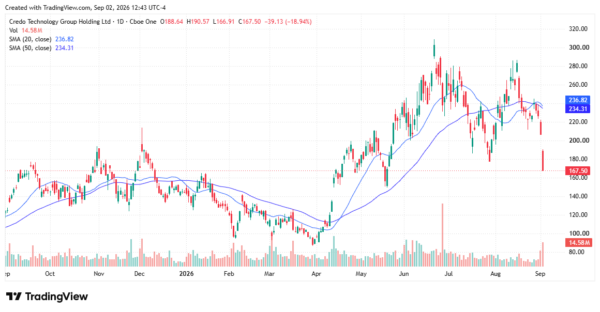
The chart has already created an interesting setup for that test, because CRDO has fallen from nearly $300 in July toward $187.51 while its 200-day moving average sits near $175.24. The 20-day and 50-day moving averages sit much higher near $237.82 and $234.71, leaving the stock underneath both short-term trend lines and showing how sharply momentum has turned.
Volume on the session shown in the chart was 241.96K shares, which is small relative to the violent price move and gives me less reason to read the decline as decisive institutional abandonment. The more important level sits around $175 to $180, where the long-term trend and 200-day moving average converge.
A break below that zone would change my view of the chart because the stock would lose the long-term support that has held through this correction, while a recovery through the $235 to $240 area would begin repairing the momentum damage and put the summer decline into a different context.
Bullish On The Bigger Credo
What keeps me bullish is the possibility that investors are still valuing Credo through the product that made the company famous, rather than the connectivity platform it is becoming. The AEC business has already delivered extraordinary growth, yet management is investing real money and engineering resources in optics before the $600 million fiscal 2027 target has fully materialized.
I would watch three things from here: optical revenue, gross margins and the speed at which new products move into meaningful revenue, because those figures will tell us whether CRDO is successfully increasing its share of each AI system’s connectivity spend.
The market has already taken almost $100 off the stock from its summer peak, giving investors a much different entry point than the one available during the July excitement. If CRDO keeps growing at this pace while optics becomes a second engine, today’s selloff will eventually look less like the market rejecting the company and more like the market giving investors time to recognize what it is becoming.
Leave a Reply