
During the California Gold Rush, most prospectors went home empty-handed. The businesses that lasted weren’t digging for gold. They sold the tools, equipment, and infrastructure everyone else needed to keep digging. And now, every major technology boom seems to produce the same dynamic.
Table of Contents
One of such, which is at the heart of AI infrastructure, is Credo Technology Group (NASDAQ: CRDO). Now, Credo reported fourth-quarter fiscal 2026 earnings with revenue of $437 million, up 157% from a year ago. Non-GAAP earnings per share came in at $1.16, while fiscal-year revenue surpassed $1.3 billion and non-GAAP net income reached $662 million. Yet much of the post-earnings discussion revolved around gross margin slipping from 68.6% in the prior quarter to 68.3%.
I understand why investors noticed it. I just don’t think that’s where the real risk sits.
The Margin Story Doesn’t Explain The Business
Imagine explaining this Q4 earnings to someone without mentioning the stock’s reaction.
Most people would assume the market loved the report.
Instead, investors spent much of their time debating a 30-basis-point decline in gross margin and signs that sequential growth may not remain explosive forever.
That tells you that the market is no longer asking whether AI infrastructure spending is strong. What they are asking is how long growth like this can continue.
That’s a fair question. Hypergrowth eventually slows for every company.
But look at where Credo sits inside the AI stack.
The company doesn’t build foundation models. It doesn’t operate cloud platforms. It doesn’t manufacture the GPUs, attracting most of the headlines. Credo operates in the connectivity layer, helping move enormous amounts of data across increasingly complex AI systems.
As AI clusters become larger and more powerful, the challenge isn’t simply generating intelligence. It’s moving data efficiently between thousands of interconnected components without creating bottlenecks.
That’s the role Credo is trying to play. And understanding that could help us see why the market may be focusing on the wrong risk.
Credo Technology, aka AI Cornerstone
One reason technology investors often miss major shifts is that they focus on demand before they focus on dependency. There’s a difference.
A company benefiting from a trend can grow rapidly for a period of time. But a company becoming necessary to that trend operates under a completely different set of economics.
Look at Credo’s progression across fiscal 2026.
First-quarter revenue came in around $170 million.
Second-quarter revenue slowed to roughly $130 million.
Then revenue exploded to $407 million in the third quarter before climbing again to $437 million in the fourth, a 157% jump.
Granted, that looks like an AI spending story. But the more I studied management’s commentary, the more it looked like an infrastructure story.
Executives repeatedly discussed helping customers maximize GPU utilization, accelerate cluster deployment, improve reliability, and reduce overall infrastructure costs. Those aren’t fringe benefits. They’re problems hyperscale customers must solve as AI systems become larger and more expensive.
Which raises an interesting question: as AI infrastructure spending expands over the next several years, does connectivity become less important? Or does it become more important?
The answer seems obvious. The larger the cluster, the more valuable efficient connectivity becomes.
That’s why I think Credo’s long-term opportunity may be more durable than many investors realize.
Investors Need Proof To Remain Believers
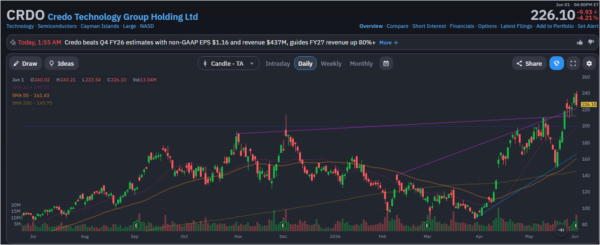
After spending months trapped between roughly $100 and $190, Credo Technology Group (NASDAQ: CRDO) broke out decisively in April and never looked back. Even the sharp pullback in late May failed to break the stock’s rising trend, with buyers stepping in near the 50-day moving average before driving shares back above $240.
Then came earnings. Revenue surged 157%, guidance called for another year of massive growth, and yet the stock finished down 4.2% on more than 13 million shares. That reaction feels less like panic and more like profit-taking after a near 150% rally from the April lows. Momentum remains firmly bullish, with the stock trading well above its 20-day, 50-day, and 200-day moving averages.
Right now, the market may be demanding perfection, but the trend still suggests investors view every pullback as an opportunity rather than a warning sign.
Who Controls Credo’s Revenue?
That doesn’t mean the story is risk-free. Far from it.
In fact, I think the real risk barely appeared in most post-earnings discussions.
I’m talking about Customer concentration. The company disclosed that four customers accounted for about 87% of the quarterly revenue.
That’s where my attention goes. Not because those customers are weak. The issue here is leverage.
When a handful of customers represent such a large percentage of revenue, future growth becomes heavily influenced by a small number of purchasing decisions. One delayed deployment, one supplier change, one shift in architecture, or one spending pause can have an outsized impact on results.
And that creates the central tension surrounding Credo today.
The business appears to be moving beyond the role of an AI beneficiary and toward becoming part of the infrastructure supporting the entire buildout. The figures support that argument. Revenue growth, earnings growth, profitability, and cash generation all point in the same direction.
At the same time, while most investors worry about 30 basis points of margin pressure. I’m asking whether Credo can transform extraordinary demand from a few customers into durable dependence across many, just as I add to my positions.
Leave a Reply