NVIDIA (NASDAQ: NVDA) delivered another quarter that should have ended the “AI bubble” debate for good, yet the biggest number in the entire report barely made the headlines. The company posted $96.2 billion in Q2 fiscal 2027 revenue, up 106% year over year, alongside GAAP earnings of $2.46 per share, up 128%. Data center revenue hit $89 billion, up 117%. Gross margin expanded to 75.0% on both a GAAP and non-GAAP basis. Every one of those numbers beat Wall Street’s consensus estimates, and every one of those numbers is, in isolation, a good story.
Table of Contents
But the real story came later on the call, almost as an aside. CFO Colette Kress told analysts that NVIDIA expects fiscal 2028 revenue to grow approximately 70%. Analysts had been modeling something closer to 44%. That’s not a modest beat-and-raise. That’s a company telling Wall Street its models are broken, and doing it in a monotone during the Q&A portion of an earnings call, as if it were a footnote.
This is the perception-versus-fundamentals gap in its purest form. The perception, reinforced by a stock that’s essentially flat this year and a chorus of bubble-callers, is that the company’s growth has to slow from here. The fundamentals, delivered by the person who actually sees the order book, say growth is about to accelerate.
What 70% Revenue Growth Could Mean for NVIDIA’s Free Cash Flow
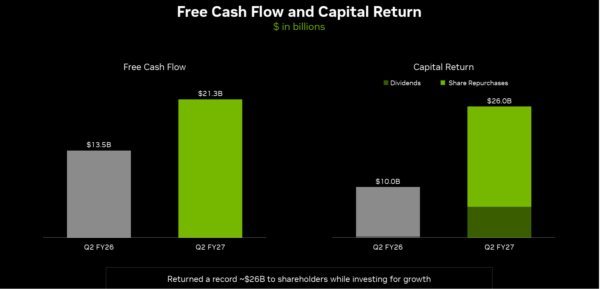
Start with what NVIDIA just did, then extrapolate. Free cash flow came in at $21.3 billion for the quarter, up from $13.5 billion a year ago, even as the company poured capital into supply and capacity. Capital returns hit a record $26 billion in dividends and buybacks. That’s a business generating enormous cash while still in expansion mode.
Now apply Kress’s 70% growth framework to fiscal 2028. If revenue scales anywhere near that pace off a base that just topped $96 billion in a single quarter, the free cash flow implications are staggering, even accounting for the memory-cost pressures and capacity constraints management flagged.
A discounted cash flow model built on 44% growth and one built on 70% growth produce very different valuations. Every dollar of near-term cash flow compounds forward under a higher terminal growth assumption, and the gap between those two DCF outputs is exactly the gap the market has yet to close. Kress herself said customer forecasts point to growth “doubling” next year, with the 70% figure reflecting supply constraints rather than a demand ceiling. That’s a company saying it could grow faster if it could build more.
NVIDIA’s Growth Outlook Could Force Analysts to Raise Price Targets
Wall Street was already leaning bullish heading into this print. Citi held a buy rating and a $300 target ahead of earnings while nudging fiscal 2027, 2028, and 2029 EPS estimates higher. Morgan Stanley carried an Overweight rating and a $288 target. The broader analyst community had clustered price targets between roughly $275 and $325, with an average north of $300, even before hearing the FY2028 number.
That was all built on a 44% growth assumption for next year. With Kress now guiding to 70%, and with backlog reportedly exceeding $2 trillion, expect a fresh wave of price target increases in the days ahead. Analysts will need to run new models, but the direction is not in question. When a company beats the current quarter by $2-4 billion in revenue and simultaneously moves the entire following year’s growth rate up by roughly 26 percentage points, price targets don’t hold still. Investors should expect a string of upgrades, not a single round.
NVDA Technical Analysis: 200-Day SMA Remains Key Support
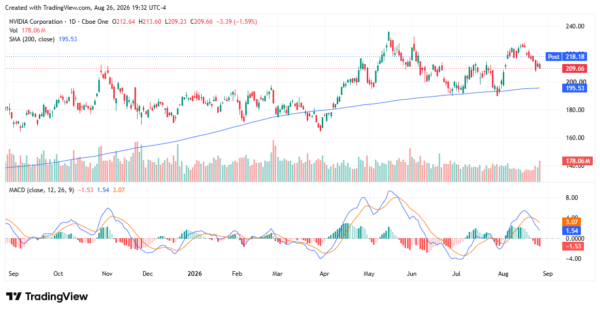
Heading into the print, NVDA shares closed at $209.66, down 1.59% on the day, still comfortably above their rising 200-day simple moving average near $195.53. That average has acted as reliable support since the stock’s spring pullback, when NVIDIA dropped from an all-time high near $240 to the $180s before rebuilding.
The MACD had been flashing a bit of near-term hesitation, with momentum cooling after a summer rally that carried the stock from roughly $195 back above $215. That’s a normal pause within an intact uptrend, not a breakdown.
NVDA Stock Could Retest Its All-Time High
Shares moved higher in after-hours trading following the report, a signal that the market is beginning to price in the guidance shock rather than just the quarterly beat. A push back toward the $230-$240 range would put NVIDIA within striking distance of retesting its prior highs, and a clean break above that zone, backed by the fiscal 2028 growth story, would be a technical confirmation of what the fundamentals are already saying.
NVIDIA’s Earnings Report Challenges the AI Bubble Narrative
NVIDIA didn’t just beat earnings. It told Wall Street to rebuild its models for next year, and it did so quietly, in the middle of a call, almost as if daring analysts to catch up. The comps only get tougher from here, and NVIDIA just guided to accelerating growth anyway. That’s not the profile of a company riding a bubble toward a pop. It’s the profile of a company still being underestimated, even after a decade of proving that instinct wrong. The lead got buried. It won’t stay that way once the price targets start rolling in.
Leave a Reply