No one doubts the narrative behind semiconductor giant NVIDIA (NASDAQ: NVDA). To go over the bullish narrative of NVDA stock would simply be an exercise in redundancy — and to make a meta point, a cynical attempt to bid up this article’s word count. I’m not going to do that because we have limited time and we need to address the substance of the matter.
Table of Contents
To provide a quick summary of the bullish case for NVDA stock, it comes down (obviously) to artificial intelligence. No matter how much criticism and controversy AI generates, the reality is that AI has fundamentally shifted our paradigm. If you’re not on board with the AI narrative, you’re hopelessly lost. And since NVIDIA sells differentiated compute, it’s arguably less likely to stumble under commoditization concerns.
However, this line of reasoning represents thesis risk, which is very much limited for NVIDIA — and some might argue nonexistent. What investors and traders should be concerned about is equity risk. This is a different category and requires a nuanced, analytical approach.
Too often, when it comes to popular securities like NVDA stock, financial writers wax poetic about AI spending, infrastructure demand and projected runways. Well, I’m sorry, but it makes me wonder why publishers even pay money for such garbage contributions. These are narratives that are clearly baked into the story.
What serious analyst is declaring that AI is a fad and demand will collapse next quarter? No one — and that’s the risk. When you have an environment where people are constantly bidding up the bullish narrative and giving little thought to the bearish case, unnecessary exuberance can easily embed itself in the target security.
Fundamentally, the risk isn’t that no one believes in the AI narrative undergirding NVDA stock; no, it’s that everybody believes it. As such, there is a premium associated with the enthusiasm. Essentially, the spread between expectation and eventual reality must be robust enough to justify this premium.
It’s quite possible, then, to have a situation where the thesis pans out but the equity doesn’t cooperate. It’s not that the thesis was wrong (because it wasn’t). Rather, the thesis didn’t quite cover the differential between expectations and reality.
Why You Need to Pay Attention to the Smart Money’s Take on NVDA Stock
Interestingly, the smart money has a very different approach to your typical buy-and-hold retail perspective — and that’s evidenced by the volatility skew. By definition, the skew identifies implied volatility (IV) across the strike price spectrum of a given options chain. Since IV reflects the pricing potential of a security at the selected strike, traders have an incentive to cover the implied move.
Basically, the skew can be considered an insurance market. On any given day, a popular security will go up or it will go down. Professional traders, especially those responsible for massive funds, must probabilistically determine which trajectory is more likely. Subsequently, the hedging transactions distort the skew, allowing observers to better determine smart money sentiment.
What’s fascinating about the further-out July 17 expiration date is that the volatility skew for Nvidia stock shows relative put dominance across the strike price spectrum. The most obvious point is that below the spot price, put IV rises sharply (and swings above calls at the lowest depths). This framework represents classic crash insurance behavior; that is, the market is assigning a meaningful premium to downside protection.
Does that mean that a crash is imminent for NVDA stock? Not at all — the smart money shouldn’t automatically be considered prescient. However, we give these traders the label “smart” because of their sophisticated transactional acumen.
I would also argue here that these pros are intellectually honest about NVDA stock. While they recognize that Nvidia can march higher (judging by the rising call IV), put dominance is still the order of the day for strikes above spot.
Conclusion? The smart money apparently believes NVIDIA stock is fairly priced relative to current expectations. And I think that’s the right take. When you look at the same skew for something like Micron Technologies (NASDAQ: MU), traders are pricing for upside convexity all the way, with seemingly little prioritization for downside protection.
That makes me nervous. NVIDIA stock also makes me pensive at this hour, but at least the smart money is recognizing the risk.
Going Conservative on NVIDIA Stock
Naturally, the disagreement about NVDA stock isn’t about whether it’s a good opportunity in the abstract. It’s up roughly 59% in the trailing year; it’s a good opportunity. But the question is about the magnitude of goodness. Again, it’s the differential between expectations and reality.
I’m going to ride with the smart money — and the data would suggest the same. If you swing back using a dataset to 1990, a random 10-week-long position would be expected to generate a forward median distribution landing between $208 and $235 (assuming a starting price of $214.86).
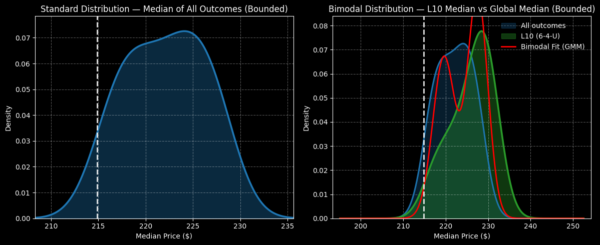
Under the current quantitative structure, in the past 10 weeks, NVIDIA stock printed six up weeks, leading to an upward slope across the period. Under this specific 6-4-U sequence, you would expect the forward 10-week distribution to land between $208 and $240.
So, the math is quite simple. Comparing aggregate to conditional sequences, you would statistically (from an observational standpoint) be looking at no added risk. But on the reward side, the distribution shifts positively, with the right-side tail differential hitting 2.13%.
Now, is 2.13% that much of a difference compared to a randomly aggregated 10-week-long position? Since the reward penalty is 0%, there is a modestly positive asymmetry here. However, it’s not a pound-the-table type of play.
This is where a very conservative bull call spread might be in order. Probably the most ambitious spread I would be looking at is the 220/225 bull spread expiring July 17. With this trade, I’m looking for NVDA stock to rise through the $225 strike at expiration. If it does, the maximum payout clocks in at nearly 144%.
Leave a Reply