
Oversold stocks are suddenly easy to find. On Friday, Nov. 20, the CBOE Volatility Index (VIX) briefly touched 40. That’s its highest level since the April 2025 tariff turmoil. The S&P 500 fell 3.6% that day, capping its worst week in seven months.
Table of Contents
Fear like that may tempt investors to sit in cash until the dust settles. But trying to time a recovery rarely works. Some of the market’s best days tend to arrive right after its worst ones.
A more effective strategy may be to look for oversold stocks, including stocks that may have recently looked overvalued. That’s where the relative strength index (RSI) can help. RSI is a momentum indicator that measures the speed of recent price moves on a scale of 0 to 100.
A reading below 30 is generally considered oversold. Traders use it most, but long-term investors can, too. Charts often signal a bullish reversal before the fundamentals confirm it. Here are five stocks with RSI readings near or below 20 as of the market close on Nov. 20, 2026.
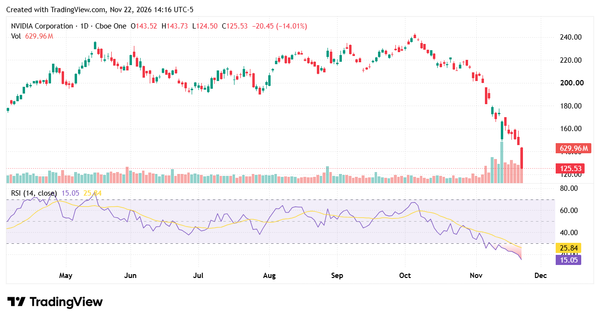
Own the AI Leader at a Bargain-Bin Multiple: NVIDIA (NVDA)
NVIDIA (NASDAQ: NVDA) stock has an RSI of 15, giving it one of the most extreme readings among large-cap stocks. Shares fell 14% on Friday to $125.56. That leaves the stock nearly 48% below its Oct. 6 closing high.
The selloff has little to do with the business. On Nov. 17, NVIDIA reported record quarterly revenue of $115.8 billion. That topped the $109.1 billion analysts expected. The stock fell anyway. Investors are worried about AI spending returns. They also fear the new Democratic-controlled Congress could slow the data center buildout.
At Friday’s close, NVIDIA trades at about 13.5 times trailing earnings. That’s a multiple usually reserved for slow-growth companies. For long-term investors, this could be a textbook gap between perception and fundamentals. The NVDA chart is pricing in a collapse the income statement hasn’t shown.
Lock In a Software Leader at a Value Price: Salesforce (CRM)
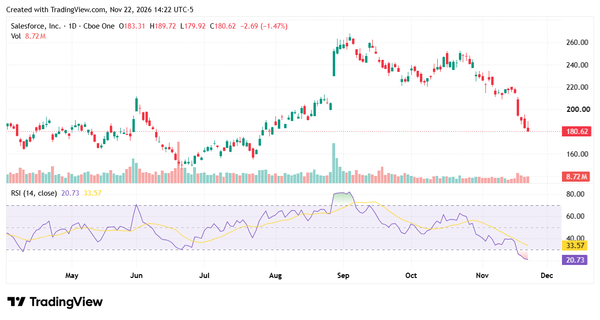
Salesforce (NYSE: CRM) has an RSI of 20.2 and closed Friday at $180.43. Shares are down roughly 32% in 2026 after starting the year near $265.
The selloff reflects fears that AI-native competitors will erode Salesforce’s customer relationship management franchise. Job cuts disclosed on Nov. 17 added to the pressure.
The numbers tell a different story. In its fiscal second quarter, Salesforce crushed EPS estimates. It also raised full-year revenue guidance to $46.1 billion to $46.4 billion. Management guides to adjusted EPS of $16.67 to $16.71 for fiscal 2027. At Friday’s price, that’s roughly 11 times earnings.
Salesforce is also buying growth. It has announced deals for Braze and Cresta since October. The next test comes with earnings in early December. A solid report could be the catalyst that turns an oversold chart into a rebound.
Tap Into the Long-Term Electrification Trade: Freeport-McMoRan (FCX)
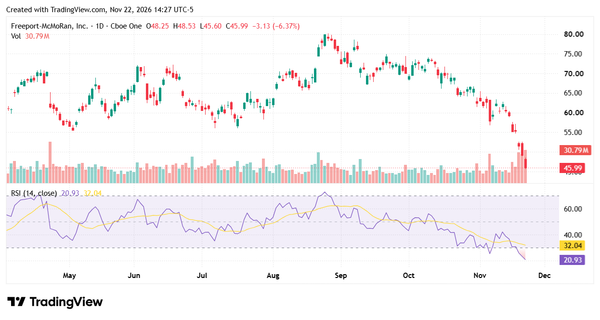
Freeport-McMoRan (NYSE: FCX) has an RSI that sits at 21.4 after shares fell 6.4% on Friday to $45.99. The stock already dropped about 7% in single sessions on Nov. 5, 16, and 18. It now trades roughly 42% below its August high near $80.
The pressure is easy to explain. Copper prices recently slipped to their lowest level since July. Freeport is a leveraged bet on the metal. The company also faces lingering production questions at its Grasberg mine in Indonesia. Analysts have taken notice, and the stock carries a recent downgrade.
The long-term case is harder to dismiss. Copper demand is tied to grid upgrades, electric vehicles, and the same data centers powering AI. New supply is slow to come online because mines take years to build. A stock this oversold may already reflect much of the bad news.
Collect a Growing Royalty Stream: Halozyme Therapeutics (HALO)
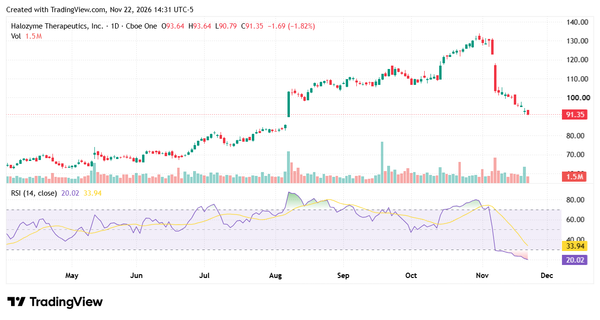
Halozyme Therapeutics (NASDAQ: HALO) stock’s RSI of 20 reflects a sharp pullback, not a broken business. Shares closed at $91.35 on Friday, down from about $103 on Nov. 9. The stock had rallied more than 80% this year before its third-quarter report.
Halozyme’s ENHANZE technology helps partners turn IV drugs into faster under-the-skin injections. The company earns royalties on those sales. Third-quarter revenue rose 39% to $493 million. Royalty revenue jumped 44% to $341 million. Management raised 2026 revenue guidance to $1.86 billion to $1.925 billion.
There’s more support beneath the surface. A Dutch court found Merck infringed a Halozyme patent with its injectable Keytruda. The company has also repurchased $400 million of stock in 2026. With a P/E near 23, Halozyme is growing faster than its multiple suggests. This looks like profit-taking after a big run.
Buy China’s AI Cloud Growth on Sale: Alibaba Group (BABA)
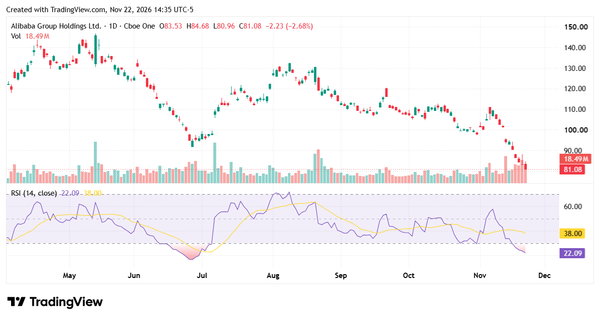
Alibaba (NYSE: BABA) has an RSI of 22, which puts it just inside oversold territory. Shares closed Friday at $81.03 after the company’s Nov. 19 earnings report. Investors focused on an adjusted EPS miss and a 60% jump in capital spending.
That overlooks the bigger story. Revenue grew 10% to 271.5 billion yuan, or about $40.5 billion. AI cloud and compute revenue surged 53% to nearly 61 billion yuan. Recurring revenue from external cloud customers climbed 67%.
Alibaba is also moving to spin off its T-Head chip unit with a separate Hong Kong listing. That could unlock value the market isn’t pricing in today. At a P/E near 12, investors pay a modest price for real AI growth. China-related risks haven’t gone away, so position sizing matters.
Use Fear to Your Advantage, With a Plan
A low RSI isn’t a buy signal on its own. Oversold stocks can stay oversold longer than expected, especially with the VIX near 40. That’s why RSI works best alongside fundamentals.
Each of these five companies pairs a deeply oversold chart with a business that’s still growing. Investors don’t need to pick the exact bottom. Scaling in over several weeks can reduce the risk of buying oversold stocks too early. When fear fades, the chart often turns first. The fundamentals tend to follow.
Leave a Reply