
Home Depot (NYSE: HD) has spent about $32 billion expanding into professional building materials distribution, assembling a business that reaches contractors and construction projects far beyond its traditional store network. That investment has changed the company’s growth opportunity, but its third-quarter earnings suggest the financial benefits are still developing.
Table of Contents
Third-quarter fiscal 2026 revenue increased 4.9% to $43.40 billion, while adjusted EPS grew 3.2% to $3.86. Richard McPhail, the executive who helped oversee the acquisition strategy as CFO, is about to become CEO. His appointment puts the next phase of Home Depot’s expansion in the hands of someone who understands what the company has bought and what shareholders need to get back from it.
Revenue Is Growing Faster Than Its EPS
HD’s Q3 earnings offer an early indication that its expanded business is contributing to growth, even as the traditional home improvement market contends with cautious consumers and pressure on discretionary spending. Revenue increased from $41.35 billion to $43.40 billion, while comparable sales rose 2.2%. That comparable-sales increase matters because it shows the existing retail business is still contributing, rather than leaving the growth story entirely dependent on acquired revenue.
The composition of those sales also tells us where demand is coming from. Comparable transactions declined 0.5%, but the average ticket increased 3%, suggesting customers are spending more per visit even as slightly fewer transactions take place. That is enough to keep sales moving higher, although a sustained recovery in customer activity would provide a broader foundation for growth.
But the more critical detail is what happened after those sales came in. Gross profit increased 2.9% to $14.22 billion, while operating income advanced just 2.4% to $5.48 billion. Operating margin consequently narrowed to 12.6% from 12.9%. Adjusted EPS grew 3.2% to $3.86, compared with GAAP EPS of $3.72, which included $0.18 per share in acquired intangible amortization.
This is where the investment case becomes more demanding for me. Home Depot is growing revenue, but its operating profit is not keeping pace, suggesting the company has more work to do before its larger business can deliver stronger earnings leverage.
Home Depot’s $32 Billion Pro Expansion Opens A $1 Trillion Market
The acquisitions explain why Home Depot is willing to accept a longer period of integration before expecting the full financial payoff. HD Supply added approximately $8 billion in enterprise value in 2020, SRS Distribution followed at approximately $18.25 billion in 2024, and GMS added another $5.5 billion in 2025. Together, these transactions represent approximately $31.75 billion invested in building a much broader professional distribution operation.
The strategic value is in what the businesses can offer together. HD Supply strengthened Home Depot’s maintenance, repair, and operations distribution business, SRS added roofing, landscaping, and pool supplies, and GMS brought drywall, ceilings, and steel framing into the portfolio. Home Depot can now serve contractors across more product categories and project requirements, with a wider distribution footprint and more opportunities to become a supplier they rely on repeatedly.
The SRS acquisition alone was expected to expand Home Depot’s addressable market by approximately $50 billion, bringing its total addressable market to around $1 trillion. That figure illustrates the scale of the opportunity, but market size alone does not create shareholder value. The real advantage comes if Home Depot can use its expanded network to win a larger share of contractor spending, cross-sell products, and fulfill more orders efficiently.
Now, the company expects fiscal 2026 sales growth of approximately 4.5%, yet adjusted EPS growth is forecast at only 2%, with operating margin around 12.4%. The company has substantially increased the market it can serve, but the earnings contribution still has room to develop. That gap is what makes the CEO transition important.
Richard McPhail Must Make The Acquisitions Pay Off
McPhail is taking over a strategy he helped shape as CFO, with responsibility for capital allocation, corporate strategy, and business development placing him close to the decisions behind HD’s expansion. His appointment is pivotal to the company moving into a different phase of the acquisition cycle. The priority is shifting from adding distribution businesses and market access to making those businesses contribute more meaningfully to consolidated earnings.
That means investors should pay particular attention to operating margins and returns on invested capital over the coming quarters. A larger distribution network should create opportunities to improve fulfillment, deepen contractor relationships, and generate more sales from existing customers. If those advantages fail to translate into better profitability, the company risks carrying a much larger cost base without earning an adequate return on the capital committed to building it.
The good thing is, HD has the cash generation to support the strategy. Operating cash flow reached $15.50 billion in the first nine months of fiscal 2026, up from $12.98 billion a year earlier. After $2.68 billion in capital expenditures, free cash flow stood at approximately $12.82 billion. However, working-capital outflows declined sharply from $2.69 billion to $358 million, explaining part of the improvement. The cash generation is substantial, but McPhail’s more important task is ensuring the acquired businesses eventually contribute stronger recurring profits.
HD Stock Still Has A $360 Ceiling
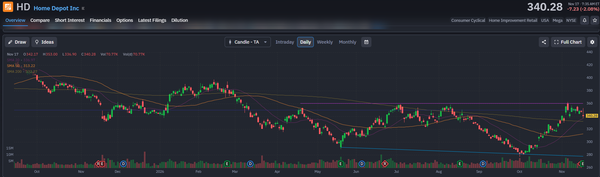
HD shares traded around $340.28 after retreating from the $350 to $360 resistance zone, following a sharp recovery from October’s lows. The stock remains above its 20-day moving average near $336.97, its 200-day average around $332.37 and its 50-day average near $313.22, leaving the broader recovery structure intact.
The $332 to $337 area now provides an important support cluster, while a decisive move above $360 on stronger volume would confirm that buyers are prepared to extend the recovery. A breakdown below that support zone would weaken the setup.
McPhail now has to turn Home Depot’s $32 billion expansion into stronger returns. That is the catalyst that could carry HD beyond its current resistance.
Leave a Reply