
Dell Technologies (NYSE: DELL) just raised its FY2027 revenue outlook by $10 billion to $202 billion, lifted non-GAAP EPS guidance to $29.68, and projected $78 billion in AI server revenue for the year. Q3 revenue reached $54.937 billion, up 103% year over year, while non-GAAP diluted EPS climbed to $9.45, up 265%. And that’s not all the good news in this report.
Table of Contents
Dell’s AI server business is pulling in record orders, but traditional server sales are accelerating at a pace that deserves just as much attention. Storage is joining the expansion, too, providing more ways for the company to benefit from investment flowing into data center infrastructure. In my view, the opportunity here is considerably bigger than the AI server numbers suggest.
AI Is Changing Where Dell Makes Its Money
Dell booked $60.2 billion in AI server orders during Q3, recognized a record $22 billion in AI server revenue and exited the quarter with $132.3 billion in backlog. Management also disclosed that it had converted $180 billion in orders over the preceding four quarters, while its opportunity pipeline remained several times larger than its backlog.
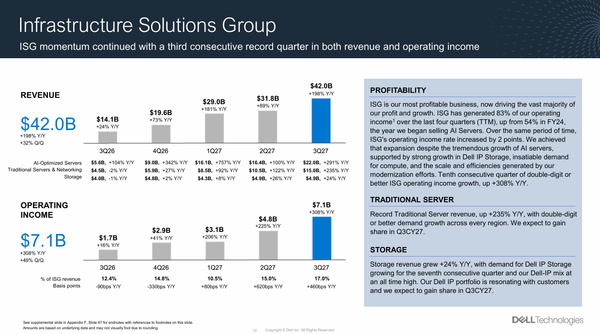
Those numbers are enormous, but I’d not let them distract me from how they’re impacting Dell’s earnings. Infrastructure Solutions Group (ISG) generated $41.97 billion in revenue, up 198%, and $7.12 billion in operating income, up 308%. Its operating margin reached 17%, compared with 12.4% a year earlier. ISG now generates 83% of the company’s trailing-twelve-month reportable segment operating income, against 54% in FY24.
Dell’s infrastructure business is capturing more data-center spending, while scale and operating leverage are allowing it to retain more revenue as profit. ISG’s operating margin improved even as AI servers rose to 35% of the company’s trailing-twelve-month revenue.
Traditional Servers Are Making the Opportunity Much Bigger
AI servers are grabbing attention, but traditional server and networking revenue grew 235% to $15.013 billion. Management disclosed that traditional server revenue climbed from $8.5 billion in Q1 to $10.5 billion in Q2 and $15 billion in Q3. Dell has already generated $34 billion from this business in the first three quarters, against $19.5 billion for the entire previous year.
The replacement cycle helps explain the acceleration. Jeff Clarke said newer 18G servers can replace 12 to 14 older systems, providing more computing capacity while reducing power, space, and cooling requirements. Companies are also modernizing data centers for AI workloads and security requirements that older hardware cannot always meet through software updates alone.
At the same time, Storage is adding another source of demand as revenue grew 24% to $4.93 billion, with Dell’s IP storage portfolio recording its seventh consecutive quarter of growth. Clarke explained that agentic workloads and larger data volumes will require substantially more storage. Indicating that the company is participating in the infrastructure buildout through more than just GPU-heavy systems.
The Backlog Still Has to Become Revenue
Dell’s $132.3 billion backlog gives management considerable visibility, but I wouldn’t treat every dollar as revenue waiting to be recognized. Clarke said the company vets customer financing, end-user quality, trade compliance, access to land and power, and deployment readiness. Management reported no customer order rescheduling and said the backlog spans nearly 100 global deployment sites.
That process gives me more confidence in the orders, particularly as the business expands across neocloud, sovereign and enterprise customers. Still, the company must secure components, build systems and coordinate deployments before orders become shipments. Management expects demand to remain ahead of supply, with the gap potentially widening in calendar 2027.
And when it comes to memory inflation, which is another pressure point, Clarke expects enterprise DRAM and NAND pricing to remain inflationary into 2027 as more DRAM capacity is allocated to high-bandwidth memory for GPUs. Dell benefits from higher system demand, but must protect margins while absorbing rising component costs.
The PC Business Is Losing Ground
Client Solutions Group revenue grew just 3% to $12.886 billion. Commercial PC revenue increased 6%, but consumer revenue declined 15%, while segment operating income fell 6% to $704 million.
Clarke said businesses are prioritizing server and storage investments, sometimes delaying PC purchases to fund AI infrastructure. The implication is that it leaves the company increasingly reliant on ISG. The concentration is manageable while infrastructure demand remains strong, but becomes a bigger problem if AI deployments slow or customers stretch their data-center budgets.
DELL Gets a Buy Rating
Dell raised FY2027 revenue guidance to $202 billion and non-GAAP EPS to $29.68. It expects $78 billion in AI server revenue, more than three times the previous year, while Q4 guidance calls for $56.25 billion in revenue and $23.5 billion in AI server sales. Management also expects traditional server growth of approximately 145% for the full year.
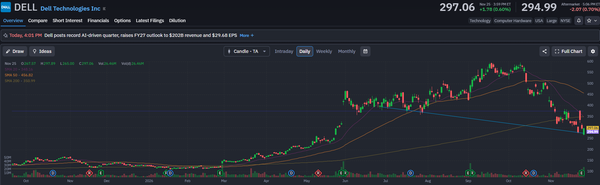
The stock has taken a beating despite those operating results. At $297.06, DELL traded below its 20-day moving average of $348.16, 50-day average of $456.82, and 200-day average of $350.99. The retreat from September–October highs near $590 has been severe, with lower highs and lower lows defining the trend. I’d watch the 270–300 area for signs of buyers defending the stock, while a recovery above $350 would indicate improving momentum.
I’m rating DELL a Buy. AI servers, traditional infrastructure, and storage are all contributing to an expanding profit engine, and management has raised its outlook again. The correction offers an opportunity to build a position, although I’d prefer to see selling pressure ease before committing aggressively.
Leave a Reply