
Higher interest rates from the Federal Reserve and ongoing market uncertainty have some investors cashing out. But that’s the wrong thing to do. Instead, staying invested in a diversified portfolio can make sense for money you won’t need for years.
Table of Contents
Dividend ETFs, for example, offer one way to stay invested, collect income, and maintain exposure to a diversified group of companies. A fund can spread your money across dozens of companies, so your dividend income doesn’t hinge on a single business. Share prices can still fall, and payouts can change, but the income gives you something tangible while you wait.
Here are three dividend ETFs to consider.
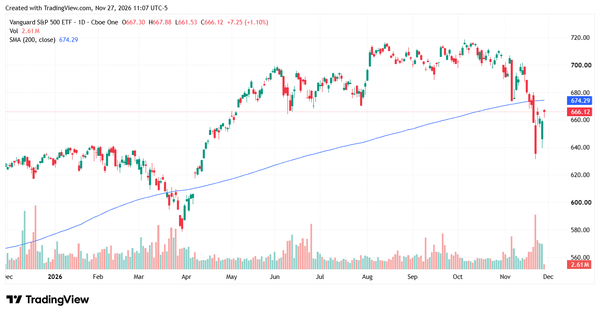
Vanguard S&P 500 ETF: Broad Market Exposure With Dividend Income
“Over the years, I’ve often been asked for investment advice,” Warren Buffett wrote in a 2016 shareholder letter. “My regular recommendation has been a low-cost S&P 500 index fund.”
With that, Buffett has named the Vanguard S&P 500 ETF (NYSEARCA: VOO) as one way to invest.
What makes the VOO ETF attractive is that it tracks the S&P 500 and includes value and growth stocks across multiple sectors. For example, some of the fund’s largest holdings are: NVIDIA (NASDAQ: NVDA), Microsoft (NASDAQ: MSFT), Apple (NASDAQ: AAPL), Amazon (NASDAQ: AMZN), Alphabet (NASDAQ: GOOGL), and Berkshire Hathaway (NYSE: BRK.B).
The fund offers a low-cost way to diversify across some of America’s largest companies, making it an ideal set-it-and-forget-it investment. In addition, with an expense ratio of 0.03%, the ETF also pays a quarterly dividend. VOO yields 1.02%, with its most recent payout of just over $1.82 per share paid on September 30.
VanEck Morningstar Wide Moat ETF: Invest in Companies With Competitive Advantages
If you follow Warren Buffett, you know he likes companies with a wide economic moat. In fact, if you want to invest in companies attractive to the billionaire, make sure they are:
- Simple companies that are easy to understand
- Companies with predictable and proven earnings
- Companies that can be bought at a reasonable price
- Companies with “economic moat,” or a unique advantage over their competition.
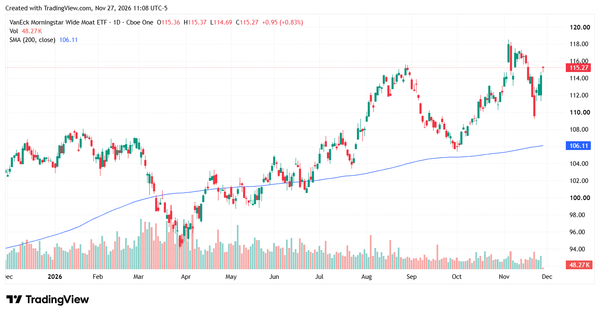
With an expense ratio of 0.46%, the VanEck Morningstar Wide Moat ETF (BATS: MOAT) tracks the performance of companies with sustainable competitive advantages. That includes Estee Lauder (NYSE: EL), Boeing (NYSE: BA), Nike (NYSE: NKE), and NXP Semiconductors (NASDAQ: NXPI).
For investors looking beyond traditional high-yield dividend ETFs, MOAT offers exposure to businesses selected for their competitive advantages. The MOAT ETF also yields 1.07% and pays a yearly dividend, with its last one for just over $1.40 per share paid on September 26, 2025. Before that, it paid just over $1.26 per share on December 23, 2024. And before that, it paid out just over 72 cents per share in December 2023.
Schwab US Dividend Equity ETF: Higher Yield for Income-Focused Investors
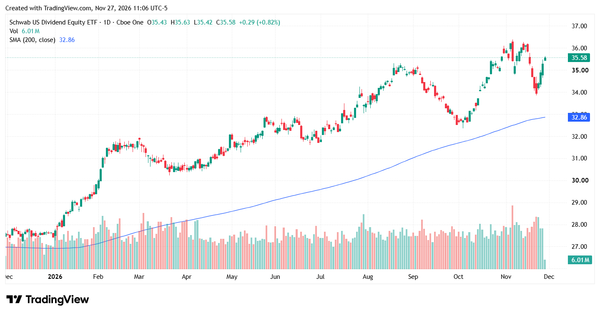
There’s also the Schwab US Dividend Equity ETF (NYSEARCA: SCHD), which tracks the performance of 100 high-yielding dividend stocks chosen by yield and five-year dividend growth rates.
With an expense ratio of 0.06%, the ETF tracks the total return of the Dow Jones U.S. Dividend Index. It also yields 3.17%, which is about three times the S&P 500’s dividend yield, and has holdings in companies such as Amgen (NASDAQ: AMGN) , AbbVie (NASDAQ: ABBV), Home Depot (NYSE: HD), Cisco Systems (NASDAQ: CSCO), Broadcom (NASDAQ: AVGO), Chevron (NYSE: CVX), UPS (NYSE: UPS), and Coca-Cola (NYSE: KO).
For investors prioritizing dividend income, SCHD stands out among these three ETFs because of its higher yield and focus on established dividend-paying companies. It also pays a quarterly dividend, with its last payout on September 28, 2026, for just over 26 cents per share.
Which Dividend ETF Is Right for Your Portfolio?
When the market swings from one inflation report to the next, it’s tempting to sell and wait for things to settle down. The trouble is that you’ll have to make a second decision about when to get back in. If you’re investing money you won’t need for years, holding a diversified portfolio can give you room to ride out a rough stretch without having to call the bottom.
Each of these ETFs serves a different purpose. VOO gives you broad exposure to large U.S. companies. MOAT focuses on businesses with durable competitive advantages. And SCHD puts more emphasis on dividend income.
These three dividend ETFs offer different approaches to staying invested through market volatility, but none is immune to losses. All three can lose value, and their payouts can change. The best fit depends on what you want your portfolio to do for you, whether that’s provide broad market exposure, focus on companies with an edge over their rivals, or generate more income along the way.
Leave a Reply