Microsoft (NASDAQ: MSFT) reports Q1 FY2027 earnings on Wednesday, October 28, with Wall Street watching Azure growth, AI monetization, and capital expenditures. Analysts expect approximately $90.6 billion in revenue and $4.71 in adjusted earnings per share, but Thursday’s tech selloff has made this report about something bigger than beating estimates: Microsoft must show that demand for its AI services can keep up with the enormous cost of building them.
Table of Contents
Thursday’s Selloff Changed the Stakes
Investors got a reminder last Thursday that even strong earnings can send a stock lower when the spending behind them raises fresh questions. Meta Platforms (NASDAQ: META) beat revenue expectations, yet its shares dropped 7% after its AI spending plans reignited concerns about how much capital Big Tech will need before investors see adequate returns. The Nasdaq Composite fell 2.6%, while the Philadelphia Semiconductor Index plunged 6.7%.
Microsoft now enters earnings with that same question hanging over its shares, which closed at $524.51 on October 23.
The timing matters because Microsoft has spent the past year building a compelling case for AI. Last quarter, I posited that the company needed to prove enterprise customers were moving beyond AI experiments and embedding Microsoft’s tools into everyday business operations. The Q4 earnings results showed that Azure growth accelerated to 43%, Microsoft Cloud revenue reached $59.3 billion, and commercial remaining performance obligations climbed to $367 billion.
That was the demand investors wanted to see. Now the expensive part is supplying enough computing capacity to serve it.
Azure Must Deliver 45% Growth
Microsoft’s July guidance gives investors a clear benchmark. Management projected Q1 revenue of $89.85 billion to $90.95 billion and Azure growth of approximately 45% in constant currency. The analyst consensus calls for roughly $90.6 billion in revenue and $4.71 in EPS, representing double-digit growth from a year earlier.
Azure is the number I would watch first because it connects Microsoft’s AI ambitions directly to customer spending. In Q4, Azure and other cloud services grew 43%, beating analyst expectations of approximately 40%. Azure also crossed $100 billion in annual revenue for the first time.
That acceleration gives Microsoft a strong starting point, but the next quarter needs to show that demand can absorb the infrastructure coming online. A 45% growth rate would mark another step forward. A slowdown, especially alongside heavier spending, could give investors a reason to question whether Microsoft’s AI investment is generating returns quickly enough.
The backlog offers another clue. Commercial remaining performance obligations reached $367 billion in Q4, giving Microsoft visibility into future contracted revenue. Investors will want to know whether those commitments are translating into cloud consumption and recurring AI revenue at the pace management expects.
Microsoft’s AI Spending Is Heading Above $50 Billion
The demand story comes with a hefty price tag. Microsoft spent $41 billion on capital expenditures in Q4, up more than 70% year over year, while free cash flow fell 23% to $19.6 billion. Operating cash flow still climbed 30% to $55.4 billion, and net income reached $35.8 billion, showing that the business remained profitable despite the infrastructure bill.
Management expects roughly $50 billion in Q1 capital expenditures following an accounting change involving data-center leases. Microsoft also projected $175 billion in calendar-year 2026 spending, down from its previous $190 billion outlook, while maintaining that demand for AI infrastructure exceeds available supply.
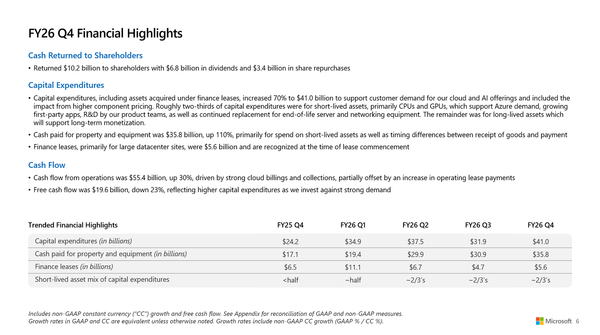
The key distinction is that reported capex can change with lease accounting even when the underlying investment plans remain intact. Investors need to look beyond the headline figure and judge whether additional capacity is producing enough Azure revenue and cash flow to justify the commitments.
Recent developments provide some evidence of where that demand could come from. Microsoft announced a strategic collaboration with Boehringer Ingelheim to explore AI-powered digital patient twins for clinical development, alongside broader Copilot adoption and data-center modernization. The work could bring Microsoft’s cloud and AI tools deeper into pharmaceutical research, where companies need secure systems to handle complex data and workflows.
That is a concrete commercial use case, although the announcement alone does not establish how much revenue the partnership will generate. The earnings report needs to provide the broader financial evidence.
MSFT Needs to Hold Its Technical Ground
Microsoft’s chart shows a stock that has pulled back from its October highs while retaining a stronger longer-term trend. At $524.51, MSFT sits just below its 20-day moving average near $526.70 but remains above its 50-day average around $508.43 and its 200-day average near $436.51.
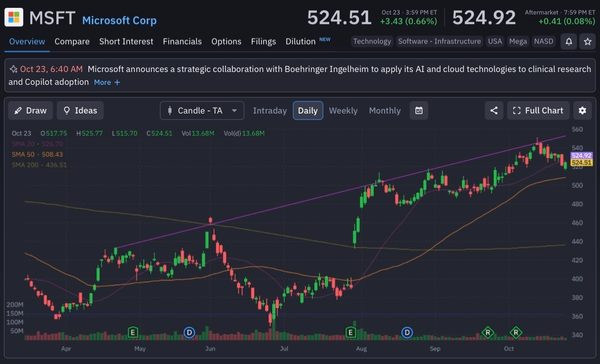
The immediate question is whether earnings can help the stock reclaim the $530 area and challenge the recent highs around $545–$550. A strong Azure print, credible spending commentary, and healthy cash generation could give buyers a reason to push back toward that resistance. A disappointment on cloud growth or another jump in spending without clear evidence of returns could leave the stock vulnerable to a deeper pullback toward $508.
Microsoft has already shown that enterprises will commit billions to its cloud and AI ecosystem. What Wednesday’s report must establish is whether that demand can keep growing fast enough to support the infrastructure being built to serve it.
Leave a Reply