
Cadence Design Systems (NASDAQ: CDNS) grew third-quarter revenue 22% year over year to $1.63 billion, raised its full-year outlook for the third time this year, and reported a record $8.2 billion backlog. The AI infrastructure buildout is driving demand for the software engineers use to design, verify, and simulate increasingly complex chips and computing systems, and Cadence is capturing that demand across its core businesses.
Table of Contents
However, revenue growth has outpaced profit growth. GAAP earnings per share remained flat at $1.05, while GAAP operating margin fell from 31.8% to 26.2%. Cadence is selling more of the tools needed to build the AI economy, but rising costs are absorbing much of the additional revenue. Its backlog and higher guidance support the growth thesis; the next test is whether that momentum can translate into stronger earnings.
AI Demand Is Lifting Cadence’s Core Business
Cadence’s strongest evidence of AI-driven demand is the breadth of growth across its established product lines. Core electronic design automation (EDA) revenue increased 20% year over year, semiconductor intellectual property revenue climbed 24%, and system design and analysis revenue rose 30%. All three businesses delivered double-digit growth in the third quarter.
Core EDA accounted for 69% of quarterly revenue, making it Cadence’s primary growth engine. As chipmakers and systems companies develop increasingly complex AI infrastructure, they need tools to design and verify semiconductors, analyze systems, and test performance before production. That creates demand across Cadence’s existing portfolio, allowing the company to benefit from AI investment without relying on a single new product.
Customer deployments illustrate how Cadence is helping engineers work more efficiently. MediaTek deployed Cadence’s ChipStack technology in production digital verification, with reported improvements of 50%–70% in verification coverage and a 1.4–2x reduction in engineering effort. Renesas deployed InnoStack across engineering tasks, with a reported 34x productivity improvement for its microcontroller team. Nokia is deploying AuraStack on its Millennium Supercomputer, with reported acceleration of up to 5x in key design and analysis workflows.
Cadence is expanding this opportunity through Maestro, its portfolio of specialized AI models, and AI Super Agents, which have more than 100 active customer engagements. Initial Maestro results reportedly show up to 30% higher quality and five times greater token efficiency than general-purpose foundation models. These products could deepen Cadence’s position, although its established businesses remain the clearest evidence of AI-related growth today.
The $8.2 Billion Backlog Supports Higher Guidance
Cadence’s record $8.2 billion backlog strengthens the case for continued expansion. The company reported $7.8 billion at the end of 2025, while $4.2 billion of revenue is expected to be recognized over the next 12 months from remaining performance obligations. That provides visibility into a substantial portion of near-term business.
Management now expects full-year 2026 revenue of $6.387 billion to $6.417 billion, implying approximately 21% year-over-year growth. Its previous forecast called for $6.260 billion to $6.340 billion. The midpoint of its non-GAAP EPS outlook also increased from $8.10 to $8.40.
For the fourth quarter, Cadence expects revenue of $1.695 billion to $1.725 billion, representing 18%–20% year-over-year growth, with non-GAAP EPS of $2.19–$2.25. The third increase to its annual outlook this year reinforces the case that demand has remained stronger than management previously anticipated.
The backlog connects Cadence’s AI opportunity to future revenue, while double-digit growth across all three product groups shows that expansion is broad-based. Customer demand and export restrictions remain risks, but Cadence enters the final quarter with a larger business base and a higher growth target.
Rising Costs Are Eating Into the AI Windfall
Despite its revenue gains, Cadence has yet to deliver comparable growth in GAAP profitability. Quarterly revenue rose from $1.34 billion to $1.63 billion, but GAAP operating income increased only slightly, from approximately $425 million to $429 million. GAAP net income edged up from $287 million to $290 million, leaving diluted GAAP EPS unchanged at $1.05.
Research and development spending rose from $423 million to $538 million, acquired-intangible amortization increased from approximately $10 million to $34 million, and restructuring expenses climbed from $27 million to $42 million. Total GAAP costs and expenses reached approximately $1.21 billion, versus $913 million a year earlier.
Non-GAAP diluted EPS rose 9% to $2.11, but non-GAAP operating margin narrowed from 47.6% to 44.1%. Cadence is growing, yet a smaller share of each revenue dollar is reaching operating profit. Its investments may support future expansion, but shareholders need those investments to produce stronger earnings over time.
Cash generation improved: operating cash flow increased 36% to $424 million, and free cash flow rose 31% to $362 million. Cadence also repurchased $400 million of stock and authorized an additional $2.5 billion buyback program. Those repurchases can support per-share results, but sustained earnings growth ultimately requires better operating leverage.
CDNS Needs $335 to Put Bulls in Control
Cadence closed October 26 at $322.17, above its 50-day moving average near $318.78 but below its 200-day average around $327.20 and 20-day average near $335.17. The stock has recovered from its September lows but remains below key resistance.
The $327–$335 zone is the immediate test. Reclaiming the 200-day average and breaking above $335 would strengthen the recovery and give buyers a clearer technical signal. Rejection would leave the stock vulnerable to a pullback toward $319.
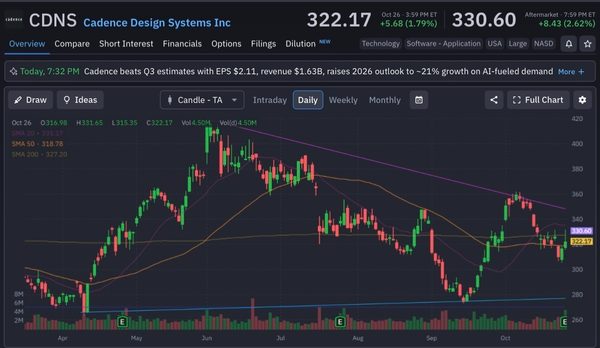
Cadence has the backlog and growth forecast to support its AI thesis. For CDNS shares to build on that momentum, buyers need to clear $335, while upcoming results show profit growth catching up with revenue.
Leave a Reply