It’s been a good month for Boeing (NYSE: BA). On Sept. 14, the company was awarded a $562 million contract from the U.S. Navy. The contract will allow Boeing to move the Navy’s MQ-25A Stingray refueling drone into low-rate initial production. This was a significant milestone for a program that has been marred by delays.
Table of Contents
Then on Sept. 29, the Navy selected Boeing to develop its F/A-XX sixth-generation fighter. This will replace the F/A-18 Super Hornet. The $20 billion contract has the potential to position Boeing for decades of future production and sustainable revenue.
In both cases, investors sold the news. In fact, they didn’t even buy the rumor. BA is down 11.2% for the month, and it’s down over 14% for the year. The stock closed Sept. 30 at $186.27, near its lowest level since the spring. That’s an unusual reaction to defense wins of this size.
Investors are dealing with an expensive stock from a company that is still managing a significant debt load, is facing potential labor strife, and just got a setback for the program that started causing problems for the company in November 2024.
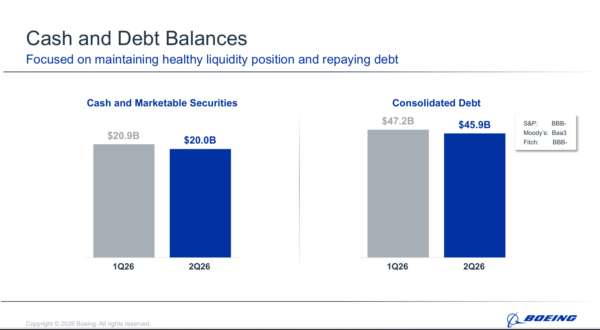
In other words, the market isn’t ignoring the good news. It’s weighing that news against a longer list of open questions. Right now, investors want more proof before they pay up. That gap between perception and fundamentals is the Boeing story today.
Why Investors Shouldn’t Dismiss the Navy Contracts
Start with the MQ-25. Low-rate initial production is the step that turns a development program into a production program. The Stingray will take aerial refueling duty off Super Hornets. That frees fighters for combat missions and extends the reach of the carrier air wing.
Production matters financially, too. The MQ-25 was one of several fixed-price development contracts that saddled Boeing’s defense unit with billions in charges in recent years. Moving into production gives the company a chance to start earning back that investment.
The F/A-XX is the bigger prize. Fighter jet programs run for decades. The Super Hornet first flew in the 1990s and remains a frontline aircraft today. Winning its replacement means design, production, upgrade, and sustainment revenue that could stretch deep into the century.
It also builds on existing momentum. In March 2025, the Air Force selected Boeing for its F-47 sixth-generation fighter. Boeing now holds both of the U.S. military’s next-generation fighter programs. That’s a rare position, and it supports the case that its defense business is turning a corner.
The catch is timing. These are long-dated revenue streams. They won’t fix near-term cash flow. Investors buying BA today are still mostly buying a commercial aircraft recovery story.
Not All the News Has Been Good
On Sept. 28, the U.S. Federal Aviation Administration (FAA) announced it was delaying certification of Boeing’s 737 Max 10 variant due to a newly flagged software issue. The timing couldn’t have been worse. Boeing appeared close to being approved to start delivering the jet.
The Max 10 is Boeing’s largest jet in its single-aisle family. The program has struggled through years of delays. However, flight testing finished in July, and the company was optimistic that it would receive approval.
Even more concerning is that the software glitch, which is tied to the company’s flight-management software versions 14 and 14.1, could impact the initial deliveries of Boeing’s Max 7 if regulators treat the software as a safety issue.
That’s why the Max 10 delay hit harder than the Navy wins helped. Commercial airplanes drive most of Boeing’s revenue and nearly all of its recovery narrative. Every certification delay pushes deliveries, and the cash that comes with them further down the road.
Labor Trouble May Be Abating
The company’s largest white-collar union, the Society of Professional Engineering Employees in Aerospace (SPEEA) will decide on Oct. 1 whether its members will ratify Boeing’s latest contract offer, which was proposed on Sept. 11. If the offer is rejected, it would clear a path for a walkout as soon as Oct. 7.
That would be the worst possible timing for Boeing. Engineers play a central role in certification work. A strike could slow the very programs investors are waiting on. However, as of this writing, there was genuine optimism that the sweetened proposal would be ratified. That means by the time you read this, it may be a moot point. Or, it may be a bigger headwind and headache for the company.
What the Chart Is Saying
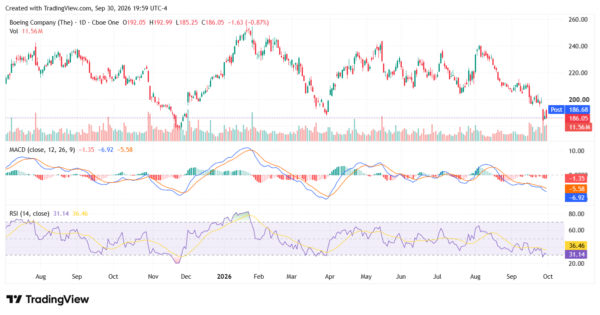
BA’s chart reflects investor frustration. The stock has fallen from around $240 in mid-August to $186.05. It’s now testing the zone near its March and April lows. A break below that area could open the door to the late-2025 lows near $180.
Momentum is stretched. The relative strength index (RSI) sits at 31, just above the 30 level that signals oversold conditions. The MACD remains below its signal line and below zero, a sign sellers are still in control. Volume also spiked on the late-September gap lower, showing conviction behind the selling.
Oversold doesn’t mean a bottom. But it does suggest much of the bad news may already be priced in.
Good News Needs Company
Boeing’s problem isn’t a lack of good news. It’s that the good news is long-term and the bad news is immediate. The Navy contracts make the next two decades look stronger. The Max 10 delay and labor uncertainty make the next two quarters look shakier.
Investors appear to want more news before they act: a clean SPEEA vote, a clear Max 10 timeline, and steady delivery numbers. Until then, defense wins alone may not lift the stock. For patient investors, though, an oversold stock with a growing defense backlog may be a setup where perception eventually catches up with fundamentals.
Leave a Reply