A record backlog should make Boeing Co. (NYSE: BA) an easy industrial business to believe in, with thousands of aircraft orders, a strong defense pipeline, and a services division generating healthy margins. After years of production trouble, certification delays, and cash burn, I’m focused on how quickly Boeing can turn those orders into profitable deliveries.
Table of Contents
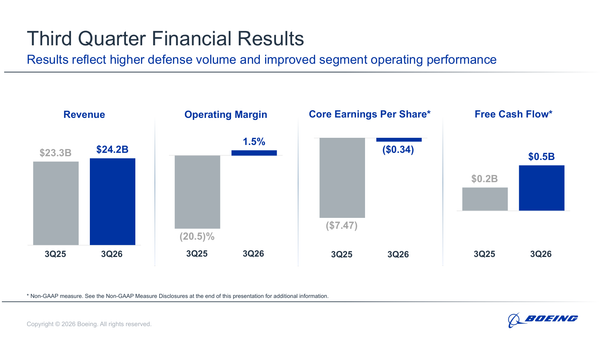
Third quarter of 2026 results gave me reasons to stay interested in the recovery, although the numbers also show why investors have been reluctant to reward every operational improvement. Revenue increased 4% year over year to approximately $24.2 billion, operating cash flow reached $1.5 billion, and free cash flow returned to positive territory at $464 million, alongside a record $745 billion backlog. Demand is substantial, and Boeing is generating cash again, but I still need to see production improve enough to deliver the financial recovery investors expect.
Delivery Problems Still Hover Around The Company
The backlog is the strongest part of Boeing’s investment case, with Commercial Airplanes accounting for approximately $612 billion of the total and more than 6,300 aircraft awaiting delivery, while Defense, Space & Security contributes another $101 billion and Global Services holds roughly $33 billion.
That gives Boeing years of potential business, provided management can build and deliver aircraft at a pace that improves the economics of the operation. I do not need Boeing to convince airlines to buy its planes. I need to see those orders translate into stronger margins and dependable cash generation.
There’s progress in this third quarter, with Boeing delivering 161 commercial aircraft while Global Services generated approximately $5.8 billion in revenue at an operating margin of 18.3% and Defense and Space reported $7.9 billion in revenue at a 6.2% margin. Those divisions provide important support while the commercial aircraft operation works through its problems.
But I’m watching commercial airplanes most closely as it generated $10.7 billion in revenue while posting a negative operating margin of 6.5%… and an operating loss of approximately $697 million. Boeing can deliver more aircraft and still struggle to earn an acceptable return if production costs, rework and program expenses consume too much revenue.
Management also expects to miss its target of delivering 500 737 aircraft in 2026, with production expected to reach 47 aircraft per month in early 2027 and increase to 52 per month in the second half of that year. The schedule has slipped, so I want to see Boeing meet its revised milestones before treating the backlog as a reliable path to stronger earnings.
Positive Cash Flow Still Needs to Become Repeatable
Boeing generated $1.496 billion in operating cash flow and $464 million in free cash flow during the quarter, a welcome improvement after the cash pressure that has defined much of its recovery, although I am careful about treating one quarter as proof that the financial turnaround has reached a new stage.
Cash flow can swing significantly with aircraft deliveries, customer advances, supplier payments and capital spending, and Boeing benefited from a $3.45 billion increase in customer advances and progress billings during the quarter. That helped cash generation, although the timing of those payments does not establish what Boeing can produce every quarter.
The nine-month free cash flow figure remains negative $359 million, a reminder that Boeing still needs to string together stronger quarters before I can call cash generation consistently healthy.
Management expects approximately $2 billion in free cash flow for 2026, followed by around $3 billion in 2027, $6 billion in 2028 and $10 billion in 2029, offering a picture of what a repaired Boeing could look like while also leaving investors with a longer wait for the financial recovery to arrive. The targets are ambitious, and recent production delays make execution more important than the promises.
Boeing also carries $45.9 billion in consolidated debt despite holding $20.7 billion in cash and investments, giving management liquidity to continue the recovery while keeping pressure on the business to produce sustainable cash. Stronger free cash flow would give Boeing more room to reduce financial risk and rebuild investor confidence.
BA Still Has to Earn Its Next Move
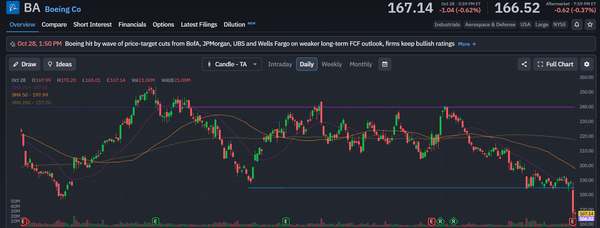
Boeing’s stock closed at $167.14 with the after-hours price around $166.52, leaving BA below its 20-day moving average near $187.41, its 50-day average around $197.99 and its 200-day average near $217.70. All three averages now sit above the share price, creating layers of overhead resistance that the stock must overcome before its chart supports a stronger recovery.
I am watching the $165 area first, with $160 below it if selling pressure continues, while a recovery toward $185 to $190 would be an early sign that buyers are returning. I would want that move supported by evidence that production and cash flow are improving rather than a rally built on backlog headlines alone.
My view on BA remains cautiously bullish over the longer term because demand is real, the services business is profitable, and positive quarterly free cash flow gives the recovery something tangible to build on. Except I am not ready to treat the $745 billion backlog as a promise of near-term profits.
My next scorecard is straightforward, with Boeing needing to bring production closer to its targets, deliver aircraft more reliably, and generate positive free cash flow without relying so heavily on favorable timing. If those improvements begin to repeat, I can make a stronger case for the stock, while further delays would keep me cautious even with a record order book.
Leave a Reply