Navitas Semiconductor (NASDAQ: NVTS) is terribly risky, despite being relevant to the artificial intelligence boom. As a designer and developer of next-generation power semiconductors used for power conversion and charging, the tech specialist fits well within the current ecosystem. But financially, a lack of profitability remains a deep concern for NVTS stock.
Table of Contents
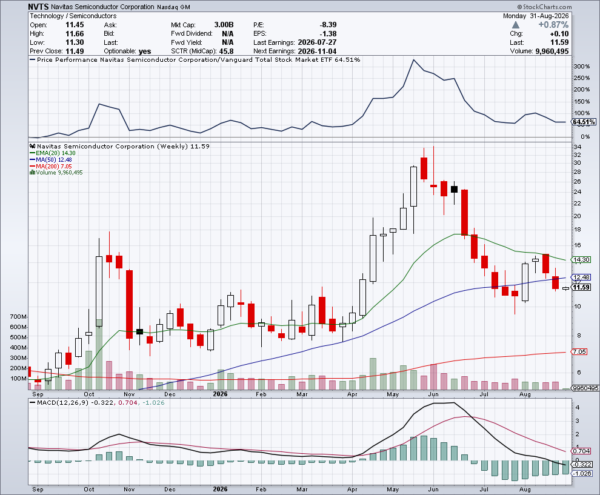
There’s also another problem. Because the Navitas stock price is nominally cheap — trading hands at $11.59 at time of writing (Monday’s close) — the movement of this security is incredibly wild. Yes, it’s worth pointing out that NVTS has gained over 62% on a year-to-date basis. At the same time, it’s down more than 62% since early June.
Basically, if you don’t catch NVTS stock at the right time, you’re liable to lose money on a debit-side trade. Indeed, the 60-month beta of 3.86 — meaning that the ticker is nearly four times as volatile as the benchmark S&P 500 index — serves as a clear warning. You don’t want overexposure to this name if you can help it.
If these problems weren’t already distracting, it has to be emphasized that NVTS stock entered the public arena via a merger with a special purpose acquisition company (SPAC). Generally speaking, SPACs haven’t really performed all that well post-merger, which means that you should be skeptical when considering such opportunities.
Nevertheless, it’s a free country, and no single investment or trading strategy is ideal for everyone. Therefore, if you have some “stupid money” lying around — that is to say, funds that you can comfortably afford to lose — Navitas stock might be somewhat intriguing.
It comes down to an inductive case. With NVTS stock suffering an extended downturn over the past two months, it’s possible that the selloff could be overdone. Should luck be on your side, the tech name could possibly see a near-term bounce back.
Order Flow Imbalance Points to a Possible Opportunity in NVTS Stock
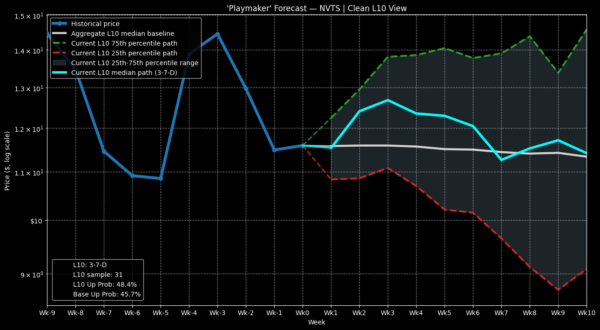
From a quantitative view, Navitas stock has only managed to print three positive weekly candlesticks in the last 10 weeks, leading to a downward slope across the period. By itself, this 3-7-D (3 up, 7 down, down slope) sequence doesn’t mean much other than a static snapshot in time. However, it’s the market’s typical subsequent response that makes this name so interesting.
Since the SPAC merger, NVTS stock has flashed this quant signal 31 times. By the third week of the signal materializing in the charts, the ticker has exceeded the equivalent of the $12.50 share price a total of 18 times. If we were to look at the empirical data from this conditioned framework, the success ratio would come out to 58.1%.
Granted, that’s not the greatest odds ever. Further, I wouldn’t classify this assessment as a high-confidence move, particularly because a sample size of n=31 is still quite small. Combined with the beta of 3.86, there’s incredible difficulty in pinpointing where NVTS stock may end up.
Still, using an inductive framework, a decent chance exists that the tech specialist may be able to clear the psychologically significant $12.50 level. Better yet, the 12.00/12.50 bull call spread expiring Sep. 18 allows extreme speculators to gamble on this inductively extracted opportunity.
Another thing to keep in mind is that the speculation is nominally low cost. The net debit (cash outlay) is only $20 per spread. Should Navitas stock rise through the $12.50 second-leg strike price at expiration, the maximum profit would be $30, a payout of 150%.
With such small outlays, you can tiptoe your exposure to the above call spread. Of course, there are always pros and cons to every trade. In this case, Wall Street’s calculated odds that NVTS stock will trigger profitability is awfully low.
Why a Random Walk May Not be Accurate for Navitas Stock
When you look at the stats for the Sep. 18 12.00/12.50 bull spread, you’ll notice that the probability of profit (breakeven) is very modest at 38.7%. It gets worse. OptionCharts’ Probability Distribution screener reveals that the odds of NVTS stock hitting the second-leg strike are only about 30%.
You don’t need to run a formal expected value (EV) calculation to see the problem here. With only 30% of trades expected to generate full profitability, you would be losing 70% of the time if you placed this bet across multiple parallel universes. Very quickly, then, you would find yourself in the negative. Because the EV is so terrible, analysts would be justified by labeling Navitas stock as a high-risk affair (that you should probably avoid).
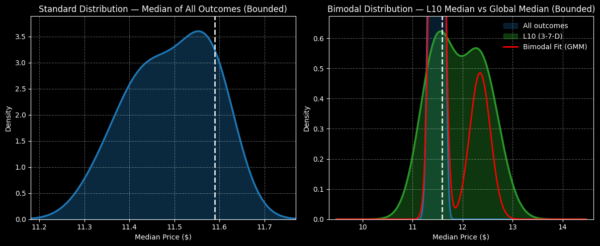
To be fair, though, these low odds stem from a critical presupposition; basically, that NVTS stock will undergo a random walk between now and the expiration date. Also, there’s another assumption that the given implied volatility (IV) will be a constant factor throughout this random journey.
So yes, if we assume that Navitas stock will trade inside a random, risk-neutral environment, the probability that it will hit $12.50 on Sep. 18 would be around 30%. It’s just how the math of Brownian motion would work.
The contention, of course, is whether or not NVTS stock will trade randomly. I’m of the opinion that the journey will be nonrandom.
Defending the Nonrandom Argument
While I don’t intend to sound arrogant, I believe Wall Street’s options pricing mechanism, from which these low probabilities are derived, is flawed. First, I have trouble believing that a 3.86-beta stock will feature a performance trajectory resembling many compounded coin tosses. Just the sheer volatility would seem to make this proposition unlikely.
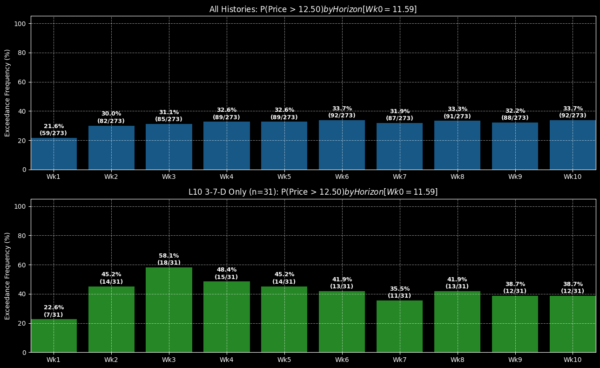
Further, NVTS stock is quantitatively suffering from an order flow imbalance: there are simply more negative candlesticks than positive over the last several weeks. Essentially, many weak hands have been flushed out. This dynamic would imply a possible discount, as speculative professional traders look for a mean-reversion play.
If indeed a perception exists that Navitas stock is discounted, this perception is evidence of a potential nonrandom move. Historically, that’s exactly what we see. Whenever NVTS has succumbed to extended bearishness, the response tends to be positive.
Obviously, a tendency is not the same as a guarantee. The core weakness of an inductive model is that there’s no way to necessarily say that a prior observed pattern will repeat in the future. But if you want to play the odds, there appears to be a stronger case for positive, nonrandom behavior. That may put the $12.50 strike in credible contention.
Leave a Reply