
Whether you are preparing for retirement, getting close to retirement or already enjoying it, one financial concern tends to rise above nearly everything else: generating reliable cash flow.
Table of Contents
After all, retirement expenses do not stop when the stock market becomes volatile. That is why many investors use exchange-traded funds, or ETFs, to create a diversified stream of investment income. ETFs can make it easier to own dozens, or even hundreds, of securities through a single investment. They can also help investors combine current income with the potential for long-term capital appreciation.
However, not every income fund works the same way. Some prioritize immediate cash distributions, while others focus on traditional dividends or long-term dividend growth. The following three ETFs offer distinctly different approaches.
How JEPQ Generates Its High Monthly Income
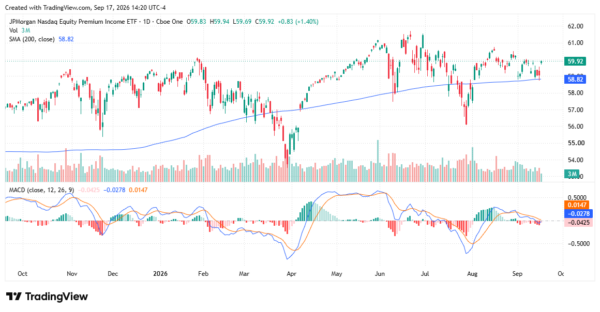
For investors seeking substantial monthly income, the JPMorgan Nasdaq Equity Premium Income ETF (NASDAQ: JEPQ) remains one of the most compelling options.
JEPQ invests primarily in large-cap growth companies while using an options-based strategy to generate additional income. In simple terms, the fund owns a portfolio with significant exposure to Nasdaq-related technology and growth stocks. It then collects option premiums through equity-linked notes tied to a covered-call strategy. Those premiums, along with dividends received from the underlying stocks, help support JEPQ’s monthly distributions.
As of September 2026, JPMorgan reported that JEPQ had delivered a 12-month rolling dividend yield of approximately 10.69% and a 30-day SEC yield of 12.87%. The fund carries an expense ratio of 0.35%.
VYMI: An Income ETF With International Diversification
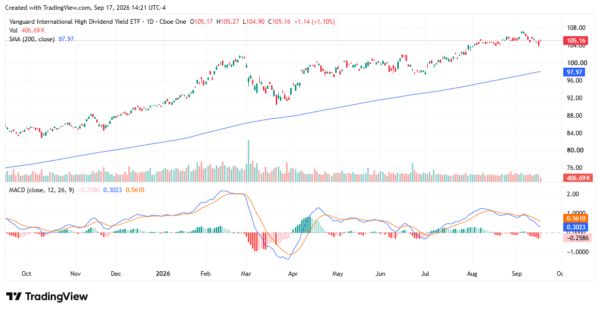
The Vanguard International High Dividend Yield ETF (NASDAQ: VYMI) tracks the FTSE All-World ex US High Dividend Yield Index. It invests in dividend-paying companies located outside the United States, including businesses in developed and emerging markets.
Its portfolio provides exposure to sectors such as financial services, energy, healthcare, consumer products, industrials, and telecommunications. Holdings may include recognizable international companies such as HSBC (NYSE: HSBC), Novartis (NYSE: NVS), Roche (OTC: RHHBY), Nestlé (OTC: NSRGY), and Royal Bank of Canada (NYSE: RY).
One important update for 2026 is that Vanguard reduced VYMI’s expense ratio from 0.17% to 0.07%. That means an investor pays approximately $7 in annual fund expenses for every $10,000 invested. Its dividend yield was recently around 3.5%.
VYMI offers more than income. It can help reduce an investor’s dependence on the U.S. economy, the U.S. dollar and a small group of highly valued American technology companies.
VIG Prioritizes Dividend Growth Over High Current Yield
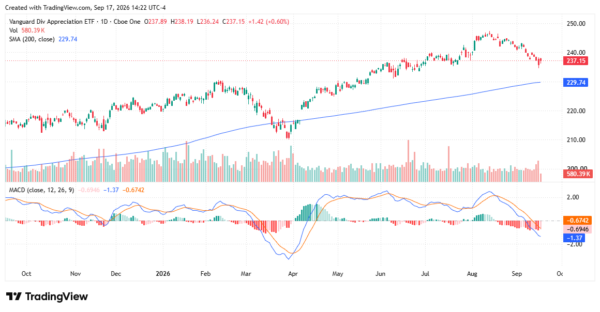
The Vanguard Dividend Appreciation ETF (NYSEARCA: VIG) is another one to consider.
VIG tracks the S&P U.S. Dividend Growers Index, which focuses on established American companies with a history of consistently increasing their dividends. Instead of simply buying the stocks with the highest current yields, the strategy emphasizes companies that have demonstrated the financial strength to raise their payouts over time.
Its portfolio includes major companies from technology, healthcare, financial services, consumer products, energy and other important areas of the economy. Large holdings have included companies such as Broadcom (NASDAQ: AVGO), Microsoft (NASDAQ: MSFT), Apple (NASDAQ: AAPL), JPMorgan Chase (NYSE: JPM), Visa (NYSE: V), Eli Lilly (NYSE: LLY), and Exxon Mobil (NYSE: XOM). VIG’s expense ratio has also been reduced and now stands at just 0.04%, or about $4 per year for every $10,000 invested.
Three Income ETFs, Three Different Strategies
These three ETFs solve different portfolio problems for investors looking for income.
One, JEPQ offers the highest immediate income and monthly distributions. Two, VYMI combines dividend income with international diversification. And third, VIG provides a lower starting yield but emphasizes quality, dividend growth, and long-term appreciation. For many investors, the best answer may not be choosing only one. A carefully balanced combination could provide monthly option income, international exposure, and long-term dividend growth.
Leave a Reply