
Right now, McDonald’s (NYSE: MCD) doesn’t really appear to be a tempting proposition, either for the buy-and-hold investor or the bullish debit-side options trade. Quite simply, the global economy isn’t really cooperating with MCD stock, leading to a disappointing market performance as Wall Street trims its exposure. Nevertheless, with the weak hands potentially flushed out, there could be a contrarian opportunity here.
Table of Contents
I don’t want to be dismissive. But there could be an argument that McDonald’s stock is so bad, it’s good.
According to Google Finance’s summary sheet, MCD stock incurred consolidation as the underlying company faced “recent global consumer spending headwinds. While value menu promotions stabilized domestic traffic, analysts project persistent pressure on international comparable sales over the next quarter due to soft macroeconomic conditions, keeping sentiment cautiously neutral.”
That doesn’t sound like a pleasant investment thesis given the macroeconomic implications. “Weak consumer discretionary spending across European and Asian markets continues to depress international development licensed sales, weighing down overall revenue growth.” It’s no wonder, then, why MCD stock has nose-dived in recent sessions.
However, there are some positives to consider, particularly regarding McDonald’s strategic, value-centered pivot. Google Finance writes, “[s]trategic promotional campaigns and expanded value menus have successfully defended domestic market share, helping sustain restaurant traffic amid intense competition.”
Additionally, digital loyalty programs have witnessed sustained expansion, suggesting a consumer propensity for the Golden Arches. That’s a tangible positive amid the weakened macro picture. Ultimately, though, the trajectory of MCD stock comes down to net market sentiment. If there’s enough of a reason to buy shares, investors will do so.
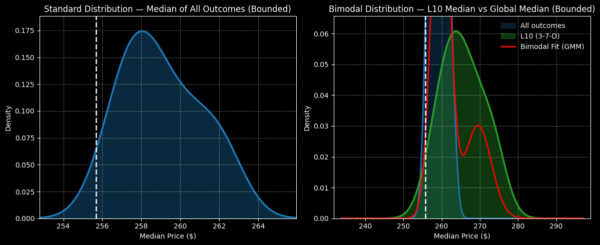
Now, the fundamental analyst may argue that the broader economic framework disincentivizes exposure to McDonald’s stock — and that’s a fair argument. Today, I want to focus more on the quantitative, mechanical argument: that bearish order flow imbalance implies a flushing out of the weak hands, thus also implying a relative discount.
If these implications are true — granted, that’s a big “if” — then we might just have ourselves a contrarian opportunity.
Laying Down the Epistemological Framework for MCD Stock
Before moving further into the analysis, we need to understand the practical difference between random and nonrandom probabilities. Consider a coin toss and also assume no funky business, such as one side being biased over the others. We understand mathematically that picking heads or tails ultimately converges toward a 50/50 wager over the long run.
Sure, it’s possible to have an unusual streak of majority heads (or tails). But given enough coin tosses, you know it would be fallacious to assume that your coin-picking abilities have some kind of uncommon (i.e. nonrandom) edge. Subsequently, if you were a rational agent, your risk exposure would reflect this circumstance, meaning that you likely wouldn’t overleverage yourself on a random-odds trade.
On the other hand, if the coin was weighted toward one side, the odds of picking heads or tails are no longer purely random. Instead, if you understand which side the weight is biased toward, you would have an edge over the long run.
No, on each pick, you wouldn’t be guaranteed to win. But you have a clear incentive to pick the biased side. That’s the beauty of nonrandomness.
Wall Street’s Presupposition Toward McDonald’s Stock
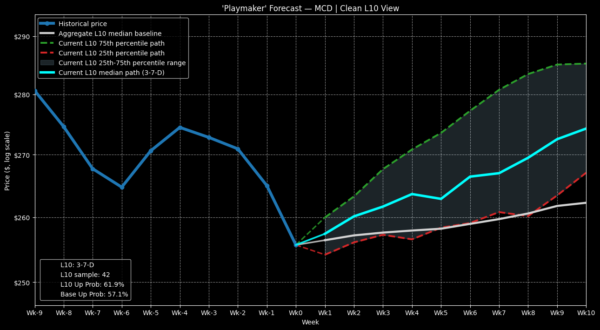
Over the last 10 weeks, MCD stock only printed three positive weekly candlesticks, thus leading to a downward slope across the period. To be fair, there’s nothing inherently special about this 3-7-D quant sequence; it’s just a static snapshot in time. However, it’s the typical (median) response when this sequence flashes in the technical charts that is most intriguing to me.
Given past empirical data, I believe there is a statistical case of McDonald’s stock reaching the $265 price level by around mid-October. Therefore, I’m very interested in the 260/265 bull call spread expiring Oct. 16. This trade requires a net debit (cash outlay) of $205. Should MCD rise through the $265 second-leg strike at expiration, the maximum profit would be $295, a payout of nearly 144%.
That may sound intriguing on paper but there’s a catch: Wall Street doesn’t view this call spread as a high-likelihood affair.
In particular, the breakeven price for the 260/265 spread is $262.05 (at time of writing). That’s 2.49% above the current spot price, which may not sound like much. But with MCD stock currently running a modest implied volatility (IV) of around 21%, there’s not much anticipated movement. As such, the probability of profit (breakeven) is only 36.1%.
Another glaring issue is the higher threshold of triggering the $265 strike on Oct. 16. OptionCharts’ Probability Distribution screener identifies the odds at only 31.97%. If you were to run an expected value (EV) calculation, you would incur a negative number as you would simply lose more times than you would win.
Still, the core presupposition here is randomness. These probabilities are derived from the Black-Scholes family of calculations, which presume that McDonald’s stock will undergo a random walk between now and the expiration date. Under this artificial construct, yes, the odds of success are incredibly low — and you probably should avoid the transaction.
The question is this, though: is the Black-Scholes presupposition justified? Personally, I don’t think it is.
Defending the Nonrandom Walk
As I pointed out earlier, MCD stock is currently structured in a 3-7-D quant sequence. That’s an obviously bearish order flow imbalance, which likely means that the subsequent 10 weeks will be heavily influenced by the structural pessimism. Essentially, I’m presupposing that market professionals will view McDonald’s as a relative discount.
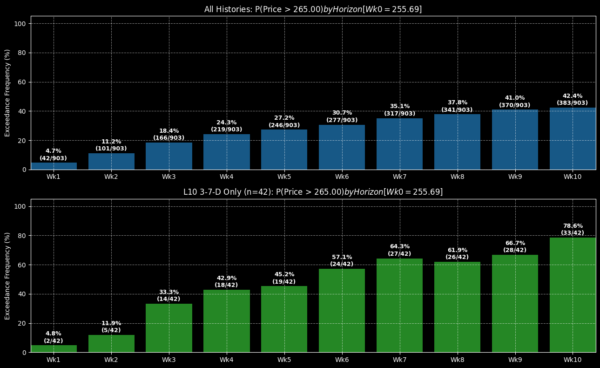
Better yet, we don’t have to rely on vibes to arrive at this conclusion. Instead, we can look at past data. Since January 2009, the above signal flashed 42 times on a rolling basis. Of this tally, MCD stock reached the equivalent of the $265 strike on week 6 (corresponding to the Oct. 16 expiration date) 24 times.
If we’re looking strictly at the conditioned, observed data, the probability of full profitability comes out to 57.1%. No, I wouldn’t say that’s remarkably high. But it’s obviously much better than 31.97%.
Does this projected outcome represent a license to buy the Oct. 16 260/265 bull spread? Only you can make that decision. Recently, I’ve been fairly accurate on this MCD stock call spread but not so much with the September spread, which is likely to end as a loss.
Finally, we must understand that presuppositions about the future are prone to error; that’s just the nature of the game. Ultimately, my point is that you shouldn’t just take Black-Scholes for granted without a deeper investigation. In this case, there may be a legitimate reason to bet on McDonald’s stock as a contrarian candidate.
Leave a Reply