
Dave & Buster’s Entertainment Inc (NASDAQ: PLAY) finally gave investors some of the evidence they’ve been waiting for, but after another quarter of declining entertainment revenue, collapsing EBITDA margins and a balance sheet carrying $1.5 billion of long-term debt, I still don’t think the improving operating trend is enough to make me want to own the stock.
Table of Contents
Revenue fell 2.4% to $544.1 million in fiscal Q2, while adjusted EPS came in at a $0.27 loss versus a $0.40 profit a year ago. Adjusted EBITDA dropped from $129.8 million to $98.9 million, pushing the margin down from 23.3% to 18.2%.
That looks ugly. But the quarter also contains something I didn’t have when I wrote about Dave & Buster’s in April: evidence that management’s turnaround efforts are beginning to work. The problem is where that improvement is showing up.
Customers Are Returning, But They Still Aren’t Playing
The most encouraging number in this report is probably the comparable-store sales trend. Comps declined 2.9% in Q2, an improvement from the 5.4% decline in Q1. Management says July improved to a 1.6% decline, with further improvement in Q3 so far. Food and beverage sales also continued growing, while special-events sales have now grown for seven consecutive quarters.
That is real progress, and it directly challenges the argument I made in my previous article on PLAY that the turnaround was still mostly a story rather than a result.
But then I looked at where the sales are actually coming from.
Entertainment revenue fell 8.8% to $332.6 million, while food and beverage revenue jumped 9.6% to $211.5 million. I’m not comfortable with this part because Dave & Buster’s isn’t fundamentally a restaurant. The games and attractions are meant to give customers a reason to visit, while food and drinks monetize the time they spend there.
If entertainment keeps shrinking while F&B grows, the company may be getting better at extracting spending from existing visitors without proving that the core experience is bringing more people through the doors. And that’s a very different turnaround.
The Business Is Replacing High-Margin Revenue With Lower-Margin Revenue
This revenue mix matters because entertainment isn’t just another line item. When entertainment revenue falls by roughly $32 million, and F&B adds about $19 million, the company isn’t replacing one dollar with another dollar of equivalent economic value. The result is visible in the profitability numbers.
Adjusted EBITDA fell nearly 24% to $98.9 million, while store operating income before depreciation and amortization declined to $127.8 million from $155.4 million. The company’s reported operating margin fell to 3.6% from 9.5%.
There is an important caveat here: management said a roughly $10 million deferred-revenue impact made the quarter’s margins look worse, so I wouldn’t treat the entire 500-basis-point EBITDA contraction as permanent operating deterioration. But even after accounting for that distortion, the fundamental mix problem remains.
PLAY is still losing the revenue stream that makes the entertainment model so attractive. That’s why I’m less impressed by the improving comps than I might have been six months ago. I need to see entertainment stabilize, not just total spending per visitor improve.
Management Is Finally Spending Less On The Wrong Problem
There is, however, a part of the turnaround I genuinely like. Dave & Buster’s has remodeled stores, introduced new games and attractions and found that remodeled locations are outperforming the broader system. Management also plans to complete two more remodels during fiscal 2026, bringing the year’s total to eight.
More importantly, the company is becoming more disciplined about capital.
Adjusted free cash flow was positive $19.5 million through the first six months of fiscal 2026, compared with negative $36.5 million a year earlier. Operating cash flow rose to $160.6 million from $129.8 million, while capital expenditures fell to $190 million from $243.8 million.
That’s a meaningful improvement, but I still have to put it against the balance sheet. Dave & Buster’s had just $16 million of cash against $1.50 billion of long-term debt at the end of Q2, with a 3.5x net total leverage ratio. Interest expense alone was $38 million for the quarter.
That leaves very little room for a turnaround that takes longer than expected.
No Reason To Rush
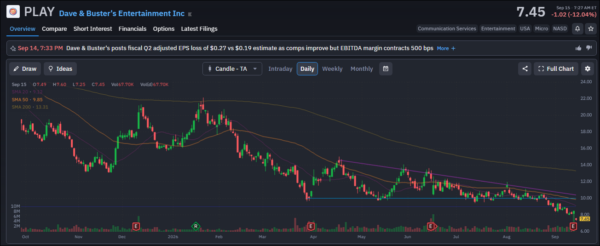
PLAY closed at $7.45, down 12% on the latest session, after spending most of the year grinding lower. The stock is below its 20-day SMA at $9.12, its 50-day SMA at $9.85 and its 200-day SMA at $13.31.
More importantly, every major recovery attempt on the chart has produced another lower high. PLAY briefly recovered toward $13–$14 in May and June, failed, and has now fallen below the $10 support zone that held through much of the summer.
At this point, $7.25–$7.50 is the level I would watch for immediate support. Lose that area, and PLAY could test $6. Above it, I would need to see PLAY reclaim $9.10–$9.20, then $9.85, before the chart begins giving me evidence that the trend has actually changed.
Why I’m Not Buying
I’m not interested in buying because PLAY has already fallen this far. The operating recovery is real, but the market is still waiting for evidence that Dave & Buster’s can fix the part of the business that drives its economics.
One can even argue that the comps are improving, F&B is growing, remodeled stores are outperforming, and cash generation has recovered. But entertainment revenue is still falling, EBITDA is contracting, and the company remains heavily leveraged, leaving too much risk in waiting for the turnaround to reach the games themselves.
I’d rather miss the first part of a genuine recovery than finance the waiting period while Dave & Buster’s tries to prove that customers are coming back to play, not simply coming back to eat.
Leave a Reply