
I made a mistake in my last StockEarnings.com article for Walmart (NYSE: WMT). It’s not so much that the published idea of the 116/118 bull call spread expiring Aug. 14 is unlikely to end up in the money (ITM), although that would be considered a miss. Rather, it’s that I failed to incorporate an expected value (EV) calculation as part of the overall analysis of WMT stock.
Table of Contents
No, implementing an EV analysis wouldn’t necessarily have saved the options-based idea. As everyone knows, the future cannot be determined — especially in a reflexive environment like the equities market. That simply means that WMT stock will respond to outside influences, including difficult-to-ascertain psychological ones. Therefore, any forecast about Walmart or any other public security is bound to be probabilistic.
Now, I must say in my defense that my idea — published on July 22 — wasn’t without merit. On that day, WMT stock closed at $109.33. At the time of writing, I was using data from July 17, when the ticker closed at $114.24. So, the idea of Walmart stock hitting $118 at the end of Aug. 14 wasn’t far-fetched.
In addition, the breakeven price of the above bull spread was $116.97. On July 28, the intraday high for WMT stock was $116.03. In the article, I stated that my inductive model pointed to a probability of profit (breakeven) at 53.6%. Black-Scholes assigned odds of 36.9%. At this point, it would seem that the truth will be somewhere in the middle.
Still, despite the potential loss — there are still a few days remaining to expiration — I do feel justified in presenting the idea. I wasn’t making an outrageous claim and Walmart stock did break into the $116 level within the expected time period.
Nevertheless, I think an EV calculation would have allowed me to consider alternative debit spreads. It’s not that I questioned the bullish call — in that sense, I was right to be optimistic. However, I am most likely wrong in the specific choice of bullishness.
Starting a New Calculation for WMT Stock
Let’s restart the narrative and focus on the current picture. In the last 10 weeks heading into Friday’s close, Walmart stock printed four up weeks, leading to an overall downward slope. Basically, there is an order flow imbalance dominated by bearish sessions. Under this specific 4-6-D quantitative sequence, we would expect a forward 10-week outcome that is positively variant compared to a random, aggregate hold of WMT.
Now, under this framework, in the second week following the flashing of the aforementioned signal, the median endpoint outcome is around $113.50. That is, of the 28 times that the 4-6-D sequence has flashed on a rolling basis since January 2019, WMT stock has exceeded the $113.50 level 14 times and has fallen short of this level 14 times.
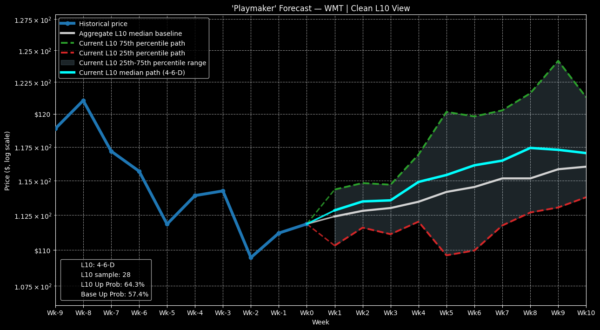
Since week 2 coincides with the Aug. 21 expiration date and that this particular options chain is denominated by single dollars, the highest-probability strike price that offers the greatest reward, along with the least dollars at risk, would be the $113 strike. As such, I would be most interested in the Aug. 21 112/113 bull call spread if I were approaching this trade from a rational perspective.
However, if WMT stock rises through the second-leg strike at expiration, the maximum payout would only be 81.82%. So, from a net debit of $55 to enter the trade, the maximum nominal profit would only be $45. Initially, this dynamic would seem to doom the transaction to a negative EV. And it’s at this point where many retail traders are tempted to consider a higher strike, say $14, to push the max profit ratio to beyond 100%.
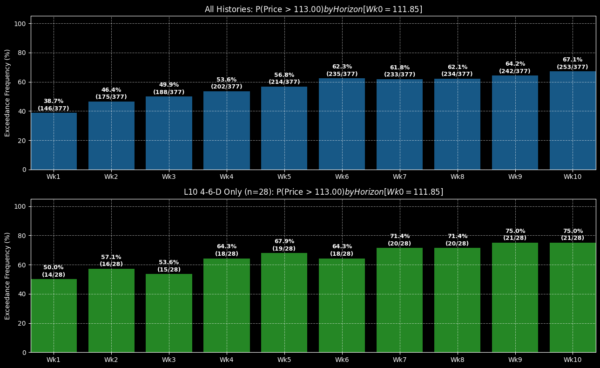
But let’s do some quick math here. Under the above inductive model, WMT stock would be expected to hit the $113 strike on Aug. 21 57.1% of the time. Out of the 28 times that the 4-6-D signal has flashed, WMT has risen above $113 a total of 16 times on week 2.
So, in 57.1% of the time, the 112/113 bull spread would be expected to pay out $25.70 ($45 x 0.571). Out of the other 42.9% of trades, the spread would be expected to lose $23.60 ($55 x 0.429). While the win margins aren’t phenomenal, you’re still expected to win about $2.11 over the long run.
Why Not Take a Greater Risk?
This might raise an intuitive question: why not take a shot with a greater risk-reward play? If you look at the 113/114 bull spread (also expiring Aug. 21), the maximum payout is 112.77%. Nominally, you’re betting $47 to make a maximum profit of $53. Since $114 isn’t that far off from $113, this trade might seem to be the better bet.
To be fair, since no one knows the future, it could be an intriguing idea. Moreover, if Walmart stock does drive up to $114, you would be capping your reward potential by going with a $113 bull spread. That is always going to be an inherent risk with options spreads.
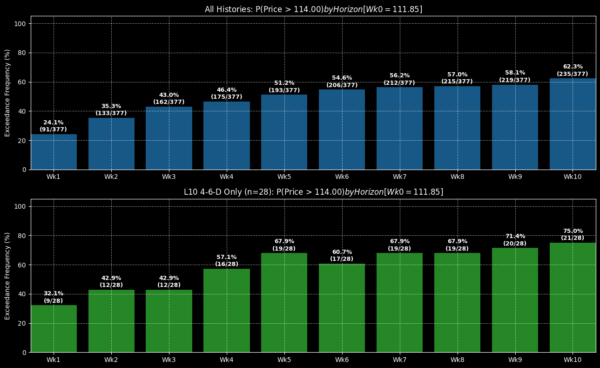
However, we’re just playing the numbers game. In my model, whenever WMT stock has flashed the 4-6-D signal, the ticker has only risen above the equivalent of the $114 strike on Aug. 21 a total of 12 times. You’re looking at a 42.9% success rate, meaning that you would be expected to win $22.74.
But because the success rate is relatively modest, this mathematically means that you’re losing 57.1% of the time. And that translates to nominally losing $26.84. Over the long run, you are expected to lose $4.10. Subsequently, we would label the 113/114 bull spread as having negative EV.
Does This Guarantee Victory?
Unfortunately, even if we run an alternative model and we do EV analysis, we still cannot guarantee a positive outcome for the above trade. I must stress this over and over to properly set expectations: the equities market will always be a game of probabilities.
All I’m doing is trying to narrow the risk down. However, no one can eliminate all risk. Further, the model itself could be wrong for that particular trade due to a number of unforeseen reasons. All inductive approaches suffer from the potential risk of the black swan. If you can’t handle this reality, options are not for you.
However, I also don’t have a nihilistic approach to the markets where we just throw our hands in the air and just accept hedge fund dominance. I believe that through creative approaches — such as inductive analyses — we can help level the playing field.
Leave a Reply