
When it comes to options trading candidates, it’s easy to overlook UnitedHealth Group (NYSE: UNH). As a health insurance and healthcare services specialist, there’s not much to be excited about. Sure, UNH stock is an important blue chip, as it undergirds one of the biggest names within the overall wellness industry. However, it’s not a volatile ticker, featuring a pedestrian 60-month beta of 0.62.
Table of Contents
In other words, those who are buying UNH stock can expect the equity to have less than two-thirds of the typical volatility found in the benchmark S&P 500 index. Sure, such a low-mobility stock can inspire confidence for long-term investors seeking to safely park their funds while collecting a solid dividend. However, when you consider that its five-year performance is a loss of 5.29%, it’s easy to lose patience.
That’s why retail traders generally prefer hot tech names. Of course, you’re often dealing with a higher-beta play, which can be a double-edged sword. At the same time, the common allure is that if you happen to time the security correctly, you could make off like a bandit. Typically, you’re not doing that with UnitedHealth stock.
However, because options — particularly debit spreads — allow traders to leverage incremental gains, you don’t necessarily need robust mobility to make a trade work. Instead, the focus is on probabilities. But even here, there’s a catch.
Essentially, UnitedHealth stock enjoys natural upward bias. Yes, like any other enterprise, UnitedHealth is subject to controversies. Further, the current political environment — where rising costs of living and questions about the sustainability of domestic healthcare — impose acute pressures on UNH. But because health is such a vital concept, the ticker is unlikely to fade into irrelevance.
Understanding this, the whole premise of positive mean reversion is arguably more credible. Technically, UNH stock is down 5% in the trailing month. Quantitatively, it has only printed three positive weekly candlesticks over the last 10 weekly sessions.
Still, this structure is exactly what makes UnitedHealth so attractive for aggressive speculators.
Arguing Against the Random Walk Framework of UNH Stock
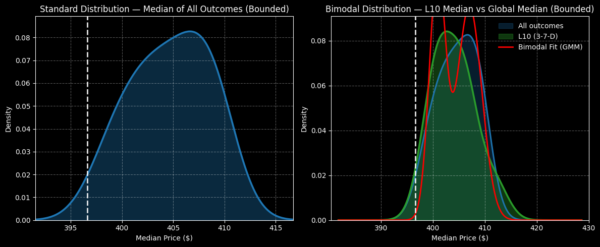
If mean reversion were to become a reality, I would anticipate over the next four weeks a lift of about 3.6% from Tuesday’s closing price of $396.59. I’ll go into the reason why I believe this. But assuming that this forecast is true, the 400/410 bull call spread expiring Oct. 16 would look attractive.
For this trade to be fully profitable, UnitedHealth stock would need to rise above the $410 strike at expiration. Doing so would convert the $485 net debit paid (cash outlay to enter the trade) into a $515 profit, a payout of over 106%. That may sound attractive but there’s a catch here: the probability of profit (breakeven) at $404.85 is set at 42.9%.
What’s even more challenging, the probability of UNH stock hitting the $410 second-leg strike at expiration is only 38.48%. That’s not great for obvious reasons because, over the theoretical long run, you would be losing more times than you would be winning — and by quite a margin.
In financial lexicon, the Oct. 16 400/410 bull spread would likely suffer from negative expected value (EV). Therefore, the more rational course of action would be to avoid the proposition altogether.
Of course, there are no guarantees in the equities market. It’s also fair to point out that options tend to exacerbate uncertainty due to the enhanced leverage. Therefore, walking away is an entirely reasonable idea.
However, it’s also fair to question where these probabilities come from. Basically, they’re derivations from the Black-Scholes family of options-pricing formulas. Without getting mired into the math, this framework assumes that UNH stock will undergo a random walk between now and the expiration date, with the current implied volatility (IV) providing the constant fuel throughout the journey. Stated differently, Black-Scholes offers implied probabilities from an artificial, risk-neutral world.
I don’t think it’s controversial to state that this assumption isn’t necessarily correct; rather, it’s a presupposition. Of course, to move an argument forward, a proposal needs to start with a presup. So, why do we then have to assume that a forward-looking model must incorporate random behavior?
A Nonrandom Presupposition Opens Doors for UnitedHealth Stock
Using Black-Scholes exclusively to trade options is a lot like assuming your particular religious belief is the truth. Don’t get me wrong — it could be the truth. However, if you’re really an open-minded person (a meta-thinker if you will), you would consider other religious and theological viewpoints. It’s the same principle with the equities market.
Frankly, it may not behoove you to frame UNH stock in exclusively random-walk terms. Instead, you should also consider the possibility that UNH will undergo a nonrandom walk. And I think there’s a very good reason for this.
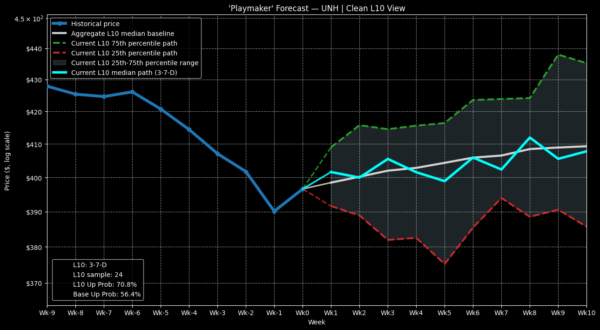
As I stated earlier, UnitedHealth stock printed only three up weeks over the last 10 weeks, leading to a downward slope across the period. This 3-7-D quant signal is clearly bearish at face value. But historically, whenever this signal flashed, select periods over the subsequent 10 weeks have generated above-average performance metrics.
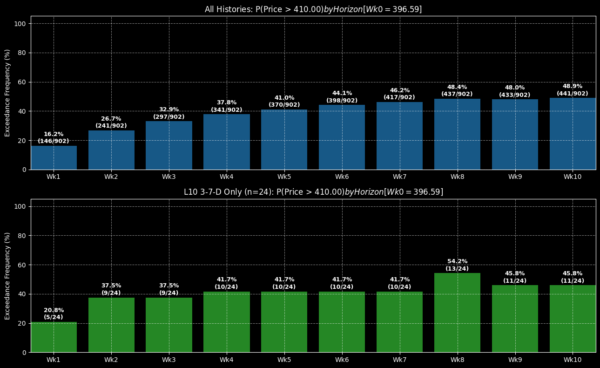
Since January 2009, the 3-7-D signal has flashed a total of 24 times. Of this tally, UNH stock has risen above the equivalent of the $410 strike price at the end of week 8 (Oct. 16) 13 times. To be fair, the sample size of n=24 is small. Nevertheless, the observed, conditional probability whenever UNH has flashed the above signal is 54.2%.
You don’t need to be a math whiz to understand that this is a much higher probability than 38.48%. Still, this raises the question: which model — the random Black-Scholes or this nonrandom Markov-chain-derived framework — is better?
Defending the Case for Nonrandomness
Honestly, there’s no way that I can say with certainty which model is better. Moreover, because UNH stock is so sedate relative to the S&P 500, there is a case to be made that in the long run, the performance quirks under various circumstances may indeed be random (or reflect random-like behavior).
Nevertheless, I do believe there’s a case for localized nonrandomness. That’s because even if UnitedHealth stock is a low beta name, institutional investors may still see value when a high-quality name suffers an extended downturn. Since it’s difficult to see a future where there are no healthcare services provided, UNH does seem a safe-ish bet.
Now, it is still a wager and adding an options element to a stable name naturally introduces risk. However, because extended downturns are so rare for UNH stock, I would argue that the subsequent trading for the ticker will be anything but random. That doesn’t mean the above call spread will be profitable but I think there’s a bigger chance than Wall Street is giving it credit for.
Leave a Reply