
When eBay Inc. (NASDAQ: EBAY) rejected GameStop’s unsolicited proposal in May, the board asked shareholders to walk away from an immediate $125-a-share offer, roughly 46% above where the stock had been trading, and trust that the company could create more value on its own over time.
Table of Contents
That decision immediately shifted the burden of proof onto management. Every quarter, especially the second quarter, from that point forward would become part of the company’s case for remaining independent.
Second-quarter earnings offered the first opportunity to judge that decision. Sure enough, revenue rose 15% to $3.13 billion, gross merchandise volume climbed 15% to $22.4 billion, GAAP earnings per share increased to $1.21, and management lifted its outlook for the remainder of 2026. The quarter also included the completion of eBay’s $1.2 billion acquisition of Depop and another strong performance from its advertising business, where first-party advertising revenue grew 25% year over year.
The numbers alone don’t answer whether rejecting GameStop was the right decision. They do establish something equally important: management asked investors to judge eBay by its execution rather than the price attached to a takeover offer. This quarter is where that argument begins.
eBay Challenged Itself To Become A Better Business
Strong quarters usually begin with more buyers, but eBay’s began with better economics. Active buyers increased just 2% to 136 million, yet gross merchandise volume grew 15%, matching the company’s 15% revenue growth. GAAP operating margin expanded to 21.6% from 17.6% a year earlier, while GAAP net income jumped 51% to $552 million.
Growth also came from businesses carrying higher long-term value. First-party advertising revenue climbed 25% to $570 million, eBay Live delivered another record quarter with GMV growing roughly eightfold, and the company completed its $1.2 billion acquisition of Depop to strengthen its position in second-hand fashion. AI-powered listing tools, card scanning and authentication services continued expanding across the marketplace, reinforcing categories where eBay has steadily built an edge instead of competing on size alone.
Turning Down $125 Looks More Rational Today
Rejecting a takeover bid at a 46% premium only becomes defensible if management can demonstrate that shareholders stand to earn more by remaining invested than by accepting an immediate payout, and while one quarter can never settle that debate, eBay’s second quarter earnings make the board’s decision considerably easier to understand. The business is growing faster, margins are expanding, advertising has become a larger profit engine, AI is lowering friction across the marketplace, and the Depop acquisition strengthens eBay’s position in one of the fastest-growing areas of recommerce rather than distracting management with the complexity of integrating two very different public companies.
I believe the rejection makes strategic sense over the long run because GameStop’s proposal offered shareholders certainty in price, whereas eBay is steadily increasing the value of the business itself. Those aren’t interchangeable outcomes. If management continues executing at this pace, compounds advertising revenue, expands higher-margin categories and successfully integrates Depop, the intrinsic value created over the next several years could exceed what shareholders were asked to accept in May. That possibility is exactly what the board asked investors to believe, and these earnings are the first meaningful evidence supporting that belief.
$125 Still Hangs Over eBay’s Head
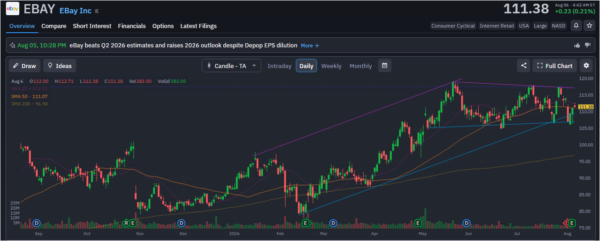
The market has already delivered one verdict. Since GameStop’s proposal became public, eBay has climbed from the low-$90s to around $111, recovering gently as each earnings report reinforced management’s turnaround. Yet the chart also shows investors stopping short of assigning the company the same value GameStop did. Wednesday’s rally carried the shares to an intraday high near $114 before profit-taking trimmed the gains, leaving the stock comfortably above its 20-day and 50-day moving averages but still well below the rejected $125 offer.
That makes $125 more than an abandoned takeover price. It has become a benchmark. Every quarter that eBay continues expanding margins, growing advertising, integrating Depop and compounding earnings narrows the gap between what the board said the business was worth and what the market is willing to pay for it. The chart suggests investors are moving in that direction, but they aren’t there yet.
Buying Time Turned Out To Be The Better Deal
Like I said, rejecting GameStop’s proposal was the correct decision – not because eBay posted a strong quarter, but because the business appears to be improving in ways a takeover price couldn’t fully capture. A marketplace that is growing advertising revenue by 25%, expanding operating margins, strengthening categories like collectibles and luxury goods, acquiring Depop to deepen its presence in circular fashion and using AI to make buying and selling easier is steadily increasing its earning power rather than simply maintaining it.
That doesn’t mean the board has been proven right forever. Shareholders gave up the certainty of $125 a share in exchange for management’s promise that the company was worth more over time, and that promise still carries execution risk. Depop must be integrated well, advertising needs to keep scaling and the marketplace has to sustain the momentum this quarter delivered. Those are meaningful hurdles, but I’d own a business whose challenge is executing on visible growth initiatives over one searching for a reason to grow. For the first time since rejecting GameStop, eBay looks like a company earning the right to remain independent.
Leave a Reply