
The stock market has conditioned investors to hunt for growth above almost everything else. We chase the company posting 30% revenue growth, then 50%, then 100%, because the math feels obvious. But that obsession with hypergrowth can cause investors to overlook the wealth-building potential of slow-growth companies that steadily return capital to shareholders.
Table of Contents
If the business gets bigger quickly enough, the stock should follow. But that thinking can make investors overlook a second route to compounding, one where the company itself barely changes the size of the pie while steadily making your slice of it bigger.
That is what stood out to me when I went back through the latest earnings from Visa Inc (NYSE: V), McDonald’s Corp (NYSE: MCD), and Booking Holdings Inc (NASDAQ: BKNG).
As you’ll see, they all generated solid numbers in previous quarters, but none of these companies belong in the conversation with hypergrowth stocks. Still, all three have another lever in terms of enormous cash generation paired with share repurchases.
Visa
Visa’s latest quarter showed why a mature business can still compound with frightening efficiency.
Net revenue grew 14% to $11.6 billion, GAAP EPS rose 10% to $2.97, and non-GAAP EPS increased 11% to $3.32, supported by 10% growth in payments volume, 12% growth in cross-border volume excluding intra-Europe, and another 10% increase in processed transactions.
The business is still growing, but the capital allocation machine is doing serious work underneath those numbers. During the quarter, Visa repurchased about 14.5 million shares for $4.9 billion at an average cost of $330.71, while dividends and buybacks together returned $6.2 billion to shareholders. Over the first nine months of fiscal 2026, the company spent $16.4 billion repurchasing Class A shares.
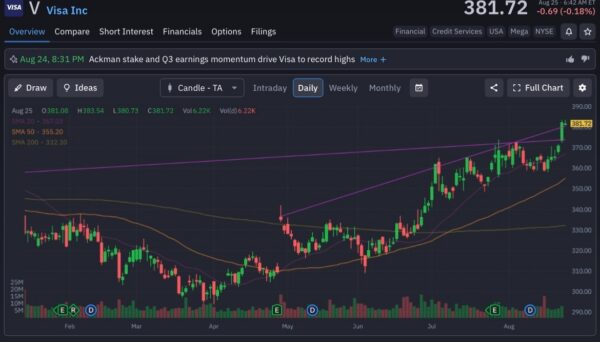
That is how a company with mature global penetration can keep improving the economics per share. Visa closed at $381.72, comfortably above its 20-day SMA of $367.03, 50-day SMA of $355.20, and 200-day SMA of $332.30, with the latest session recording 6.22K in volume. The stock is near record territory because investors are still willing to pay up for a business that combines steady growth with relentless capital returns.
The risk, naturally, is valuation. A premium stock can become expensive enough that even excellent execution produces mediocre returns. But Visa does not need to reinvent itself every quarter; it only needs to keep growing transaction volumes and shrinking the share count without damaging its balance sheet.
McDonald’s
McDonald’s offers a different version of the same compounding equation, built on a franchise system that turns global restaurant sales into unusually durable cash flows.
Second-quarter revenue grew 4% to $7.1 billion, net income increased 5% to $2.36 billion, and diluted EPS climbed 6% to $3.32, while the diluted share count fell from 717.6 million to 711.1 million.
That last figure is easy to ignore, but it is central to this thesis.
McDonald’s does not need to own and operate most of its more than 45,000 restaurants to benefit from their growth. Roughly 95% are operated by independent business owners, allowing the company to collect franchise revenue while avoiding the full capital burden of owning every location.
So modest sales growth can produce something more valuable when it passes through an asset-light system and is then divided across fewer shares.
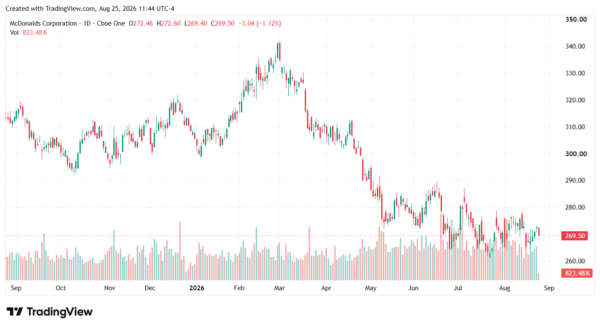
At $272.27, MCD sits almost exactly on its 20-day SMA of $271.12 and 50-day SMA of $272.03, while remaining below its 200-day SMA of $297.65, with 4.48K in volume during the latest session.
That is a stalled stock, but a stalled stock can still compound shareholder value underneath the surface.
My concern would be whether buybacks and dividends start consuming too much capital relative to the growth coming from the business. Slow growth only becomes attractive when the underlying cash engine remains healthy enough to keep feeding shareholders.
Booking Holdings
Booking Holdings may be the cleanest demonstration of how this strategy works when a company throws off obscene amounts of cash.
Revenue grew 8% to $7.4 billion during the second quarter, room nights increased 5% to 325 million, adjusted EBITDA rose 9% to $2.6 billion, and free cash flow jumped 16% to $3.6 billion.
That means Booking converted nearly half of its quarterly revenue into free cash flow.
Now look at what that cash allows management to do. The company can invest in technology, expand its travel ecosystem, fund its Transformation Program, and still have enormous financial flexibility. It has already increased the expected annual run-rate savings from that program to about $650 million by the end of 2027.
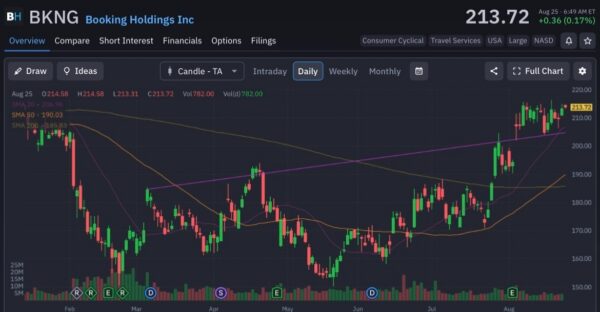
BKNG closed at $213.72, above its 20-day SMA of $206.96, 50-day SMA of $190.03, and 200-day SMA of $185.83, with 782 in volume on the latest session.
This is the type of stock where investors can become richer without needing to see 30% revenue growth. The danger comes if travel demand weakens sharply or the company uses its cash poorly, because buybacks amplify good capital allocation and bad capital allocation equally.
For now, though, Booking is producing enough cash to keep giving management options.
Final Words
What I like about this trio is that none needs a moonshot. Visa can keep monetizing a growing global payment network while buying back billions in stock. McDonald’s can collect more cash from a franchise model that does not require it to own every restaurant. Booking can turn a relatively modest increase in travel activity into billions of dollars in free cash flow.
My point is, when a company cannot grow the pie dramatically faster, look at whether it can keep increasing your ownership of it anyway, because sometimes the slowest revenue grower is not always the slowest wealth creator. Sometimes the company does the compounding for you, one repurchased share at a time.
Leave a Reply