
Quantum computing stocks were heavily featured in the week of earnings reports between Aug. 3 and Aug. 7. IonQ (NYSE: IONQ), Rigetti Computing (NASDAQ: RGTI), and D-Wave Quantum (NASDAQ: QBTS) all reported second-quarter results within days of each other, giving investors a rare side-by-side look at where the sector actually stands.
Table of Contents
The reports told three different stories. IonQ posted its fifth straight quarter of record revenue and closed a major acquisition. Rigetti grew revenue nearly threefold while landing a potential government funding deal. D-Wave saw bookings surge even as quarterly revenue stayed flat and the stock sold off.
That divergence sums up the industry. Quantum computing is no longer a single trade. It’s a basket of companies moving at different speeds, with different business models and different paths to profitability.
For long-term investors, that creates an opportunity to separate commercial traction from hype. The technology itself is advancing quickly, with government backing, enterprise pilots, and early revenue all becoming real rather than theoretical. The companies that convert that momentum into recurring, scalable revenue are the ones likely to lead the next phase of the industry.
Here’s what each earnings report revealed, and what it means going forward.
Why Quantum Computing Could Reshape Entire Industries
Quantum computing promises to solve problems that today’s fastest supercomputers simply can’t handle. Classical computers process information as bits, either a 0 or a 1. Quantum computers use qubits, which can represent multiple states simultaneously. That property allows them to explore huge numbers of possibilities in parallel.
The practical applications are wide-ranging. Drug developers could simulate molecular interactions to speed up discovery. Financial firms could optimize portfolios and model risk with far more precision. Logistics companies could solve complex routing problems in real time. Materials scientists could design new batteries, alloys, or chemicals atom by atom.
Governments have taken notice. National security applications, from cryptography to advanced simulation, are driving public investment alongside private capital. That’s why deals like Rigetti’s letter of intent with the Department of Commerce carry weight beyond the dollar figure attached to them.
The industry is still early. Most quantum computers today are error-prone and limited in scale. But the roadmap toward larger, more reliable systems is becoming clearer, and each earnings season now offers real data instead of just promises. That shift from concept to commercialization is what makes this sector worth watching closely.
IonQ Extends Its Record-Breaking Streak
IonQ delivered the standout report of the group. Second-quarter revenue hit $80.1 million, up 287% year-over-year and its fifth consecutive record quarter. Organic growth reached 132%, well above the company’s own full-year target.
Growth came from expanding global deployments of IonQ’s fifth-generation Tempo systems, including new installations in South Korea and Switzerland. Management raised full-year revenue guidance to a range of $280 million to $290 million.
The bigger story may be strategic. IonQ closed its $1.8 billion acquisition of SkyWater Technology, adding U.S.-based chip design and manufacturing capability. That move supports IonQ’s roadmap toward 256-qubit systems by 2027 and, eventually, chips with 10,000 qubits.
Losses remain heavy, and a large non-cash accounting charge inflated the reported net loss. But for investors focused on execution and market share, IonQ’s operational momentum is difficult to ignore right now.

Rigetti Combines Revenue Growth With Government Validation
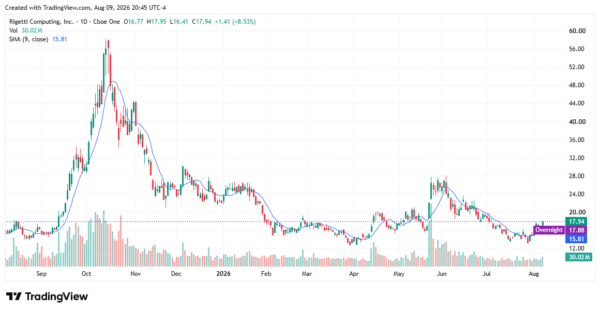
Rigetti’s quarter showed real commercial progress. Revenue climbed to $5.1 million, up 183% year-over-year, driven by sales of its on-premises Novera QPU systems. Gross margin improved to 43%, a meaningful jump from 31% a year earlier.
The headline development was a letter of intent with the U.S. Department of Commerce for up to $100 million in potential CHIPS Act funding. While not yet finalized, and likely to involve some equity issuance, the deal signals government confidence in Rigetti’s superconducting chiplet approach.
Rigetti also expanded its partnership with Hewlett Packard Enterprise and the Pittsburgh Supercomputing Center to build a hybrid quantum-classical system. The company reaffirmed its three-year target of reaching roughly 1,000 qubits. With $541.3 million in cash and no debt, Rigetti has a runway to continue investing in its roadmap as revenue scales.
D-Wave’s Bookings Signal Demand Ahead of Revenue
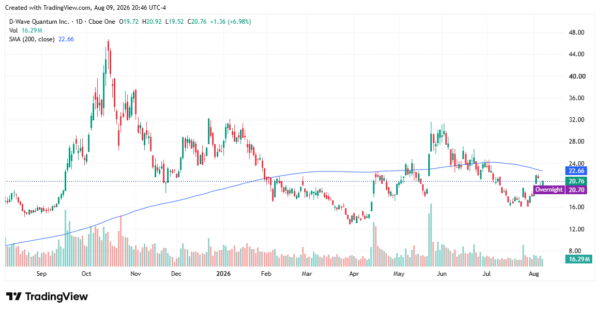
D-Wave’s results were more mixed. Quarterly revenue held essentially flat at $3.1 million, missing analyst expectations, and the stock fell after the report. Adjusted EBITDA losses widened as the company invested more heavily in product development and go-to-market spending.
The more encouraging figures sat beneath the headline number. Bookings jumped 59% year-over-year, and first-half bookings surged more than 1,120% compared to a year earlier. Remaining performance obligations rose sharply as well, suggesting stronger demand than current revenue reflects.
Management expects revenue to increase modestly in the third quarter, followed by a larger jump in the fourth quarter, driven by system shipments and installation work. D-Wave’s dual-platform strategy, offering both annealing and gate-model quantum computing, remains a differentiator. For investors, the question is whether that growing order backlog converts into revenue fast enough to justify patience.
Leave a Reply