
SpaceX (NASDSQ: SPCX) is quickly falling back to earth after a red-hot IPO. All after the company was forced to abort the launch of its highly anticipated Starship rocket just moments before liftoff, adding fresh uncertainty for investors following the company’s record-breaking initial public offering earlier this year.
Table of Contents
The company had planned to launch its Starship rocket during a 90-minute launch window beginning at 5:45 p.m. on Thursday from its Texas launch facility. However, the countdown came to an abrupt halt when an engine ignition issue triggered an automatic safety shutdown.
SpaceX founder and CEO Elon Musk quickly addressed the failed launch attempt in a post on X, explaining that the problem was detected before liftoff. “Some of the engines didn’t start, triggering an automatic launch abort,” Musk wrote. “Now offloading propellant. Next launch attempts hopefully in a few days.”
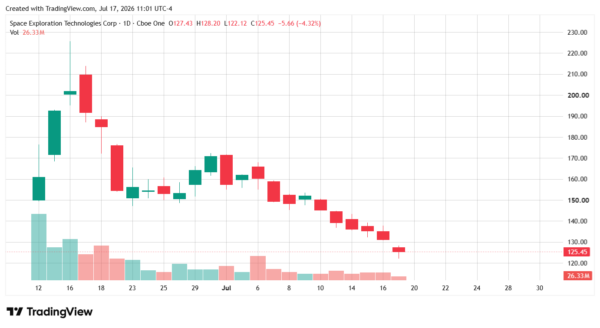
Investors reacted negatively to the setback.
Investors have been paying especially close attention to the performance of Starship following SpaceX’s blockbuster initial public offering in June. The company raised a record $85.7 billion in what became the largest IPO ever, pricing shares at $135 each. Since then, the stock has experienced significant fluctuations as investors weigh the company’s long-term growth prospects against the technical challenges associated with developing next-generation space transportation systems.
Starship remains central to SpaceX’s long-term strategy.
The reusable rocket system is designed to carry astronauts and cargo to destinations including the Moon and Mars while also supporting commercial satellite deployments and future deep-space exploration missions. The vehicle is widely regarded as one of the most ambitious aerospace projects ever undertaken, but its development has been marked by a series of high-profile test failures and engineering setbacks.
Although Thursday’s launch was canceled before liftoff, many analysts say such aborts to be a sign that the rocket’s safety systems functioned as intended. Modern launch vehicles are equipped with sophisticated monitoring systems that continuously assess engine performance and thousands of other parameters during the countdown. If an anomaly is detected, the system is designed to halt the launch rather than risk a catastrophic failure after ignition.
Even so, the delay highlights the complexity of developing the massive Starship launch system. Each Super Heavy booster is powered by dozens of Raptor engines that must ignite and operate in precise synchronization. Even a minor issue affecting one or more engines can force engineers to postpone a launch while the problem is investigated.
The latest setback follows another challenging Starship test flight earlier this year. During a previous launch attempt in May, the Starship upper stage failed to complete its planned mission after heading toward the Indian Ocean. Meanwhile, the Super Heavy booster was unable to execute a successful controlled landing in the Gulf of Mexico after five of its 33 Raptor engines failed to reignite during the landing sequence.
Despite the issues, Musk is confident.
Despite the market’s immediate reaction, Musk expressed confidence that the issue would be resolved quickly. By replacing the two affected Raptor engines and preparing for another launch attempt within days, SpaceX aims to demonstrate that the latest setback represents a routine engineering challenge rather than a significant obstacle.
All eyes will now be on next week’s planned launch attempt, which could provide both engineers and investors with a clearer indication of Starship’s progress as SpaceX continues working toward its long-term goal of making fully reusable spaceflight a reality.
Leave a Reply