
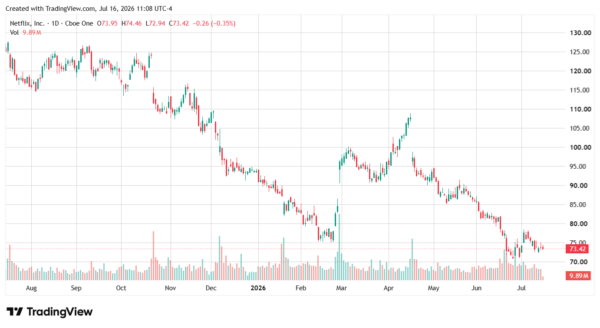
Netflix’s (NASDAQ: NFLX) latest earnings report gave investors a mixed picture. While the streaming giant continued to grow revenue, profits, and advertising sales, the results did little to excite Wall Street. Shares of Netflix fell more than 8% in after-hours trading as investors focused on the company’s cautious outlook and questions about future growth.
Table of Contents
For the second quarter, Netflix reported revenue of $12.56 billion, a 13% increase from the same period last year. That figure was just below analysts’ expectations of $12.59 billion. Earnings per share came in at 80 cents, slightly ahead of the expected 79 cents.
The company’s profit also improved. Net income reached $3.4 billion, up from $3.13 billion a year ago, showing that Netflix continues to benefit from higher subscription prices, steady membership growth, and increasing advertising revenue.
Price Increases Continue to Pay Off
One of the biggest drivers of Netflix’s financial performance has been its recent subscription price increases. Earlier this year, the company raised prices across all of its streaming plans. Management said those increases have performed as expected, with little impact on subscriber demand. Combined with continued membership growth and expanding advertising revenue, the higher prices helped offset slowing growth in new subscribers, a trend affecting much of the streaming industry.
Despite those positive results, investors were hoping for stronger guidance.
Netflix expects revenue to grow about 12% in the third quarter and said its outlook for 2026 remains largely unchanged. The company narrowed its full-year revenue forecast to a range of $51 billion to $51.4 billion, compared with its previous guidance of $50.7 billion to $51.7 billion. While the updated forecast reflects confidence in the business, it was not enough to satisfy investors looking for stronger growth projections.
Engagement Remains Under the Spotlight
Beyond revenue and earnings, analysts spent much of the earnings call asking about one important topic: viewer engagement.
Netflix said engagement remains healthy, with subscribers watching more than 97 billion hours of content during the first half of 2026. Live programming has become an increasingly important part of that success, helping drive subscriber sign-ups and keeping viewers engaged.
However, some recent reports suggested that audiences are increasingly abandoning Netflix series after the first season. Company executives pushed back against those claims.
Co-CEO Greg Peters said there is not a direct relationship between viewing hours and financial performance. “Not all viewing hours are created equal,” Peters explained, noting that some content generates significantly more value than others through subscriber retention and advertising opportunities.
Co-CEO Ted Sarandos also dismissed concerns that viewers are losing interest in returning series. He said second-season viewership has actually improved slightly compared with last year and that Netflix has no plans to change how it releases new shows.
Fewer Transparency Reports
Although Netflix defended its engagement numbers, it also announced a change that raised some eyebrows. The company said it will stop releasing its “What We Watched” engagement reports twice a year. Instead, beginning in 2027, the report will be published annually during the first quarter.
Netflix said separating the report from quarterly earnings will help investors focus more on financial performance rather than viewing statistics. Still, some analysts may see the move as reducing transparency into how audiences are consuming Netflix content.
The earnings report also addressed speculation about Netflix pursuing major acquisitions after reports surfaced that it had explored buying parts of Warner Bros. Discovery’s film and streaming business before walking away.
Executives reiterated that Netflix still prefers building its own business rather than acquiring competitors. Chief Financial Officer Spencer Neumann said the company maintains a “very high bar” for acquisitions and plans to continue investing primarily in its own content, technology, and selective business opportunities while maintaining a strong balance sheet.
What’s Next for Netflix
Unfortunately, the company’s outlook failed to impress investors looking for faster growth, sending shares sharply lower after the earnings release.
As subscriber growth across the streaming industry slows, Netflix is increasingly relying on advertising, live sports, and premium content to fuel its next phase of expansion. Whether those strategies can keep the company ahead of an increasingly competitive entertainment landscape will remain one of the biggest questions for investors over the coming year.
Leave a Reply