
One of the most dangerous words in investing isn’t bubble. It’s cheap. The moment a great company loses half its value, investors start circling with the same thought that it can’t possibly get any cheaper. That is how many investors fall into value traps.
Table of Contents
History encourages that instinct – buying Amazon (NASDAQ: AMZN) after a brutal selloff made fortunes, Apple (NASDAQ: AAPL) looked broken more than once before becoming the most valuable company on earth, and Microsoft (NASDAQ: MSFT) spent years going nowhere before Satya Nadella rewrote the entire trajectory of the business.
But markets have another habit investors forget when a stock they’ve watched for years suddenly goes on sale. Some companies never come back. So when does a cheap stock stop being a bargain and start becoming a value trap? Most investors answer with a price chart. I start with the business.
When a Cheap Stock Becomes a Value Trap
The biggest mistake investors make when a stock falls hard is assuming a lower valuation automatically creates a better investment. Intel (NASDAQ: INTC) is the cleanest example of why that assumption keeps destroying capital in portfolios that should know better.
For years, investors pointed to Intel’s forward earnings multiple as proof the market was irrationally ignoring a bargain. At various points it traded near 10-12x forward earnings. A steep discount to most of the semiconductor industry and screeners kept flagging it as one of the cheapest names in tech.
That’s where they fell into a value trap. Let me explain why the problem was never the multiple but the moat.
While investors anchored to Intel’s P/E ratio, the company was losing manufacturing leadership, falling behind in AI accelerators, and watching customers like Apple exit to design their own silicon. NVIDIA, meanwhile, was building an ecosystem around CUDA that locked developers and hyperscalers into a platform competitors couldn’t displace simply by offering similar hardware at a lower price.
Intel became cheaper because its competitive advantage contracted. NVIDIA stayed expensive because its competitive advantage expanded. Those are two completely different businesses wearing similar sector labels, and the P/E ratio was the last thing you should have been looking at to tell them apart.
Management Either Builds Tomorrow Or Defends Yesterday
Sometimes the business itself isn’t the problem, the people running it are.
A decade ago, Microsoft looked exactly like a mature technology company whose best years were behind it. Windows defined its entire identity, revenue growth had stalled, and the market had largely written off its chances of finding the next platform shift.
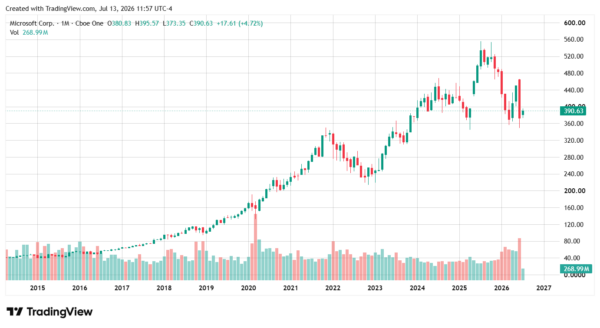
It looked like a value trap, and probably was. But then Satya Nadella took over in 2014 and made the decision that separated Microsoft from every other legacy technology company facing the same disruption: instead of protecting the businesses that had made the company wealthy, he rebuilt its entire future around cloud computing, subscriptions, and AI.
Annual revenue has since grown from roughly $93 billion to well over $280 billion. And investors smiled at the bank thanks to the management changing what the business was becoming before the market forced its hand.
Intel faced the same technological disruption during roughly the same period. Only one reinvented itself in time, and the stock charts of both companies since 2014 tell you everything. Whenever I study a beaten-down stock, I keep asking if management is building tomorrow’s company, or defending yesterday’s? That answer matters more than anything on the income statement.
Some Industries Change Faster Than Any Company Can Follow
This is where most value traps are born because the company can still look operationally sound while the ground underneath it shifts permanently.
Take PayPal (NASDAQ: PYPL) for example. During the pandemic, investors valued it as if it owned the future of digital payments. Today it trades at mid-teens on forward earnings, a fraction of its former multiple, and the easy conclusion is that the stock has become cheap.
My question is whether it deserves the valuation it earned when digital wallets were still an emerging category PayPal effectively defined. Today, Apple Pay, Google Pay, Block, Stripe, and modernized bank apps have collectively fragmented a market PayPal once owned by default. Digital payments are still growing. PayPal simply no longer controls the category it helped create, and a falling multiple on a business losing structural positioning isn’t value. It’s the market updating its opinion in real time.
The Market Is Never Wrong About The Multiple For Long
Professional investors spend surprisingly little time asking whether a stock is cheap and more time asking why, because valuation multiples aren’t random noise. They’re the market’s collective opinion about what a company’s future looks like relative to its present, and that opinion updates as the evidence does.
Sometimes the market becomes too pessimistic about a business that is genuinely healing, and multiple expansion follows as confidence returns. But the opposite also happens more often than most retail investors account for. A company keeps generating profits while the market steadily lowers the multiple it’s willing to pay, because the consensus has shifted on whether tomorrow will resemble yesterday at all. That’s multiple compression, and it can erase years of earnings growth while the income statement continues to look acceptable on the surface.
Keep this in mind, every cheap stock deserves three questions before it earns a place in your portfolio:
Has its competitive advantage weakened or expanded?
Has management adapted to the disruption it faces, or is it defending a position that no longer exists?
And has the industry changed faster than the company can follow?
Personally, how far a stock has fallen from its peak doesn’t really matter. I’m more focused on whether the business that once justified yesterday’s valuation still exists in a recognizable form today. Every great investment eventually becomes cheap at some point. Some cheap stocks eventually become great investments too. The distance between those two sentences is where most of the money gets lost.
Leave a Reply