
Palantir Technologies (NASDAQ: PLTR) is going to release its second-quarter earnings report next Monday after the closing bell. No one really knows with certainty what’s going to happen, let alone how the results and forward guidance will impact PLTR stock. However, given the ticker’s bearish cycle, prior historical trends following a similar situation have resulted in a near-term pop.
It’s an inductive analysis, banking on established patterns to ring true moving forward. Of course, the problem with any forecast involving a reflexive, non-determinative system like the equities market is that the law of nature cannot be guaranteed to repeat. Just because we observed a particular pattern recurring doesn’t mean that it can be 100% relied upon when we actually place our trade.
For a name like Palantir stock, it’s going to be even trickier to narrow down where the ticker could go. PLTR carries a 60-month beta of 1.56. Therefore, even though the underlying company — which made a name for itself in big data analytics and artificial intelligence — is a tech stalwart, its price discovery process is quite wild compared to the benchmark S&P 500.
Nevertheless, the presupposition that PLTR stock could be due for a comeback is arguably very reasonable. Shares have dropped 30.5% on a year-to-date basis, reflecting deep skepticism. However, Palantir has a strong history of earnings beats. For the upcoming disclosure, analysts are seeking earnings per share of 33 cents on revenue of $1.81 billion. If history is any guide, Palantir should be able to deliver the goods.
But that leaves the question of how PLTR stock may respond. Looking at the volatility skew for the options chain expiring Aug. 7, the volatility surface is structured in the shape of a smile. However, demand for far out-the-money (OTM) puts significantly exceeds that for OTM calls. So, while the smart money anticipates the possibility of big upside from Palantir, it’s also cognizant of severe downside risks.
PLTR Stock Could Benefit From a Volatility Cluster
No trader or institution knows where PLTR stock will go following the Q2 earnings print — that much is obvious from the volatility skew closest to the release date. But people can just throw their hands up in the air. They need some standard way of pricing options or derivatives. That’s where the Black-Scholes model comes into the frame.
Now, I’m not going to engage in an exegetical analysis of Black-Scholes and its elegant mathematical construction. What you need to know, though, is that this model is parametric. In other words, any output that comes out of the model cannot exceed the parameters defined by the formula. A different way of saying this is that an entity can’t outgrow itself.
One issue with this parametric model, then, is that price pathways are assumed to be continuous. In other words, if you start from Point A, the next step in the model is Point B, then Point C…you get the point. So, when all other factors are equal, the probability that the target security will rise from the starting point to the end destination decreases sequentially.
Suppose that the probability of moving from Point A to Point B is 65%. All other things being equal, you know that under this parametric model, the probability of going from Point A to Point C will necessarily be lower, perhaps 58%. That’s the continuous path assumption, and it is intuitive: the longer the shot from the basket, the lower the odds of success.
However, the real market doesn’t work that way. Instead, price paths often exhibit discontinuous behavior, especially in high-catalyst regimes such as earnings releases. In certain cases, the probability of moving from Point A to Point B could be the same as the probability of moving from Point A to Point C. Depending on the specifics of the options trade you’re looking at, you may be able to find favorably mispriced opportunities.
I’m harping on this issue because PLTR stock could soon benefit from a volatility cluster.
Exploiting an Order Flow Imbalance for Palantir Stock
As I’ve expressed in prior StockEarnings articles, one of my key presuppositions is that order flow imbalances often trigger a reflexive response by the market. Assuming that a similar response plays out, we may be able to exploit likely trends before they materialize.
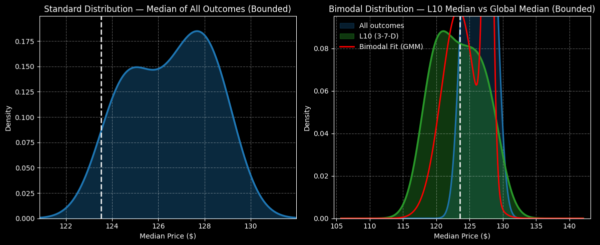
Obviously, PLTR stock has suffered a severe order flow imbalance. Quantitatively, PLTR has printed only three up weeks in the past 10 weeks, leading to a downward slope. Having identified this 3-7-D sequence, we’re going to look back to its price history and uncover how previous such signals responded.
The nuance here is that over the next 10 weeks, the 3-7-D sequence actually leads to a lower median return than what would be expected under random conditions. That’s not great if you were planning on holding Palantir stock for two months. But historically, there is expected to be a volatility cluster over the next three weeks — and that’s what I’d like to take advantage of.
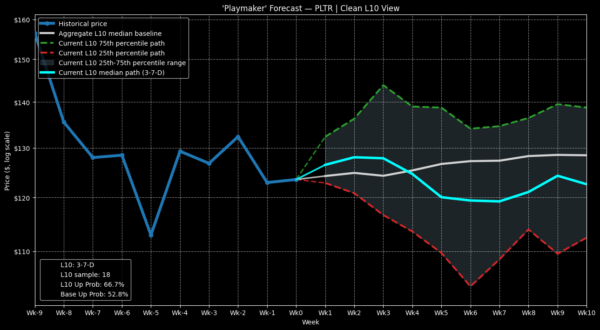
Generally speaking, we’re looking at a volatility cluster with a median impact of about 2.8% up. Given Tuesday’s close of $123.53, a rational target is to aim for the $127 price level at the end of Aug. 14.
Identifying an Intriguing Idea
Because we’re talking about a highly speculative trade, I’m looking at the 125/127 bull call spread expiring Aug. 14. While the maximum payout is only 90.48%, the net debit required per spread is only $105. If things go sideways, you’d be risking a few bucks over a Benjamin.
However, the highlight of the trade in my opinion is the breakeven price of $126.05. According to the Black-Scholes model, the probability of profit (of hitting this threshold) is only 45.2%. But because my model anticipates a volatility cluster around this timeframe, I believe the risk assigned is much higher than is historically justified.
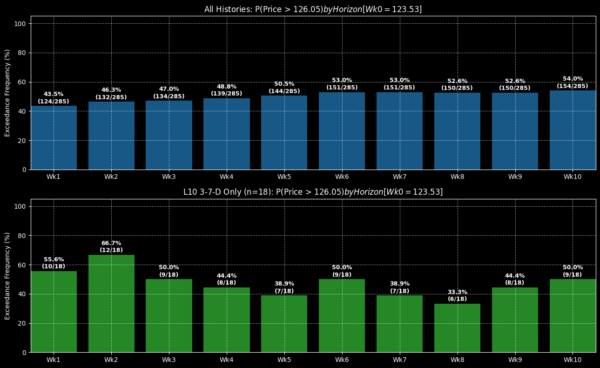
Of the 18 times that the 3-7-D signal has flashed. PLTR stock has exceeded the equivalent of the $126.05 breakeven price a total of 12 times on week 2 (between Aug. 7 and Aug. 14). Therefore, the conditional, observed probability of profit could actually be 66.7%.
A sharp cautionary note is that, because of the extremely small sample size, this probability should not be taken as gospel truth. Still, Palantir stock has exhibited discontinuous behavior in the near term whenever it has encountered severe bearish cycles. So, if you’re willing to speculate, there’s a mathematical incentive to consider the above bull spread.
Leave a Reply