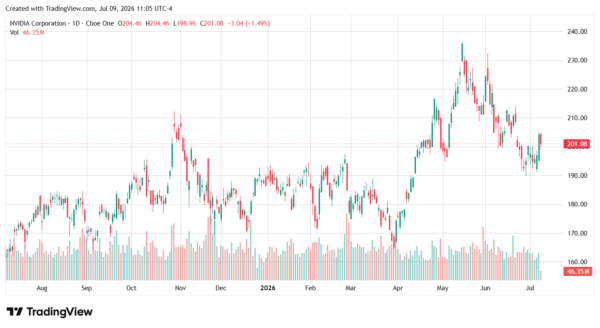
Artificial intelligence stocks recently hit an unexpected rough patch as investors sold off many of the market’s biggest AI winners. The pullback erased billions of dollars in market value and left many wondering whether the AI boom had finally started to lose steam.
Table of Contents
NVIDIA (NASDAQ: NVDA) CEO Jensen Huang doesn’t see it that way.
Instead, he believes the recent weakness is a buying opportunity because the AI revolution is still in its early innings. “The buildout of artificial intelligence has just begun,” Huang said.
His confidence isn’t just based on optimism.
AI Infrastructure Spending Remains Strong
NVIDIA remains the dominant supplier of the chips powering today’s AI infrastructure, and demand for its newest products continues to be strong. The company’s GB300 systems, built on its Blackwell architecture, are now shipping in large volumes.
Demand is coming from several directions. Hyperscale cloud providers are spending billions to expand their AI capabilities, governments are investing in sovereign AI projects to strengthen domestic computing power, and businesses across multiple industries are deploying increasingly complex AI applications that require more powerful hardware.
That demand is showing up in NVIDIA’s financial results. Its data center business grew about 66% year over year, a sign that spending on AI infrastructure remains healthy. Looking ahead, Nvidia expects its fiscal 2026 data center revenue to reach roughly $190 billion, representing growth of about 65%.
Why Investors Are Divided on AI Stocks
Some investors believe AI stocks have become too expensive after several years of massive gains. Heavy spending by large technology companies and uncertainty about future returns have made some investors more cautious.
Others see today’s spending much differently.
They compare it to the early days of the internet, when companies poured billions into building infrastructure that initially seemed excessive. Over time, demand caught up, and those investments became the foundation of the modern digital economy. From that perspective, today’s AI data centers, advanced chips, and networking equipment could become the backbone of tomorrow’s economy.
Huang Believes AI Will Become Essential Infrastructure
He has repeatedly argued that artificial intelligence will become essential infrastructure, much like electricity or the internet. If that’s true, today’s massive investments are simply laying the foundation for decades of future growth. Under that view, market pullbacks are a normal part of a long-term trend—not a sign that the AI boom is over.
Of course, investors have heard bold predictions from technology leaders before.
History shows that even revolutionary technologies can go through painful corrections before delivering on their long-term potential.
NVIDIA also isn’t without challenges.
Competition is increasing as rival chipmakers develop their own AI accelerators. At the same time, major cloud providers are investing heavily in custom chips to reduce their reliance on NVIDIA’s GPUs. And eventually, companies spending billions on AI infrastructure will need to show those investments are producing meaningful returns.
Still, NVIDIA has important advantages.
Its combination of industry-leading hardware, a mature software platform, and one of the largest AI developer ecosystems creates high switching costs for customers. That ecosystem remains one of NVIDIA’s biggest competitive strengths.
Is the AI Selloff a Buying Opportunity?
Whether Jensen Huang is right will ultimately depend on how quickly AI adoption continues to grow. If businesses, governments, and consumers keep embracing AI at the current pace, today’s market volatility could end up looking like a temporary pause in a much bigger growth story. If spending slows or companies struggle to generate returns on their AI investments, recent concerns about inflated expectations may prove justified.
For now, Huang is sticking with a simple view: artificial intelligence is still in its infancy, and the massive infrastructure buildout needed to support the next generation of AI applications is only getting started.
Leave a Reply