
Morgan Stanley (NYSE: MS) reported Q2 earnings with record net revenues of $21.3 billion for Q2 2026, up 27% from $16.8 billion a year ago, with EPS climbing 62% to $3.46 from $2.13, ROTCE hitting 26.6% versus 18.2%, and pre-tax income surging 59% to $7.3 billion.
Table of Contents
The expense efficiency ratio dropped from 71% to 65%, meaning the firm extracted more revenue from every dollar of cost it ran through the business. On paper, this looks like a firm that simply had a great trading quarter with trading equity up 69% in a volatile market.
However, the more eye-opening story is just one layer deeper, and I think most investors are going to miss it entirely.
Equities Fed The Entire Machine.
Institutional Securities generated $11.0 billion in net revenues against $7.6 billion a year ago, with Equity revenues alone hitting $6.3 billion – up 69% from $3.7 billion – driven by record performance across businesses and regions, with particularly notable strength in Asia. Investment Banking contributed $2.4 billion, up 58% from $1.5 billion, powered by a surge in IPOs, follow-on offerings, convertibles, and M&A advisory activity concentrated in the Americas. Fixed Income added $2.5 billion, up 13%.
Most people will stop there and call this a trading story. After all, a combination of volatile market and elevated client activity means Morgan Stanley (NYSE:MS) wins. But that’s incomplete, because what happened inside Institutional Securities this quarter didn’t just stay inside Institutional Securities.
Wealth Management pulled in $148.1 billion in net new assets during the quarter, compared to $59.2 billion a year ago, a 2.5x increase that management didn’t fully headline but absolutely should have. The detail buried in the Q2 release is the one that changes everything: just over half of those inflows came from IPO-related activity through the Workplace channel. The investment banking machine underwriting deals on the institutional side directly manufactured asset inflows on the wealth management side, in the same quarter, with the same clients moving through both pipelines simultaneously.
Yes, this is Ted Pick’s Integrated Firm thesis producing actual, measurable results and it’s the story the headline EPS number obscures rather than reveals.
Wealth Management Hit $10 Trillion
Wealth Management generated $8.9 billion in revenues, up 14% from $7.8 billion, with a pre-tax margin of 30.5% and fee-based client assets reaching $3.0 trillion against $2.5 trillion a year ago. Total client assets across Wealth and Investment Management crossed the $10 trillion milestone this quarter, a number Ted Pick specifically highlighted in his opening remarks.
The composition of that $148 billion in net new assets matters as much as the size. Fee-based asset flows came in at $39.1 billion for the quarter, and net interest income increased to $2.3 billion from $1.9 billion as sweep deposits grew and the lending book kept compounding. Asset management revenues hit $5.3 billion against $4.4 billion a year ago. This is a business that actively converts institutional relationships into recurring wealth management revenue, and the connection between the two is becoming more structural with every passing quarter.
Investment Management contributed $1.6 billion in revenues, essentially flat, but AUM reached $2.0 trillion against $1.7 trillion, with $7.5 billion in long-term net flows. Steady, not spectacular, but exactly what you want from the segment that anchors the recurring revenue base.
The Chart Is Setting Up A Decision Point
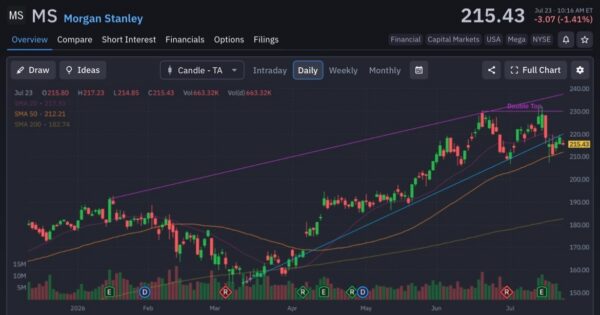
Morgan Stanley trades at $215.43 as of July 23, sitting between the 50-day moving average at $212.21 and the 20-day at $217.93, with the 200-day well below at $182.74, confirming the long-term uptrend remains structurally intact.
The chart shows a double top formation that printed near $230 earlier in the year, followed by a controlled pullback that found support at the rising 50-day average, with today’s price attempting to hold just above it on volume of 663,320 shares. A relatively contained session given the magnitude of the earnings beat.
The double top is the honest part of this picture. It tells you the market tested $230 twice and couldn’t hold it, which means sellers were waiting at that level with enough conviction to establish real resistance. The question isn’t whether the fundamentals justify a higher price, the 62% EPS growth and the $10 trillion AUM milestone suggest they do. The question is whether the institutional buyers defending the 50-day are strong enough to absorb whatever supply comes from investors who bought the first top and are looking for their exit.
How I’m Thinking About This
This quarter convinced me that Morgan Stanley is becoming harder to analyze as a traditional investment bank.
The market still tends to judge the company through the lens of investment banking fees and trading revenue. Those businesses remain cyclical by nature. They depend on market activity, capital raising and client engagement.
What stood out this quarter is that those businesses are serving another purpose.
Institutional Securities is generating relationships that become Wealth Management assets. Those assets then produce recurring advisory fees, lending income and asset management revenue that compound long after the original transaction has closed. That’s a fundamentally different earnings model from simply producing another strong trading quarter.
To me, that’s the real significance of this earnings release.
The record revenue, record EPS and record profitability are impressive, but they’re outcomes, not the story itself. The story is that Morgan Stanley’s Integrated Firm strategy is no longer an aspiration management discusses on conference calls. It’s beginning to show up in the numbers.
That’s what makes this quarter important. Exceptional trading environments come and go. Businesses that consistently convert transactional relationships into recurring assets tend to become more valuable over time.
Based on this quarter, Morgan Stanley looks more like the latter.
Leave a Reply