Undeniably, Cisco Systems (NASDAQ: CSCO) ranks among the top surprises on Wall Street this year. Since the January opener, CSCO stock gained almost 44%, a remarkable performance for a previously boring enterprise. However, this label quickly changed due to explosive demand for its AI data center networking gear.
Table of Contents
Of course, all good things must come to an end — or at least a correction. In the case of CSCO stock, the tech ticker is down nearly 9% in the trailing month and is more than 7% below parity relative to the past five sessions. Nevertheless, because the modern equities market is largely algorithmically driven, it’s very possible that major institutions could quantitatively view CSCO as a discount.
Fundamentally, the primary reason why Cisco stock tumbled recently appears to be related to post-rally profit-taking and valuation exhaustion. Following its stellar fiscal third-quarter earnings report in May — where Cisco raised its full-year AI infrastructure order forecast to $9 billion — the security logged its biggest single-day gains in decades. However, that massive rally stretched Cisco’s valuation well beyond its historical norms.
I’m not a big fan of using commonly cited financial metrics as a mechanism to forecast future events. But as a post-hoc rationalization, there is something to be said about the multiple compression as CSCO stock well-exceeded prior norms. And while it’s a subjective view, institutional discounted cash flow (DCF) models implied a fair value closer to $109 to $119 per share.
Volatility Skew Highlights an Interesting Nuance for CSCO Stock
You should note that Cisco is set to release its next earnings report on Aug. 12. It’s interesting that the weekly options chain just ahead of disclosure — the expiration date of Aug. 7 — features a volatility skew aligned in the shape of a “smile.” Ordinarily, if the market were fearful of a downturn, you would see a “smirk,” meaning that smart money traders would pay a higher premium for out-the-money (OTM) puts than OTM calls.
With Cisco stock, you have traders paying heightened premiums for both downside protection and upside convexity; hence, elevated volatility readings on both sides of the scale (thus creating the smile shape). Probabilistically, we can’t prove anything from the volatility skew but it does show that traders are cognizant of the potential for CSCO to swing higher.
In other words, just because some folks buy more auto insurance coverage doesn’t necessarily mean that they’re more likely to get involved in a car wreck. But it strongly indicates that these buyers are more concerned about such risks and want the comfort/security of additional coverage. A similar framework can be centered around Cisco stock.
No one’s saying that the volatility skew is predicting a rebound. What it is saying (as a reasonable inference) is that traders — while engaging in standard risk management — don’t want to be caught unawares if CSCO stock does end up swinging higher.
Leaking an Important Takeaway for Cisco Stock
One of the important takeaways from the volatility skew — aside from the implied meaning behind the hedging activities — is that it demonstrates that the smart money is transactionally sophisticated, not necessarily prescient. That’s an important distinction because the common assumption is that the smart money is better at predicting future outcomes.
I don’t think so. Otherwise, the whole point of the volatility skew — a reflection of the insurance demand that the smart money is buying or selling — simply evaporates. If you consistently could tell the future, you wouldn’t need to buy countervailing options to protect yourself against an anomalous market movement. Since nobody has a crystal ball, risk management through advanced options trading is a thing.
This dynamic also gives us retail traders an important clue: we stand on relatively level ground when it comes to forecasting what might happen next. In contrast, we cannot play the information latency game because we’re always downstream to the data flow. If you’re reading about a blue-chip opportunity in a financial newsletter, there’s a high probability that you’re already too late.
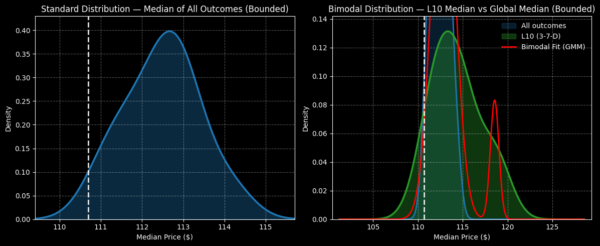
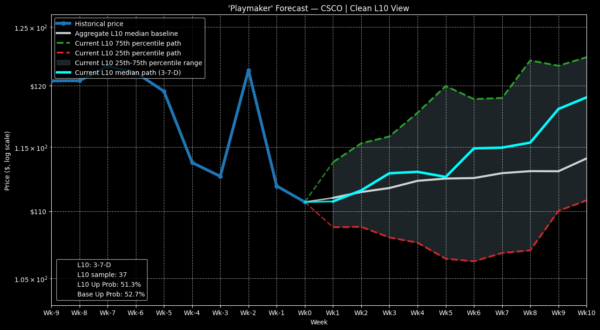
Getting back to CSCO stock, the ticker — as I mentioned earlier — is currently stuck in a downdraft. Quantitatively, in the past 10 weeks, CSCO printed only three up weeks, thus leading to a negative slope. However, this 3-7-D sequence — which has materialized 37 times on a rolling basis since January 2019 — offers a critical advantage: historically, the security has performed better than the random baseline when this signal has flashed.
Specifically, the expected forward 10-week distribution of Cisco stock is between $105 and $124, with probability density peaking at around $113. In contrast, the distribution of outcomes under random conditions is between $109.50 and $115.50, with peak probability density at roughly $112.60.
Notably, the performance variance between the signal and the random baseline is not perfectly orderly and linear. A narrowed takeaway is that on week 3 following the flashing of the 3-7-D signal, the expected median endpoint is about 1.98% up, the nominal equivalent of $112.90.
Playing the Inductive Game
If we’re strictly playing the numbers, the 110/113 bull call spread expiring Aug. 7 is appealing. First, we avoid the crazy volatility dynamics of a post-earnings disclosure that could send CSCO stock in either direction. Second, based on an inductive analysis, CSCO has a solid chance of rising through the $113 second-leg strike at expiration.
Even better, this options spread may be mispriced in your favor. Currently, this spread has a breakeven price of $111.70 and Wall Street gives traders a probability of profit of 46.3% that Cisco stock will meet this threshold at expiration. However, the vulnerability of these odds is that they represent a theoretical output.
Probability of profit metrics stem from an implied volatility figure that is plugged into the Black-Scholes model. Ultimately, the probability represents the distance in standard deviations that the target price is from the spot price. But because Black-Scholes is a deterministic formula, the answer that it spits out cannot exceed the formula’s parameters.
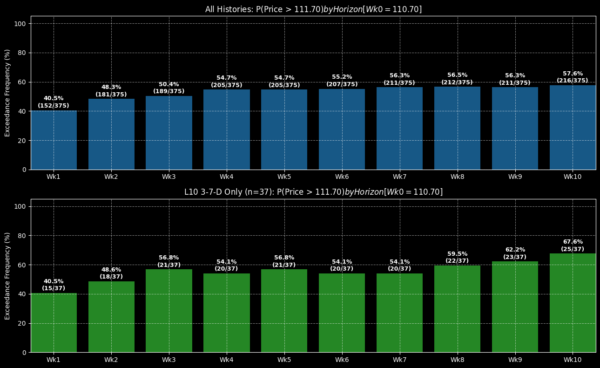
My model is different because I don’t impose parameters; instead, I simply ask how CSCO stock responds given specific changes in its order-flow balance. Under a 3-7-D regime, CSCO typically mean reverts in the positive direction.
In this case, of the 37 times that the aforementioned signal has flashed, Cisco stock has risen above the equivalent of the $111.70 breakeven price a total of 21 times on week 3 (Aug. 7). Subsequently, it’s possible that the observed, empirical probability of profit is 56.8%, more than a thousand basis points higher of free odds.
Leave a Reply