Lockheed Martin Corp (NYSE: LMT) reported second-quarter sales of $20.1 billion, up 11% year-over-year, with diluted EPS of $7.94, $2.9 billion in free cash flow, $65 billion in new orders, and a record $230 billion backlog… numbers strong enough to send the stock surging 10.54% to $568.59 on 3.28 million shares, one of the heaviest trading sessions of the year.
Table of Contents
The headline read exactly as investors expected from a defense contractor riding elevated global military spending.
But here’s the thing, for the better part of two years, the debate surrounding Lockheed Martin centered on one question: would governments sustain elevated defense spending once geopolitical tensions eventually cooled, or would today’s order books prove temporary?
This quarter makes that question feel outdated because a $230 billion backlog isn’t projected demand, but a contracted work. Management then spent more time discussing production agreements, manufacturing partnerships, and munitions ramps than convincing investors demand still exists, and that shift in emphasis tells you more about where this business actually stands than any single metric in the release.
Why The Factory Must Come Alive Now
The clearest evidence of that shift is where the backlog is growing. Missiles and Fire Control backlog nearly doubled to $87.9 billion from $46.7 billion at the end of 2025, accounting for more than the entire increase in Lockheed’s consolidated backlog during the first half of the year alone. Segment sales rose 19% to $4.1 billion, driven by higher production on PAC-3, THAAD, and the Precision Strike Missile program, and none of those are new demand signals. They’re production signals, confirming that the commercial argument has already been won and the industrial argument is only now beginning.
Jim Taiclet reinforced that framing throughout the earnings release. Alongside the $35 billion multi-year THAAD contract announced earlier this year, he highlighted the company’s agreement with Rheinmetall to co-produce ATACMS in Europe and its collaboration with General Motors Defense to expand manufacturing capabilities. A CEO who is negotiating co-production agreements across multiple continents is not a CEO still selling the product. That’s a dedicated chief trying to build enough of it, and as such, it carries real investment implications because winning contracts only creates backlog, but expanding production capacity determines how fast that backlog converts into revenue, cash flow, and shareholder returns.
Market Just Repriced The Business
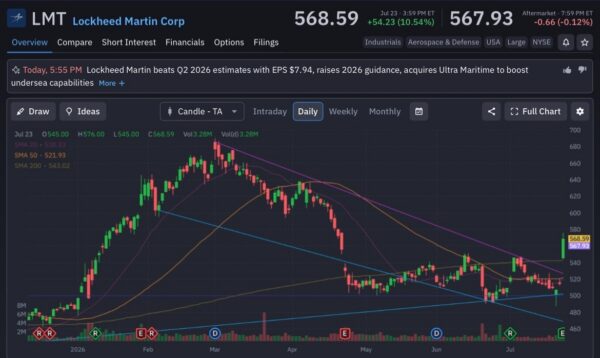
Lockheed Martin (NYSE: LMT) spent most of the past five months trapped in a downtrend that rejected every meaningful rally attempt. The 20-day moving average at $520.33 and the 50-day at $521.93 acted as consistent overhead resistance as institutions questioned whether defense spending had peaked after an extraordinary multi-year run. The stock made a series of lower highs from the March peak near $680, and each bounce into the declining moving averages met sellers who weren’t yet convinced the execution story justified a higher price.
Thursday’s session changed that picture decisively. Shares opened at $545.00, ran to an intraday high of $576.00, and closed at $568.59 on 3.28 million shares, volume that dwarfs every session visible on the daily chart and confirms this wasn’t retail enthusiasm chasing an earnings headline. Institutions were repricing the business. The stock sliced through both the 20-day and 50-day moving averages in a single session, closing well above both, while the 200-day at $543.02, which had acted as a gravitational floor during the deepest part of the decline, now sits below current price as potential support rather than resistance.
The next meaningful test sits near the declining long-term trendline in the high-$570s to low-$580s, where the stock found sellers repeatedly since March. Clearing that level would complete a decisive structural break from the multi-month downtrend and shift the conversation from whether the stock deserves to recover toward whether it deserves to make new highs.
How I’m Playing This
I’ll be direct about where I stand. The demand debate is already settled. What I’m watching now is the execution debate, which is only beginning, and I think that’s the more interesting investment question for the next several quarters.
What I find most compelling about Taiclet’s commentary is what he didn’t spend time on. He didn’t defend demand. He didn’t cite geopolitical tailwinds or argue that defense budgets would remain elevated. He talked about production agreements, co-manufacturing partnerships, and capacity expansion, the language of a company whose biggest bottleneck has moved from the sales floor to the factory floor. That’s exactly the phase transition I want to own in a defense contractor, because it means incremental revenue growth no longer requires incremental selling, it requires incremental building.
The breakout above the 20-day and 50-day on record volume tells me institutions agree with that read. I’d be comfortable owning Lockheed at current levels with the 200-day at $543.02 as the first meaningful support to watch on any pullback, and the declining trendline near $580 as the level that determines whether this is a sustained re-rating or simply a post-earnings pop. If the stock consolidates above the moving averages over the next couple of sessions, the structure is clean enough to hold with conviction. The execution debate is just beginning and so is the next phase of this chart.
Leave a Reply