
Kinder Morgan (NYSE: KMI) just delivered a second-quarter earnings report that midstream investors shouldn’t ignore. The pipeline giant posted record net income of $867 million, up 21% year-over-year, alongside adjusted EPS of $0.37, a 32% jump from a year ago. That’s the kind of growth story usually reserved for tech names, not “boring” pipeline operators.
Table of Contents
While traders chase AI infrastructure plays, Kinder Morgan compounds cash flow through fee-based contracts tied to natural gas demand. The company’s $9.6 billion project backlog dwarfs many peers, and management now expects to beat its full-year Adjusted EBITDA budget by more than 5%.
The board also approved a dividend increase to $0.2975 per share, a 2% bump, continuing a pattern of steady payout growth. For income investors, that combination of earnings acceleration and rising dividends is rare.
This report also reinforces a broader thesis: midstream energy infrastructure could be the forgotten leg of the AI power trade. Data centers need electricity, electricity increasingly comes from natural gas, and natural gas needs pipelines. Kinder Morgan sits at that intersection.
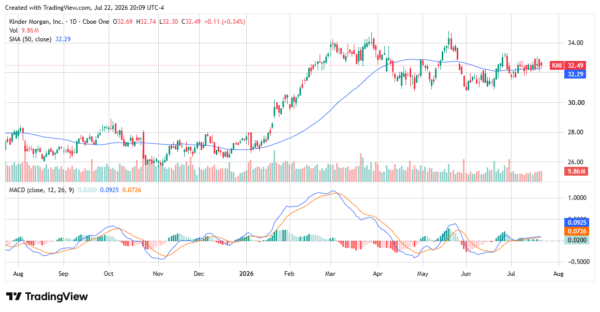
Shares reacted modestly after the report, trading near $32.49, just above the stock’s 50-day moving average. But the fundamentals point to a company executing better than the market currently prices in — and that gap may not last.
Record Earnings Growth Signals Underappreciated Momentum
Kinder Morgan’s second quarter wasn’t just solid. It was the best second quarter in company history. Net income hit $867 million, and Adjusted EBITDA reached $2.199 billion, up 12% from last year.
Executive Chairman Richard Kinder pointed to rising LNG exports and power demand as tailwinds. CEO Kim Dang echoed that, citing $2 billion in operating cash flow and $1 billion in free cash flow for the quarter.
Natural gas transport volumes climbed 7%, while gathering volumes surged 26%, led by the company’s KinderHawk system. These aren’t one-time gains. They reflect structural demand growth tied to LNG exports and data center power needs.
For a company often labeled “slow and steady,” this is genuine acceleration. That’s the part of the story many investors are still missing.
A Backlog That Outpaces the Sector
Kinder Morgan ended the quarter with a $9.6 billion project backlog, even after placing roughly $660 million of projects into service. Nearly 92% of that backlog is natural gas-related, and most of it supports power generation demand.

That backlog matters because it’s essentially locked-in future earnings. Management expects an aggregate first-year EBITDA multiple of about 5.6 times on the remaining $8.5 billion. Few midstream peers can point to a pipeline of projects this large, this visible, or this tied to a durable demand driver like electricity generation.
Combined with a Net Debt-to-EBITDA ratio of 3.6 times, near the low end of its target range, Kinder Morgan has room to keep funding growth internally.
Technical Setup: Stock Consolidating Near Support
KMI shares have traded in a range near $32 to $34 since May, after a strong run from below $28 late last year. The stock currently sits at $32.49, just above its 50-day moving average of $32.29.
The MACD line remains near flat, suggesting the stock is consolidating rather than trending strongly in either direction. Volume has moderated compared to the sharp rally earlier in 2026.
This pattern often precedes a breakout once a catalyst arrives. Earnings, paired with a dividend hike, could serve as that trigger if buyers step back in above the moving average.
Why KMI Belongs on Investor Watchlists
Kinder Morgan’s combination of earnings growth, dividend increases, and a record backlog makes a compelling case that midstream stocks deserve more attention this earnings season. The stock also offers ETF exposure through funds like the Global X MLP & Energy Infrastructure ETF (NYSEARCA: MLPX), where Kinder Morgan represents roughly 7.5% of holdings, alongside peers like Enbridge (NYSE: ENB) and TC Energy (NYSE: TRP).
Whether investors buy KMI directly or through diversified midstream ETFs, the underlying thesis remains the same. Natural gas infrastructure is becoming AI infrastructure, and Kinder Morgan is positioned at the center of that shift. For investors overlooking the sector, this earnings report is a reminder to reconsider that idea.
Leave a Reply