
Vision always gets sold first. That’s what investors buy into. The promise of a bigger future, a larger market, a revolutionary product. But after a while, execution decides whether they keep buying… or quietly head for the exit.
Table of Contents
That’s the thought I couldn’t shake after reading Meta Platforms (NASDAQ: META)‘s second-quarter earnings.
A few days ago, I wrote that I wasn’t looking for another ambitious AI vision from Mark Zuckerberg. Revenue and EPS were never going to settle the debate. What I wanted was specificity – a named business, a monetization roadmap, something concrete that proved Meta’s AI infrastructure was beginning to evolve from a massive cost center into a measurable revenue engine.
I didn’t get that. Instead, Meta reported another excellent advertising quarter. Revenue climbed 28% to $60.8 billion, easily demonstrating that the core business remains one of the strongest cash-generating machines on the planet. Yet earnings per share fell 13% to $6.18, operating margin contracted from 43% to 31%, and the stock responded by erasing roughly 10% of its value overnight. And now, investors are beginning to question how much longer they’re expected to finance it before seeing something more tangible.
CAPEX Is Smothering Meta’s Cash Machine
One thing became obvious as I worked through the earnings release. The business is producing more cash than ever, yet shareholders are seeing less of it.
Yeah, it was an outstanding quarter as revenue climbed 28% to $60.8 billion, daily active people reached 3.60 billion, ad impressions increased 14%, and the average price per ad rose another 12%. AI is clearly making Meta’s core products more engaging and more valuable to advertisers. On that front, Zuckerberg deserves credit…until the financial statements take a sharp turn.
Capital expenditures reached $31.08 billion during the quarter, almost matching the $31.86 billion generated from operating activities. The result was free cash flow of just $784 million, down dramatically from $8.55 billion in the same quarter last year. At the same time, operating margin compressed from 43% to 31%, while earnings per share fell 13% despite the surge in revenue..
None of those investments are difficult to understand. The market knows Meta is building AI infrastructure at a pace few companies can match. However, it has failed to answer my questions before the earnings; when does all of this stop looking like investment and start looking like a new, money-making business? Because until investors can point to a product, a revenue stream or a commercial timeline that connects today’s spending with tomorrow’s returns, every additional billion dollars risks feeling less like progress and more like another promise.
Even Patient Investors Eventually Get Tired
For the better part of three years, shareholders have been asked to look beyond today’s numbers and focus on tomorrow’s possibilities. First it was the metaverse. Then generative AI. Now it’s the next wave of opportunities those investments are expected to unlock. Each quarter extends the timeline just a little further, while asking investors to remain just as convinced as they were before.
That bargain becomes harder to accept with time. The market can be forgiving when it believes a destination is getting closer. It becomes far less generous when every milestone feels like another sign pointing to a place that’s still miles away. That’s why this earnings reaction felt different to me. I didn’t see investors rejecting Meta’s vision. I saw them growing weary of waiting for the vision to become something they could measure.
I came across one investor who summed it up better than any earnings model could. “Meta can’t keep asking shareholders to buy another idea. Eventually, the ideas have to start introducing themselves as businesses”. And that’s exactly the mood every bull is wrestling with today – the quiet, longing exhaustion that comes from believing in a story for so long that you begin checking your watch instead of the horizon.
The Chart Is Waiting For Zuckerberg Too
Meta’s fundamentals and its stock have been telling two different stories for months.
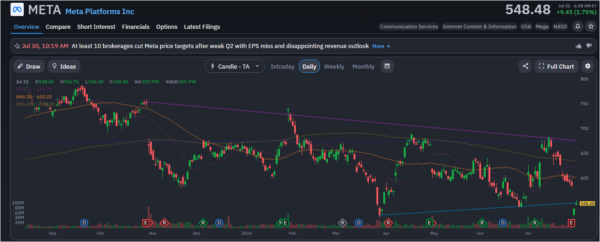
Since February, every meaningful rally has run into the same descending trendline before losing momentum. Buyers keep showing up, but they haven’t shown up with enough conviction to change the trend. The latest earnings reaction only reinforced that pattern. The stock gapped nearly 10% lower, lost both its 20-day and 50-day moving averages, and once again found itself leaning on a rising support trendline that’s been holding the longer-term uptrend together.
If investors had genuinely concluded Meta’s spending spree was a mistake, I’d expect a far uglier technical picture. Instead, every sharp decline over the past six months has eventually attracted buyers, while every rally has run into sellers asking for the same thing: proof. The result is a stock trapped between optimism and evidence.
Sooner or later, one side wins. If Zuckerberg starts connecting today’s investment with tomorrow’s revenue in a way the market can actually measure, this chart has plenty of room to resolve higher. If not, another quarter of exceptional vision may simply produce another quarter of exceptional patience.
At this point, long-term Meta investors probably deserve a support group. Every quarter asks them to fund another ambitious idea while waiting for the last one to mature.
Don’t get me wrong, Meta is still a great business. And great businesses sometimes frustrate shareholders before they reward them. But after this quarter, I completely understand why investors are becoming restless. At some point, the market stops applauding another brilliant vision and starts asking to see the invoice. Until Zuckerberg replaces possibility with proof, I suspect patience – not advertising – will remain Meta’s most valuable asset.
Leave a Reply