
Charles Schwab Corp (NYSE: SCHW) Q2 earnings looked like another straightforward beat. Adjusted EPS came in at $1.62, revenue reached a record $7.1 billion, and client activity remained exceptionally strong. The easy conclusion, the one investors have reached for the past two years, is that higher interest rates continue to support Schwab’s earnings power.
Table of Contents
I think that interpretation is becoming outdated, and this quarter gave me enough evidence to say so directly.
The Schwab investors worried about in 2023 was heavily dependent on net interest revenue, and the valuation reflected that single-variable risk.
The Schwab that reported this quarter is monetizing something far more valuable than a rate environment: a $13.1 trillion client base with penetration levels across most product categories that are still a fraction of the industry average.
No wonder Management spent little time arguing for a rate story in the Q2 earnings release and Summer Business Update. While they spent most of it talking about deeper client engagement, broader product adoption, and the significant runway remaining to increase wallet share from relationships that already exist on the platform.
The Market Is Still Pricing The Wrong Charles Schwab
For most of the past two years, Schwab’s valuation has been anchored to one question: what happens to earnings when interest rates fall?
That framing made sense when net interest revenue appeared to be the primary driver of profitability. This quarter showed a business generating growth from multiple directions simultaneously, and the composition of that growth matters as much as its size.
Net interest revenue increased 19% year-over-year. Asset management and administration fees rose 16%. Trading revenue jumped 28% as daily average trades reached a record 11.9 million. Core net new assets totaled $118.7 billion, reflecting client engagement that remains exceptionally healthy well into the second year of a rate normalization cycle that was supposed to compress the earnings story significantly. None of those revenue streams depend on identical economic conditions, and that diversification deserves a different valuation treatment than concentrated revenue does. The more independent earnings engines a business develops, the less a single macro variable should determine its multiple, and I don’t think Schwab’s current multiple fully reflects how much that mix has changed.
Lending Penetration
The most revealing figure in Schwab’s presentation wasn’t revenue growth or EPS. It was lending penetration, and management’s framing of it deserves more attention than it received.
Bank lending balances have grown from roughly $50 billion to $67 billion over the past year, a 33% increase that most companies would headline aggressively. Charles Schwab Corp (NYSE:SCHW) highlighted it as evidence of how much opportunity still remains because lending penetration sits at approximately 1% of client assets against an industry average closer to 4%.
A company sitting on $13.1 trillion in client assets and 48 million brokerage accounts, operating at one-quarter of the industry’s average lending penetration rate, doesn’t need to acquire millions of new customers to compound earnings meaningfully. It needs existing clients to do one more thing with their relationship, and then another, and the math on that compounding is considerably more powerful than customer acquisition at scale.
Lending is one example. Managed investing is another. The same logic applies to trust services, estate planning, alternatives, and the broader advisory capabilities highlighted throughout the Summer Business Update. Each additional service added to an existing relationship generates revenue without restarting the expensive process of customer acquisition, and the aggregate opportunity across $13.1 trillion in assets is the kind of number that justifies a structural re-rating rather than a cyclical one.
Platforms Compound Faster Than Brokers
One slide from management’s presentation captured Schwab’s strategy better than any quarterly metric. It wasn’t about revenue or earnings. It mapped the expanding range of services Schwab wants clients to use, from banking and lending to managed investing, trust services, alternatives, digital assets and AI-enabled advice.
That’s platform thinking.
A brokerage earns more when clients trade. A platform earns more every time clients deepen the relationship. AI supports that strategy by improving servicing, automating workflows and increasing developer productivity by 15% to 20%, making the platform more efficient and harder to leave.
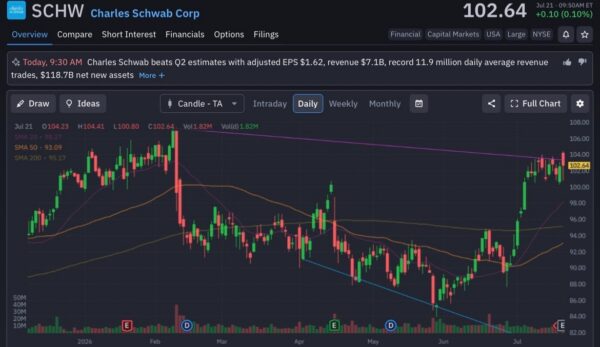
Now, since bottoming near $85 in June, Schwab has rallied about 20%, reclaiming both its 50-day moving average ($93.09) and 200-day moving average ($95.17). Shares are now pressing against the $104-$104.40 resistance zone that rejected buyers after February’s earnings report, with Monday’s intraday high reaching $104.41.
Rather than reversing after a sharp advance, the stock is consolidating just beneath resistance while holding comfortably above both moving averages.
That’s consistent with institutional accumulation, not speculative momentum, and supports the idea that investors are beginning to value Schwab less as a rate-sensitive broker and more as a financial platform.
Why Schwab Deserves A Higher Multiple Than It Did Two Years Ago
Two years ago, investors valued Charles Schwab Corp (NYSE:SCHW) based on where they expected interest rates to go. That framework was appropriate for a business whose earnings were primarily rate-dependent. It no longer captures what this business is becoming.
Record trading activity, strong asset gathering, expanding managed investing, and a lending franchise operating at a fraction of its structural capacity all point toward a company whose earnings are increasingly supported by client monetization rather than a single macro tailwind.
With all of these in mind, it’s logical to say this company doesn’t need the rate environment to cooperate in order to grow.
It needs management to keep executing on the platform model they’ve been quietly building for the past two years – and after this quarter, I believe that’s exactly what’s happening.
Leave a Reply