
ASML (NASDAQ: ASML) just posted another strong quarter, highlighting how artificial intelligence (AI) continues to reshape the global chip industry.
Table of Contents
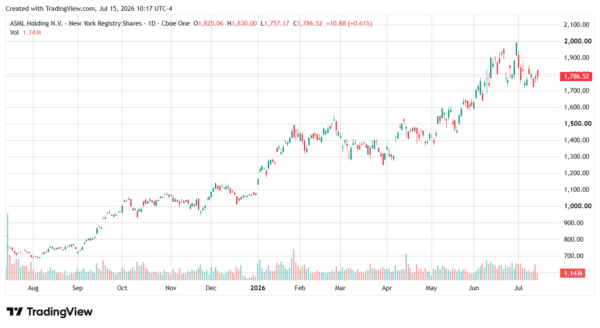
The company reported better-than-expected second-quarter earnings and raised its full-year financial outlook for the second time this year. All thanks to soaring demand from semiconductor manufacturers racing to expand production of AI chips.
Strong Results Beat Expectations
ASML reported second-quarter net sales of 9.3 billion euros ($10.67 billion), which was ahead of analyst expectations of 8.8 billion euros ($10.06 billion). Net profit also exceeded forecasts, reaching 2.9 billion euros ($3.32 billion), compared with estimates of 2.6 billion euros ($2.97 billion).
The company also increased its full-year revenue guidance, now expecting sales of between 43 billion and 45 billion euros ($49.16 to $51.45 billion), up sharply from its previous forecast of 36 billion to 40 billion euros ($41.16 to $45.73 billion). Gross margins are now expected to range between 54% and 56%, reflecting stronger profitability than previously anticipated.
Chief Executive Officer Christophe Fouquet said customer demand remained “extremely strong” during the first half of the year, giving ASML greater confidence in long-term growth.
The Company Behind the World’s Most Advanced Chips
ASML is the only company capable of producing Extreme Ultraviolet (EUV) lithography machines, the systems required to manufacture the world’s most advanced computer chips.
Each EUV machine contains thousands of precision components and can cost hundreds of millions of dollars. These machines are essential for producing cutting-edge processors used in AI accelerators, advanced graphics processors (GPUs), high-performance computing, and next-generation smartphones.
In addition to EUV systems, ASML also manufactures Deep Ultraviolet (DUV) lithography equipment, which remains critical for producing many other types of semiconductors.
With demand continuing to rise, ASML plans to increase its production capacity by expanding both its EUV and DUV manufacturing capabilities by approximately 30% by 2026.
AI Is Driving the Next Wave of Chip Investment
The rapid adoption of artificial intelligence has triggered one of the biggest booms the semiconductor industry has ever experienced.
Major chipmakers are investing billions of dollars to build new fabrication plants and expand existing facilities to meet demand for AI processors used in data centers, cloud computing, autonomous vehicles, and other AI-powered applications.
ASML says many of its customers are accelerating their expansion plans, providing the company with greater visibility into future orders. Analysts note that ASML is increasing production by making better use of its manufacturing facilities in the Netherlands while also speeding deliveries of completed machines.
What This Means for AI Chips
ASML’s latest results are another sign that the AI chip boom is far from over.
Every advanced AI processor—from those powering large language models to chips used in cloud data centers—requires sophisticated manufacturing equipment before it can be produced. Since ASML is the sole supplier of EUV lithography systems, rising demand for AI chips almost always translates into increased demand for ASML’s equipment.
As companies such as NVIDIA, AMD, Apple, Intel, and other chip designers continue introducing more powerful AI processors, manufacturers like TSMC, Samsung, and Intel Foundry need additional production capacity. That expansion depends heavily on ASML’s ability to deliver more EUV and DUV machines.
The company’s decision to expand manufacturing capacity by 30% suggests management expects AI-related chip demand to remain strong for years rather than months.
What’s Next for ASML?
With record demand for its unique lithography systems, higher revenue forecasts, and plans to expand manufacturing capacity, ASML appears well positioned to benefit from the continued growth of artificial intelligence. Also, if ASML continues seeing strong orders, it is likely to signal that the AI investment boom still has significant room to run.
Leave a Reply