
The U.S.-Iran ceasefire was nice while it lasted. Even the pullback in oil prices was great to see. Unfortunately, not only are oil prices starting to gush higher again, but the ceasefire is no longer in place. In fact, according to President Trump, the ceasefire is over after the latest round of strikes.
Table of Contents
Those comments come after the U.S. and Iran accused each other of violating the agreement. In turn, the U.S. conducted a “series of powerful strikes” against Iran in retaliation for three commercial vessels transiting the Strait of Hormuz coming under attack, as noted by CNBC.
In addition, as noted by Centcom, as also quoted by CNBC, “The U.S. strikes are in response to Iranian attacks on three commercial vessels that were transiting the Strait of Hormuz. Iran’s demonstrated aggression was unwarranted, dangerous, and a clear violation of the ceasefire.”
That’s why oil prices are just starting to gush higher again.
And that’s because any optimism created by the temporary ceasefire has been replaced by fresh concerns about potential disruptions to oil supplies. For now, the hope that the ceasefire would bring lasting stability has faded, and markets are once again watching developments in the region closely.
How Can Investors Make Money From It?
One way is to invest in oil giants like Exxon Mobil (NYSE: XOM), Chevron (NYSE: CVX), and Occidental Petroleum (NYSE: OXY). The second way is to jump into exchange-traded funds, which allow you to diversify with a good number of energy-related names.
Here are three to consider.
ETF #1: Large-Cap Energy Exposure
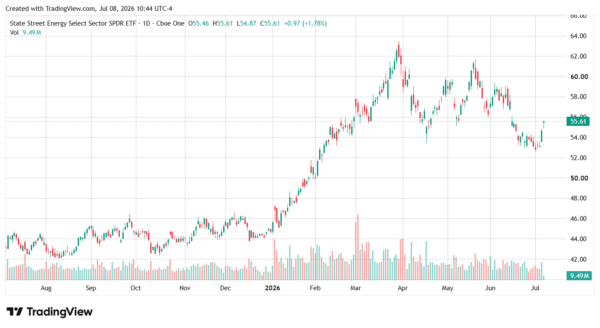
SPDR Energy Select Sector ETF (NYSEARCA: XLE)
With an expense ratio of 0.08%, the SPDR Energy Select Sector ETF provides exposure to companies in the oil, gas and consumable fuel, energy equipment and services industries, as noted by State Street SPDR
The ETF is heavily weighted toward large, established energy giants, which account for a significant portion of its total holdings and help provide more resilience during market downturns.
Some of those holdings include Exxon Mobil, Chevron, ConocoPhillips, Williams Cos., and EOG Resources, to name just a few.
ETF #2: A Play on Oil Exploration
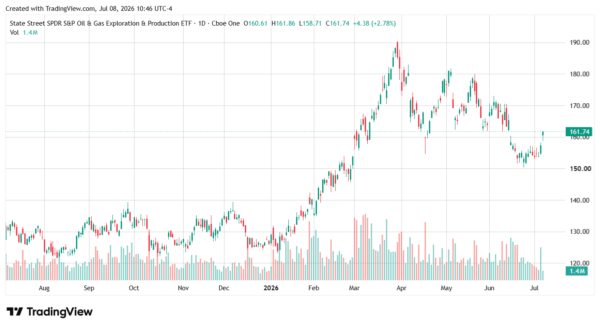
SPDR S&P Oil & Gas Exploration & Production ETF (NYSEAERCA: XOP)
With an expense ratio of 0.35%, the SPDR S&P Oil & Gas Exploration & Production ETF provides exposure to the oil and gas exploration and production segment of the S&P TMI, which comprises the following sub-industries: Integrated Oil & Gas, Oil & Gas Exploration & Production, and Oil & Gas Refining & Marketing, as noted by State Street SPDR. Some of its top holdings include Callon Petroleum, SM Energy Company, Devon Energy Corporation, EOG Resources, and ConocoPhillips, for example.
XOP also has an extremely high correlation with the price of oil, making it a suitable for investors seeking direct leverage to upward movements in crude oil prices.
ETF #3: Global Energy Exposure
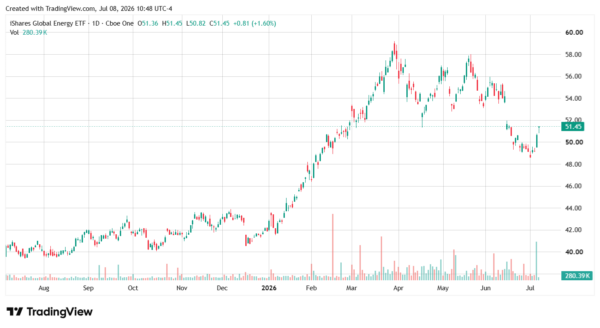
iShares Global Energy ETF (NYSE Arca: IXC)
With an expense ratio of 0.40%, the iShares Global Energy ETF provides investors with broad exposure to the global energy sector by tracking the investment results of an index composed of energy-related equities from companies around the world. The fund is designed to capture the performance of large- and mid-cap companies involved in the exploration, production, refining, distribution, and servicing of energy resources, including traditional oil and gas businesses as well as integrated energy firms.
Because of its global focus, IXC provides exposure not only to U.S.-based energy companies but also to international firms, allowing investors to participate in global trends.
Which Energy ETF Is Right for You?
While investing directly in individual oil companies such as Exxon Mobil, Chevron, or Occidental Petroleum can provide targeted exposure to higher oil prices, energy ETFs offer a diversified approach by spreading exposure across multiple companies within the sector. Funds like the SPDR Energy Select Sector ETF (XLE), SPDR S&P Oil & Gas Exploration & Production ETF (XOP), and iShares Global Energy ETF (IXC) provide investors with different ways to participate in potential energy market strength.
Leave a Reply