Ulta Beauty (NASDAQ: ULTA) posted a genuinely strong first quarter of fiscal 2026. The market sold it off anyway. Shares of the beauty retail giant fell nearly 5% following the fiscal year 2027 Q1 earnings report, closing at $471.21, despite results that beat on nearly every meaningful metric.
- Net sales grew 11.1% year-over-year to $3.2 billion.
- Comparable sales accelerated to +5.3% versus a +2.9% comp in the prior year period.
- Diluted EPS climbed 15.5% to $7.74.
- Operating income rose 11.6% to $448.3 million.
- Gross margin expanded 100 basis points to 40.1%, driven by lower inventory shrink and improved merchandise margins.
Table of Contents
The official explanation for the sell-off centered on multi-year guidance that left some investors wanting more. Management held net sales growth guidance flat at +6% to +7% and kept comparable sales guidance unchanged at +2.5% to +3.5%. The company did nudge full-year EPS guidance slightly higher — to $28.36–$28.80, implying 10.6% to 12.3% growth — but not enough to satisfy a market that had perhaps priced in a more aggressive raise.
The more honest read, though, may be simpler: the stock needed a reason to move, and a solid-but-steady print wasn’t it.
ULTA Chart Tells a Complicated Story
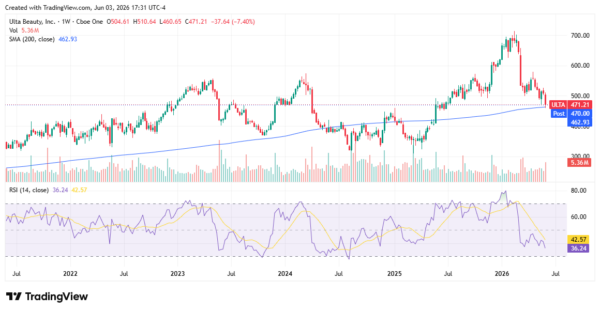
Look at the five-year weekly chart, and a clear picture emerges. Ulta spent most of 2022 through mid-2025 trading in a well-established range between roughly $400 and $550, punctuated by brief excursions in either direction. The run to over $600 in late 2025 and early 2026 stands out as the anomaly — a momentum-fueled extension above the long-term trend that has since been unwinding in orderly fashion.
The stock is now trading just above its 200-week moving average near $462, and the RSI on the weekly chart has dropped to 36, approaching oversold territory not seen since the 2022 drawdown. That combination — mean reversion from an extended high, a return to a well-established long-term support zone, and a momentum indicator nearing a washout — is the kind of technical setup that tends to attract contrarian buyers.
A recovery toward the $550 area, which represented the upper bound of Ulta’s multi-year range before the late-2025 breakout, would represent a gain of roughly 17% from current levels. That is a meaningful return for a company growing earnings in the double digits, with a loyalty program of nearly 47 million members and broad-based category growth — fragrance in the high teens, haircare in the high single digits, and every other category positive in Q1.
The Ulta Unleashed Strategy: More Than a Catchy Name
Ulta’s “Ulta Beauty Unleashed” strategic framework is organized around three pillars: driving core business growth, scaling new accretive businesses, and aligning its operational foundation. Q1 showed real progress across all three.
On the core business, the company hosted more than 40,000 in-store events and launched its TikTok Shop, a move that positions it to reach younger consumers in the discovery-driven commerce environment where beauty spending increasingly originates. More than 20 new brands were added in the quarter, and the loyalty program grew 4% year-over-year to approximately 46.9 million members — a competitive moat that remains one of the most underappreciated assets in retail.
On new businesses, the international expansion is quietly gaining traction, with new store openings in Mexico City and Dubai. The company’s digital marketplace now carries 325+ brands and more than 8,000 SKUs. UB Media, its retail media network, continues to scale. These businesses are early-stage but represent genuine optionality that is not yet reflected in earnings models. The company also debuted “Ask Ulta AI,” a beta product that offers personalized recommendations — a small but telling sign that management is investing in the next generation of the customer relationship, not just defending the current one.
Approaching a Level Worth Watching
From a purely technical standpoint, ULTA is at an interesting juncture. The stock is trading just above its 200-week moving average, a level that has historically marked meaningful bottoms during prior corrections. The weekly RSI at 36.24 is approaching, but has not yet reached, the oversold threshold that has historically preceded recoveries. Volume on the post-earnings decline — 5.36 million shares on the weekly bar — was elevated but not panicked.
The risk is that the stock tests the $440–$450 zone before finding a sustainable floor. The reward, if the 200-week holds, is a base-building setup with a clear path back toward $520–$550.
Why the Bulls May Still Have the Better Argument
At roughly 18x forward earnings on guidance of $28.36–$28.80 per share, Ulta is not expensively valued for a company with its profile. Double-digit EPS growth, a fortress loyalty program, expanding gross margins, and $555 million returned to shareholders through buybacks in a single quarter — these are the metrics of a mature compounder, not a broken story.
The buyback program in particular deserves attention. With the share count shrinking and the company generating $262 million in operating cash flow in Q1 alone, the math on per-share earnings growth is structurally supportive. Analysts who cover the stock have price targets meaningfully above current levels, and the valuation compression of the past several months has actually improved the risk/reward rather than impaired it. For a long-term investor willing to look past a quarter of uninspiring guidance, the setup is arguably more compelling now than it was when the stock was trading above $600.
The Bear Case: Consumer Risk Is Real, If Unlikely to Be Fatal
The counterargument to all of this is the consumer. Beauty spending, while historically more resilient than discretionary categories, is not immune to an economic downturn. If tariffs translate into higher prices, or if employment begins to soften, the question of whether consumers continue to trade up within Ulta’s assortment — or simply spend less — becomes relevant.
SG&A expenses rose 14.6% in Q1, driven in part by Space NK integration costs and Unleashed strategy investments. That means margin protection becomes harder if the top line disappoints.
It is worth noting, though, that this is an asymmetric risk rather than a base case. Beauty has proven remarkably sticky through prior recessions — often described as a “lipstick effect” category — and Ulta’s position across both mass and prestige segments gives it a natural hedge. The bear case requires a meaningful consumer pullback to materially impair the thesis. A soft landing — even a bumpy one — probably leaves Ulta’s earnings power largely intact.
Is Ulta’s Post-Earnings Pullback a Buying Opportunity?
Ulta Beauty’s Q1 fiscal 2026 results were, by most reasonable measures, a good quarter. The sell-off that followed says more about where the stock had been than where the business is going. The $600 high was the outlier; the current level near $470 is closer to fair, with a credible path toward $550 and beyond if the business continues to execute. The loyalty ecosystem is deep, the category is resilient, and the valuation is no longer stretched. For investors who can tolerate some near-term volatility while the chart works through its correction, the beauty may be in the buying.
Leave a Reply