
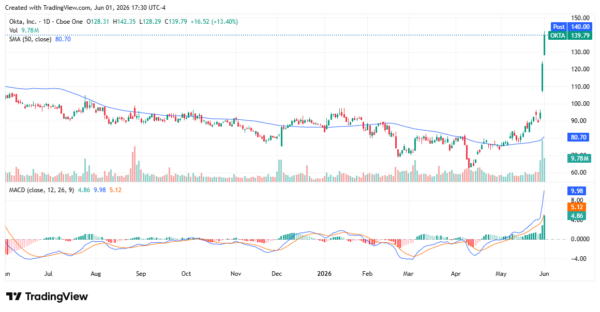
Okta (NASDAQ: OKTA) delivered a solid Q1 FY27, and the identity security market took notice. OKTA shares surged more than 13% in after-hours trading following the May 28 report, closing the session at $139.79. For a company that spent much of the past two years rebuilding trust after a pair of high-profile security incidents, the quarter felt like a genuine turning point.
Table of Contents
Revenue came in at $765 million. That was up 11% year-over-year, with subscription revenue — which accounts for 98% of the total — matching that growth rate.
- Remaining performance obligations rose 16% to $4.72 billion, a forward indicator suggesting the pipeline is strengthening.
- The dollar-based net retention rate ticked up one point to 107%, a modest but meaningful sign that existing customers are spending more.
- Free cash flow margin hit 35.5%, comfortably above management’s full-year guidance range of 27–28%.
The headline, though, is Okta’s longer-term ambition: a self-calculated $80 billion total addressable market. With FY27 revenue guided at roughly $3.2 billion, the company is capturing only about four cents of every dollar in its stated opportunity, which is either a compelling growth runway or an aspirational target that deserves scrutiny.
The $80B TAM: Opportunity or Aspiration?
Okta breaks its $80 billion TAM across three broad buckets: workforce identity and identity governance, privileged access management, and customer identity. The workforce and governance piece is modeled off U.S. Bureau of Labor Statistics data on businesses with 250-plus employees, then doubled to account for international markets — implying a $42 billion opportunity there alone. Customer identity adds another $30 billion, derived from assumptions about global internet users and per-user pricing.
The math is internally consistent. However, like most vendor-generated TAM calculations, it assumes near-total market penetration across every product line Okta currently offers or has announced. The question is how quickly Okta can expand its share of the identity security budgets it is already competing for — particularly as AI-driven threats are rapidly reshaping what “identity security” even means.
To Okta’s credit, the company is leaning into that shift. New products like Okta for AI Agents and Auth0 for AI Agents address the emerging challenge of non-human identities — machine accounts, service tokens, and autonomous AI systems — which represent a rapidly expanding attack surface. If enterprises standardize on a single identity platform as agentic AI proliferates, the TAM argument becomes more defensible.
Competition: Microsoft Is the Stated Rival, But Watch CrowdStrike and Palo Alto
Okta’s investor presentation dedicates considerable real estate to why it is “the superior choice vs. Microsoft,” citing Gartner rankings, MFA adoption data, and integration depth. The comparison is understandable — Microsoft’s Entra ID is the primary incumbent in enterprise identity, and displacement deals represent a meaningful portion of Okta’s pipeline.
But the more interesting competitive threat may be coming from a different direction entirely. CrowdStrike (NASDAQ: CRWD) and Palo Alto Networks (NASDAQ: PANW) have both expanded aggressively into identity security as part of broader platform consolidation strategies. CrowdStrike’s Falcon Identity Protection and Palo Alto’s Prisma Access offer identity capabilities bundled within security platforms that enterprises are already paying for — removing a procurement hurdle that Okta, as a standalone identity vendor, cannot easily replicate.
The platform bundling risk is real. CISOs under budget pressure are increasingly receptive to “good enough” identity features packaged within a broader security contract rather than a best-of-breed point solution. Okta’s counter-argument — that identity is too critical to delegate to a secondary capability within a broader platform — is reasonable, but it requires enterprise buyers to agree. As Palo Alto and CrowdStrike continue to invest in their identity modules, the “best-of-breed vs. platform” debate will intensify.
Technical Analysis: Digesting the Post-Earnings Spike
From a technical standpoint, OKTA’s move from roughly $113 to $139 on earnings is striking but may need time to consolidate. The stock had been tracking along a declining 50-day moving average (now at $80.70) for much of the past year before breaking sharply higher, and volume on the move — nearly 9.8 million shares — was elevated but not extreme for a post-earnings gap of this magnitude.
A pullback toward the $120–$125 range in the near term would not be surprising, and could represent a more constructive entry point for investors who missed the initial move. MACD momentum is sharply positive, which favors bulls in the intermediate term, but post-earnings gaps of 10%-plus in software stocks frequently retrace at least partially before establishing a new base.
Why the Bulls May Believe
The bull case for Okta is not simply about this quarter — it is about a maturation story finally gaining traction. Non-GAAP operating margin expanded from 14% in FY24 to 26% in FY26, and management is guiding for 25–26% in FY27 even while investing in new products. Free cash flow for FY27 is projected at $855–$885 million, implying a free cash flow yield that begins to look attractive relative to growth-stage software peers.
Perhaps most telling: customers spending more than $100,000 annually grew 6% year-over-year to 5,180, and the cRPO growth of 12% suggests that larger deals are being signed with longer durations. If Okta can sustain revenue growth in the 10–12% range while continuing to expand margins and free cash flow, the earnings power at scale starts to make the current valuation more defensible — and the $80 billion TAM starts to look less like a slide deck number and more like a genuine long-term target.
Can Okta Defend Its Identity Security Lead Against Cyber Rivals?
Okta enters the second half of FY27 with genuine momentum: accelerating RPO growth, expanding margins, and a product portfolio increasingly aligned with where enterprise security is heading. The identity security market is real, large, and growing — and Okta remains the most credible independent platform in the space.
The risks, however, deserve equal attention. CrowdStrike and Palo Alto are not standing still, and platform bundling strategies could compress Okta’s addressable market more quickly than the $80 billion TAM suggests. For investors, the question is whether Okta’s focus and depth in identity security outweigh the scale advantages of its larger rivals — a debate that will likely define the stock’s trajectory over the next several years.
Leave a Reply