
Investors may want to prepare as if it were 1929, 2000, or even 2008. Each of those years was marked by a market crash. And today’s market is eerily similar.
Table of Contents
Right now, the Dow Jones, the NASDAQ, and the S&P 500 are at all-time highs, even as investor optimism soars and valuations climb to levels many analysts consider difficult to justify. Despite trade disputes, geopolitical uncertainty, persistent inflation concerns, and questions about economic growth, investors have largely shrugged off potential risks.
The bulls will say this is the market being forward looking. That means pricing stocks for a time when the conflict with Iran is settled, the Strait of Hormuz is open, and inflation is moving lower.
However, you can put an “if” in front of all those statements, and you could also be correct. That’s why it’s concerning that investors are behaving much like they did before the major crashes of 1929, 2000, and 2008. History may not repeat itself exactly, but it often rhymes. And when markets become driven by excessive optimism and speculation, corrections can be swift and painful.
Lessons from Past Market Crashes
The crashes of 1929, 2000, and 2008 demonstrate how excessive speculation can fuel a stock market bubble that ultimately leads to a severe market crash.
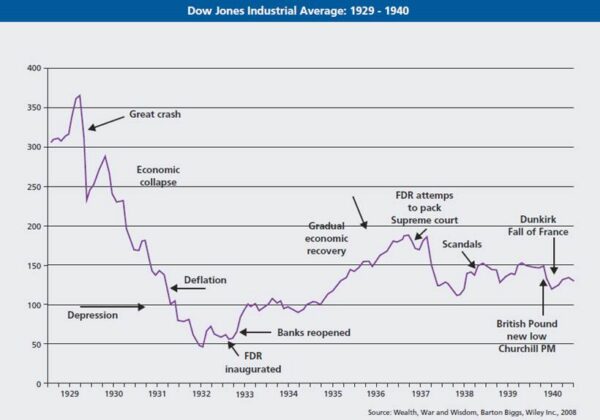
Between 1923 and 1929, the Dow Jones rallied about 300%.
Investors believed stocks could only go up. Speculation forced stocks to unbelievable highs with unjustifiable valuations. Then it all fell apart. Between 1929 and 1932, the Dow Jones lost 86% of its value. Unfortunately, many weren’t prepared.
Around 2000, dot-com optimism sent the Dow Jones screaming higher as investors poured money into technology companies with little regard for earnings or profitability. When reality finally caught up with expectations, the bubble burst and billions of dollars in market value disappeared.
In 2008, rampant speculation sent the Dow Jones to a high of 14,038 on the heels of a housing boom. Americans were buying homes they couldn’t afford, lenders were extending excessive credit, and stocks were exploding on economic optimism and unjustifiable valuations.
Then it all fell apart. The Dow Jones would sink to 6,500.
Many weren’t prepared.
Warning Signs Investors Should Watch
It’s happening again now. And once again, many investors appear complacent.
Also worrisome is how overextended the Shiller P/E has become. Historically, elevated Shiller P/E readings have often preceded periods of below-average market returns. While high valuations alone do not cause crashes, they can leave stocks vulnerable when economic conditions weaken or investor sentiment shifts.
In addition, market concentration has become another concern. A relatively small group of mega-cap technology stocks, such as Alphabet (NASDAQ: GOOGL) and Amazon (NASDAQ: AMZN), has driven a significant portion of recent market gains. If leadership in those stocks begins to falter, broader indexes could come under pressure.
Using Volatility as a Hedge
Instead of being unprepared for a potential decline, investors may want to consider strategies designed to benefit from rising market volatility.
We can do that by using:
- ProShares Ultra VIX Short-Term Futures ETF (BATS: UVXY): The ETF was designed to match two times (2x) the daily performance of the S&P 500 VIX Short-Term Futures Index.
- iPath S&P 500 VIX Short-Term Futures ETN (BATS: VXX): The VXX provides exposure to the S&P 500 VIX Short-Term Futures Index.
- ProShares VIX Short-Term Futures ETF (BATS: VIXY): This ETF provides long exposure to the S&P 500 VIX Short-Term Futures Index, which measures the returns of a portfolio of monthly VIX futures contracts with a weighted average of one month to expiration.
Preparing for the Next Market Crash
While no one can predict exactly when the next major market correction or market crash will occur, history shows that periods of extreme optimism and elevated valuations often end with increased volatility.
The crashes of 1929, 2000, and 2008 all shared common characteristics: investor complacency, excessive speculation, and the belief that markets could continue rising indefinitely.
Today’s environment contains many of those same warning signs. Investors who remain aware of those risks and consider protective strategies may be better positioned to weather the next downturn whenever it arrives.
Leave a Reply