Walmart (NASDAQ: WMT) has spent the past few years winning the value war with shoppers. Lower prices, a sprawling footprint, and an e-commerce engine that finally rivals Amazon (NASDAQ: AMZN) have made it the default destination for budget-conscious households. But there’s a difference between being the better deal for consumers and being the better deal for investors, and right now those two things are pointing in opposite directions.
Table of Contents
Kroger (NYSE: KR) CEO Greg Foran summed up the environment bluntly on the company’s first-quarter earnings call this month: shoppers are under pressure, and it’s changing how they buy groceries. High gas prices and reduced SNAP benefits are squeezing budgets, Foran told analysts, pushing customers toward smaller, promotion-driven trips instead of the traditional weekly stock-up. “We’re getting too many promotional trips and not enough of the full basket,” he said.
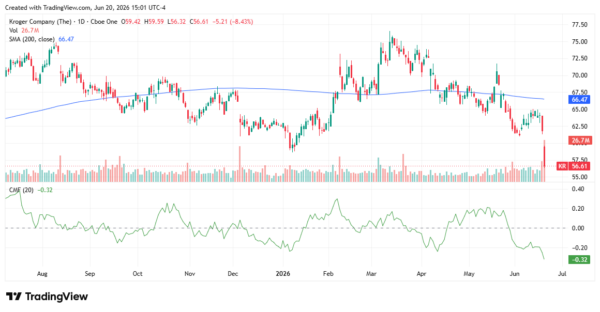
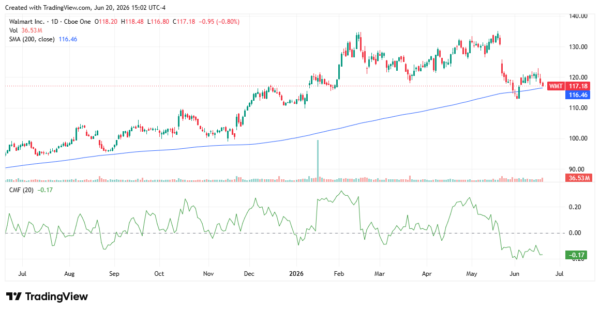
That’s a real headwind, and the market punished Kroger for it. KR shares fell more than 8% the day the company reported, landing near $56 and deep below its 200-day moving average. Walmart, by contrast, has held up far better, trading around $117, just below its own 200-day line after a more modest pullback from 2026 highs near $137.
On the surface, that makes Walmart look like the safer bet. Underneath it, the numbers tell a more interesting story for investors willing to look past the headline.
The Earnings Engine Is Still Running at Kroger
Despite the post-earnings selloff, Kroger’s underlying business hasn’t broken down. The company grew adjusted earnings per share by roughly 8% in fiscal 2025, and Wall Street expects a similar pace in fiscal 2026, with full-year adjusted EPS guidance reaffirmed at $5.10 to $5.30. Management didn’t cut that outlook after the first-quarter report, nor did it touch its free cash flow guidance of $2.7 billion to $2.9 billion, which still leaves room for buybacks, dividends, and reinvestment in price and digital.
The quarter itself was messier than the stock reaction suggested. Adjusted EPS of $1.58 came in only a penny short of estimates, and adjusted e-commerce sales jumped 19% year over year. The real issue was identical sales excluding fuel, which grew just 1%, down from 3.2% a year earlier, and gross margin, which slipped to 22.7% from 23.0% as Kroger absorbed higher transport costs and leaned into price cuts to win back share from Walmart, Costco, and Aldi.
In other words, Kroger is spending money today to defend its competitive position tomorrow. That’s a legitimate risk. It’s also precisely the kind of self-inflicted, sentiment-driven drawdown that contrarian investors look for, especially when the company’s own full-year guidance says the strategy is still on track.
Walmart’s Premium Is Already Priced In
Walmart’s chart tells the opposite story. Shares are still up sharply over the past year, trading at roughly 41 times trailing earnings and close to 39 times forward estimates, a premium multiple for a grocery and general merchandise retailer. That reflects a market that has already given Walmart enormous credit for its omnichannel execution, advertising business, and Sam’s Club momentum.
There’s nothing wrong with paying up for quality, but valuation matters for forward returns, and Walmart’s current setup leaves less room for error. The stock’s dividend yield sits below 1%. That’s a reflection of how far the share price has run relative to the payout rather than any weakness in the underlying business.
Kroger’s dividend tells a different story. The stock currently yields close to 2%, more than double Walmart’s, and that payout looks well covered. Kroger’s free cash flow guidance comfortably exceeds its dividend obligations, even after funding buybacks and store investments. For income-oriented investors, that combination of yield and coverage is hard to find in a name this size trading at a depressed valuation.
Analysts See More Room to Run in KR
Wall Street’s price targets reinforce the gap. Consensus estimates put Kroger’s 12-month target in the $68 to $76 range, while KR stock trades in the high $50s to low $60s, implying meaningful double-digit upside from current levels. Walmart’s consensus target sits in the $134 to $139 range against a stock already near $117 to $118, working out to upside in the high teens, but starting from a far richer valuation.
The reaction to Kroger’s first-quarter report split the analyst community in a way worth noting. JPMorgan trimmed its price target to $70 from $72 and stayed Neutral, citing margin pressure from the price investment strategy, and BMO cut its target to $60 from $70.
But Goldman Sachs raised its target to $82 from $72, and Telsey Advisory Group reiterated an Outperform rating with an $82 target, arguing the long-term payoff from Foran’s pricing push outweighs the near-term margin drag. Jefferies stayed at Buy. That kind of split, where some firms see a temporary cost of doing business and others see a structural problem, is a hallmark of a stock the market hasn’t fully repriced yet, not a unanimous red flag.
Reading the Charts
The technical picture adds another layer. Kroger’s Chaikin Money Flow has turned negative and is still falling, currently near -0.32, signaling sustained distribution as the stock trades well below its 200-day moving average of roughly $66. That’s not bullish in isolation, but for value-oriented investors, a beaten-down momentum reading on a stock with intact full-year guidance is often the entry point, not the exit sign.
Walmart’s CMF has also turned negative, near -0.17, with the stock recently slipping below its own 200-day average around $116 before stabilizing. The difference is that Walmart’s pullback is happening from a much higher valuation base, while Kroger’s decline has pushed an already reasonably priced stock into statistically cheap territory relative to its own earnings power.
The Bottom Line
Walmart has earned its premium through years of consistent execution, and nothing here argues it’s a bad business. But “better business” and “better stock to buy today” aren’t the same question.
At current prices, Walmart asks investors to pay nearly 40 times forward earnings for a sub-1% yield, while Kroger offers a covered 2% dividend, high-single-digit earnings growth management has reaffirmed even after a rough quarter, and a valuation that’s fallen far enough to catch fresh price-target raises from Goldman Sachs and Telsey.
Consumers chasing value right now are trading down to cheaper baskets and more selective trips. Investors looking for the same kind of value in their portfolios may want to take a similar approach: skip the name trading at a premium multiple and take a closer look at the one the market just put on sale.
Leave a Reply