The AI boom is rapidly reshaping global markets, driving unprecedented growth across industries from healthcare and finance to cloud computing and robotics. With the AI sector projected to expand from roughly $137 billion in 2022 to more than $1.8 trillion by 2030, according to Grand View Research, investors are looking for ways to gain exposure.
Table of Contents
Research highlighted by the Marketing AI Institute and Accenture suggests AI could lift global profitability by as much as 38%, contributing an estimated $14 trillion in additional economic value by 2035. Even MIT Technology Review has noted the accelerating pace of AI development, emphasizing its potential to transform nearly every aspect of the global economy over the coming decades.
Of course, you can always invest in heavyweights like Nvidia and Advanced Micro Devices. However, for those looking for a more diversified investment, AI-focused exchange-traded funds (ETFs) offer a safe alternative.
A Diversified AI and Technology ETF
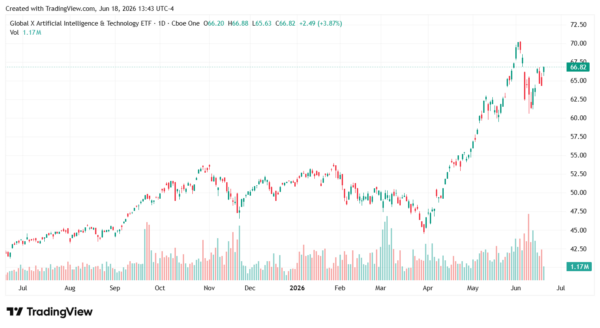
For investors seeking diversified exposure to artificial intelligence, the Global X Artificial Intelligence & Technology ETF (AIQ) is one of the most widely followed options. With an expense ratio of 0.68%, the fund targets companies positioned to benefit from the growth and adoption of AI technologies across industries.
Its holdings include major technology leaders such as Palantir, Oracle, Broadcom, Netflix, Nvidia, Microsoft, and Meta Platforms, among others, spread across more than 80 total positions. This diversified structure allows investors to participate in AI growth while reducing reliance on any single company.
After pulling back earlier in the year, AIQ has rebounded strongly, moving from roughly $45 in April to around $66. Looking ahead, continued momentum in AI adoption could support a potential move toward the $80 level if broader market conditions remain favorable.
A Robotics-Focused AI ETF
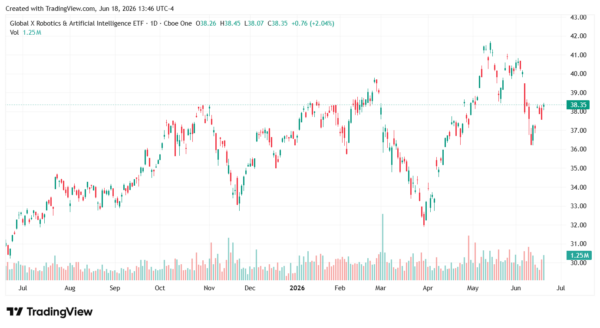
Another popular option is the Global X Robotics and Artificial Intelligence ETF (BOTZ), which focuses more heavily on robotics alongside AI-driven innovation. With the same 0.68% expense ratio, BOTZ invests in companies benefiting from automation, machine learning, and advanced robotics systems.
Top holdings include Nvidia, Keyence, Dynatrace, SMC Corporation, Intuitive Surgical, Upstart Holdings, and C3.ai, among others. The fund’s narrower focus on industrial automation and robotics gives it a slightly different risk and growth profile compared to broader AI ETFs.
After bottoming near $24 in April, BOTZ has climbed to approximately $38.55. If momentum continues in the sector, we’d like to see it rally to at least $50 near term.
A Pure Play on the Generative AI Boom
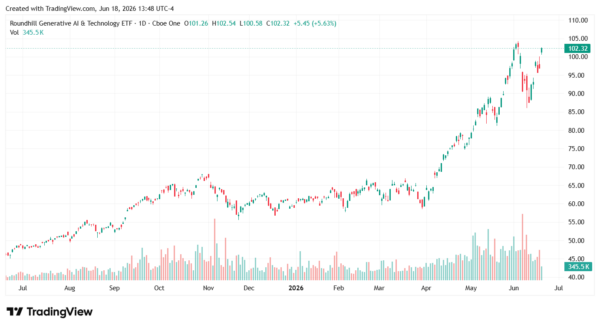
The Roundhill Generative AI & Technology ETF (CHAT) focuses on companies driving the generative AI wave. With an expense ratio of 0.75%, it holds a concentrated portfolio of leaders shaping next-generation AI applications. Its holdings include Nvidia, Alphabet, Meta Platforms, Microsoft, Oracle, Palantir Technologies, and Alibaba Group, reflecting a mix of U.S. and global technology giants at the forefront of AI development.
Since dipping to around $60 in March, CHAT has staged a strong recovery and is now trading near $101.95. If enthusiasm around generative AI remains strong, a continued push toward the $110 level could be possible in the near term.
The Bigger Picture Behind the AI Boom
The AI boom is driving massive growth across global markets, and ETFs like AIQ, BOTZ, and CHAT offer diversified ways to invest in the trend, offering diversified exposure to companies building the infrastructure, applications, and breakthroughs powering the next wave of innovation.
For investors, the real opportunity may not be in trying to pick the single biggest winner in AI, but in maintaining broad exposure to a sector that is still in the early stages of its long-term growth cycle. As adoption accelerates across industries, staying invested in the AI theme—rather than timing it—may ultimately prove to be the more durable strategy.
Leave a Reply