
During the California Gold Rush, finding gold wasn’t the hardest part. Building the railroads needed to reach it was. Ciena Corp (NYSE: CIEN)‘s Q2 2026 earnings report just exposed a tension that maps almost perfectly onto that dynamic – a business delivering extraordinary results inside an opportunity the market had already decided to price as if it were further along than it actually is.
Table of Contents
Revenue surged 40% year-over-year to $1.57 billion. Adjusted EPS climbed 290% to $1.64. Gross margin expanded to 44.9%. Management raised full-year revenue guidance to roughly $6.3 billion.
By almost any conventional measure, this was the quarter investors wanted from a major beneficiary of the AI infrastructure buildout. Then the stock fell anyway – and that reaction is worth scrutinizing, because it has nothing to do with the business and everything to do with the clock.
Demand Is A Foregone Conclusion
Ciena Corp’s quarter 2 report becomes much easier to understand once we stop looking at the stock and start looking at the business, because the business itself gave investors very little reason to worry.
Revenue increased 39.5% year over year to $1.57 billion. Optical Networking, Ciena’s largest segment, generated $1.1 billion in revenue, up 42% from a year ago. Routing and Switching revenue surged 88% to $174 million. Together, those businesses accounted for more than 80% of total company revenue.
Cloud providers continued expanding their contribution as well, representing nearly half of total revenue during the quarter. These are the very customers building the infrastructure needed to support artificial intelligence are spending heavily on the networking equipment sitting underneath that buildout. If demand were slowing, this is where it would show up first.
Instead, the opposite happened.
The strongest parts of the business became even stronger. And that’s where the first bearish explanation begins to fall apart as weak demand would have shown up in customer spending, segment growth, and most obviously, in revenue. But it showed up nowhere.
Which leaves us with the question of profitability.
A Quarter With No Weakness Or Bearish Case
Revenue growth attracts attention, but profit growth is what compounds wealth, and Ciena delivered both in a combination that doesn’t appear in most earnings reports at this stage of a growth cycle. Gross profit increased 53% to nearly $692 million, outpacing revenue growth by a meaningful margin. Adjusted gross margin expanded from 41.0% to 44.9%. Adjusted operating expenses, meanwhile, increased just 7.7% against nearly 40% revenue growth, and that gap between the two is where the real story lives.
Adjusted operating margin expanded from 8.2% to 19.5%. Operating income surged from $33 million to $238 million. Adjusted EBITDA jumped 193% to $342 million. Net income climbed from $9 million a year ago to more than $218 million. Revenue rose 40% and operating income rose more than 600%. Indicating that operating leverage arrived at scale after years of investment, and it is the kind of financial inflection that typically precedes a sustained re-rating rather than a selloff.
Operating cash flow increased 87% to $487 million across the first six months of the fiscal year, inventory declined, deferred revenue increased, and the balance sheet held roughly $1.4 billion in cash and investments.
Bottomline is, the deeper you go into this quarter, the harder it becomes to find a meaningful weakness or bearish thesis in the operating results – which makes the market’s reaction the most interesting part of the entire report.
Another Company Falls Victim To The Wrong Metric
The answer to why the stock fell despite exceptional results lies in something investors rarely discuss with the precision it deserves: time. You see, the management spent the quarter discussing deployment schedules, customer readiness, execution complexity, and the long-term arc of an infrastructure buildout still unfolding across multiple years.
However, the market was focused on a different metric entirely, that is: how fast the opportunity converts into the earnings trajectory that had already been priced into the stock.
Normally, infrastructure projects move in years. And stock prices move in expectations. But when those two timelines diverge, even exceptional quarters can read as disappointments to a market that has positioned itself ahead of the delivery curve. Ciena confirmed that demand exists, that customers are spending, and that the company can convert that spending into extraordinary profitability.
What it didn’t confirm was that the full scale of the opportunity would arrive quickly enough to satisfy investors who had already run far ahead of the buildout itself.
Wall Street Ran Ahead Of The Buildout
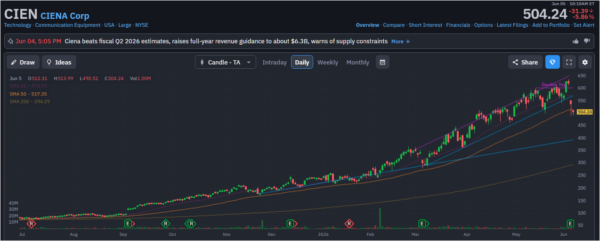
By the time Ciena reported earnings, shares had already climbed from roughly $230 at the start of the year to more than $620, a gain of nearly 170% in less than six months. A move of that magnitude is a reflection of the fact that investors were convinced the future is arriving faster than everyone else realizes.
Wednesday’s reaction suggests that conviction finally met resistance.
More than 7.6 million shares traded as the stock sliced below its 20-day moving average near $572. Yet the bigger picture barely changed. Shares remain above the 50-day moving average around $516 and nowhere near the 200-day moving average near $292.
Institutions didn’t abandon this position. They trimmed it. The selloff challenged the speed of the opportunity, not the destination, and that distinction matters enormously for how you think about what comes next.
What Comes Next?
Ciena’s results confirmed everything that matters about the long-term thesis. The demand is real, profitability is inflecting, and the customers funding the AI infrastructure buildout are spending heavily on exactly what Ciena builds. The only thing the quarter didn’t deliver was permission for the market to move even further ahead of the business than it already had.
Meaning, time is the only thing standing between Ciena and the future Wall Street already tried to buy at $620
Leave a Reply