The FDA PreCheck pilot program just handed Eli Lilly (NYSE: LLY) and Regeneron Pharmaceuticals (NASDAQ: REGN) a small regulatory tailwind. On June 29, 2026, the Food and Drug Administration named both drugmakers among seven companies chosen for an initiative designed to accelerate reviews of new domestic pharmaceutical manufacturing facilities.
Table of Contents
The program aligns with the Trump administration’s broader push to onshore U.S. manufacturing across critical industries. For drugmakers, faster facility approvals could mean shorter timelines between capital investment and revenue recognition.
However, retail investors should not overstate the catalyst. Being selected for a pilot program is a long way from a material earnings driver. Neither company will see immediate revenue or margin lift from the announcement, and the broader pharmaceutical pipeline still depends on clinical trial outcomes and pricing dynamics.
What the news does offer is a reason to look more closely at two stocks sitting at very different points in their respective cycles. Eli Lilly continues to ride the wave of GLP-1 demand and is quietly building an oncology pipeline that could eclipse the weight-loss franchise. Regeneron, by contrast, has been beaten down in 2026 and now trades at levels that may offer a short-term bounce setup.
For investors using the FDA PreCheck news as a starting point, the better short-term trade and the better long-term hold may not be the same name. The charts tell one story, and the fundamentals tell another. Both deserve a fresh look this week.
Eli Lilly’s Oncology Push May Outshine Its GLP-1 Franchise
Eli Lilly has become synonymous with the GLP-1 trade. Mounjaro and Zepbound have transformed the company’s revenue profile and made tirzepatide one of the most valuable drug franchises in the industry. Wall Street is pricing in continued demand growth, and capacity expansion remains a core part of the bull thesis.
However, the more interesting long-term story may be oncology. Lilly has been steadily building a cancer pipeline that targets some of the largest unmet needs in the market, including breast and lung cancer indications. Verzenio is already a multibillion-dollar franchise, and the company’s recent acquisitions and internal programs are aimed at extending that footprint.
The FDA PreCheck inclusion reinforces a pattern of constructive regulatory engagement that benefits Lilly as it scales both franchises. For long-term investors, the GLP-1 story may be the headline, but oncology could be the real durability lever.
Regeneron Offers a Discounted Entry After a Tough 2026
Regeneron has had a difficult 2026. Eylea biosimilar competition has weighed on the company’s most established franchise, and the stock has dropped from highs near $800 in late 2025 to roughly $632 today. That is a meaningful drawdown that has reset expectations and valuation.
However, Regeneron is not a one-product story. Dupixent, partnered with Sanofi, continues to expand into new indications and remains a major growth contributor. The company also has a deeper oncology and immunology pipeline, including Libtayo and several early-stage programs that could surface meaningful catalysts over the next 12 to 18 months.
The FDA PreCheck designation does not change the Eylea biosimilar dynamic, but it does signal that Regeneron’s manufacturing footprint is viewed favorably by regulators. For investors looking at a stock that has been left for dead, the combination of compressed valuation and a steady pipeline makes Regeneron worth a second look.
Technical Setup Favors REGN for a Near-Term Bounce
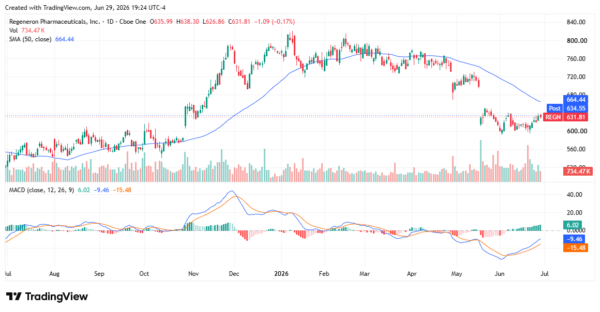
Regeneron’s chart shows the early signs of a reversal attempt. Shares trade at $631.81, still below the 50-day simple moving average at $664.44, which remains the first resistance level to clear. However, the MACD line has crossed above its signal line, and the histogram has flipped positive at 6.02. Both MACD lines are still in negative territory, suggesting the trend change is early, but the momentum is improving. Volume has remained steady through the basing process. A break above the 50-day SMA could open the door to a move back toward the $700 area, offering a clean short-term setup.
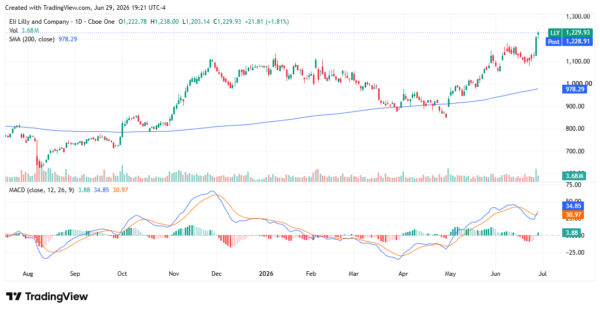
Eli Lilly looks technically stronger but offers less immediate upside. Shares closed at $1,229.93, up 1.81% on the day, and are well above the 200-day SMA at $978.29. The MACD line at 34.85 sits above the signal line at 30.97, with the histogram positive at 3.88. That confirms an ongoing uptrend, but the price is extended versus the moving average. New entrants may prefer to wait for a pullback toward the $1,100 area before adding. For existing holders, the chart supports continued accumulation rather than chasing here.
Why Biotech May Be the Next Hot Sector
Biotech has lagged the broader market for much of the past two years. Higher interest rates, drug pricing reform, and uncertainty around the regulatory environment kept capital on the sidelines. However, the setup is changing.
The FDA PreCheck program signals a more constructive regulatory tone, particularly around domestic manufacturing. Onshoring incentives, an aging U.S. population, and a wave of late-stage oncology and obesity catalysts could reset sentiment. If rate cuts continue and small-cap biotech stocks catch a bid, large-cap names like Lilly and Regeneron may benefit from a sector-wide rotation as investors look for both growth and defensive characteristics.
Two Ways to Play Pharma’s Onshoring Tailwind
The FDA PreCheck announcement is not a transformative catalyst for Eli Lilly or Regeneron, but it does point investors toward two distinct opportunities. Regeneron offers a near-term technical setup for a bounce after a steep 2026 decline, supported by a positive MACD crossover and a clear resistance level to break.
Eli Lilly remains the long-term compounder, with an oncology pipeline that may ultimately rival its GLP-1 franchise. Investors do not need to choose one over the other; the timeframes differ, and that should drive the allocation decision.
Leave a Reply