
Corporate America has figured out something investors already knew: a company without an AI story trades like a company without a growth story. Earnings calls that once centered on customers, margins, and market expansion now spend most of their airtime on artificial intelligence roadmaps and infrastructure spending, as executives race to claim a seat at what they believe is the defining technological shift of this generation.
Table of Contents
The results have been remarkable on paper. Earnings beats. Revenue growth. Higher guidance. New products landing on schedule. And yet investors checking their portfolios after these reports keep finding the same thing waiting for them – a lower stock price.
After working through earnings from Adobe, Salesforce, Broadcom, Ciena, and a handful of AI infrastructure names, the pattern became unmistakable. Since these companies delivered exactly what Wall Street asked for but still plummeted, let’s look into the reasons why this could be happening.
Adoption Is Old News, Revenue Decides What Happens Next.
Let’s start with Adobe Inc (NASDAQ: ADBE). In what seemed to be a clapback to narratives about the company becoming obsolete in the new age world of AI, the company recorded a second quarter revenue of $5.87 billion. Record EPS of $5.06. Raised guidance across the board. A fresh $25 billion buyback. And Firefly crossed 190 million users, a number that would have dominated headlines two years ago.
Investors went straight past it to one question: how much revenue do those 190 million users actually generate?
That single question didn’t just immediately deflate the company’s share price…
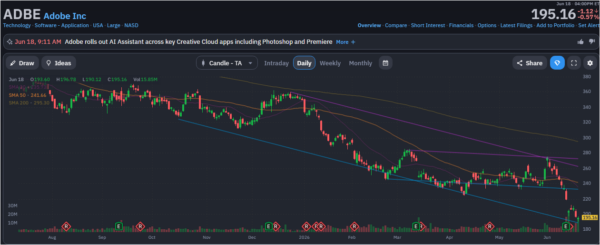
It marked the real shift happening across this entire sector. The market stopped asking whether AI works a couple of years ago.
Today, investors want to know whether AI pays and companies generating real dollars from artificial intelligence are starting to separate from companies generating excitement about it. Those are two different businesses wearing the same label, and the market is finally waking up to that shocking reality.
The Industry Has To Justify The Bill
AI has become one of the largest capital allocation exercises, surpassing the spending peak of the late 1990s Dotcom boom. Data centers are expanding. Chip orders keep climbing. Cooling and power infrastructure spending would have sounded absurd three years ago and now reads as routine.
Broadcom Inc (NASDAQ: AVGO) sits directly inside that cycle as the companyrecorded a second quarter revenue of $15 billion. AI revenue up 46% year-over-year to $4.4 billion. Guidance pointing to $5.1 billion in AI semiconductor revenue next quarter. Numbers built to settle any lingering debate about demand.
Those figures should have settled the debate. Instead, they created another one. Investors started evaluating whether AI revenue could continue expanding quickly enough to justify the billions being spent throughout the ecosystem.
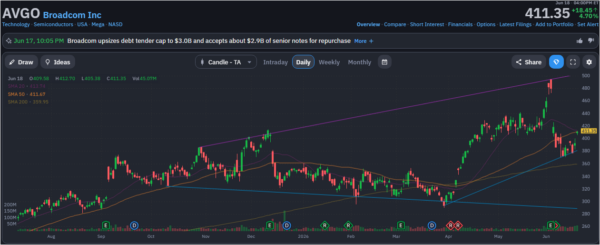
That question is now showing up on every call in this space. Executives talk about opportunity. Investors talk about efficiency. The conversation has moved from building AI infrastructure to extracting value from it, and that shift raises the bar every company in this sector has to clear, every single quarter, with no exceptions for size or track record.
The Next Three Years Are Important Than The Last Strong Quarter
Take a gander at Salesforce Inc (NYSE: CRM) last strong quarter. The company generated a revenue of $9.83 billion. Adjusted EPS of $2.58. Raised guidance to about $41 billion – $41.3 billion, expanded margins, free cash flow around $6.3 billion, continued buybacks. By any traditional measure, an excellent quarter.
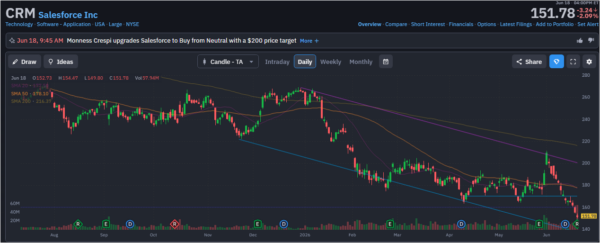
The conversation moved immediately to Agentforce and whether it can become a growth engine large enough to push revenue past what investors already expect. That’s the part most reactions get wrong. Investors weren’t grading last quarter. They’re pricing what this quarter implies about the next three years, and the market had already assumed Salesforce would execute well. What it wanted was proof that future growth could exceed assumptions that were already optimistic going in. That’s a considerably higher standard than beating last quarter’s number, and it’s becoming the standard test across this entire category.
My point is, each win pushes investor expectations up another notch, forcing companies to deliver even more just to hold the same level of enthusiasm they had last quarter.
That’s why strong numbers keep producing falling stocks because the market has moved past AI adoption to AI profits.
The Boom Is Real And The Winners Are Still Emerging
I remain bullish on artificial intelligence, and corporate America’s spending pattern says the conviction is shared broadly. Companies keep reorganizing around AI because customers want it, competitors are building it, and capital keeps flowing toward whoever looks best positioned to benefit. The infrastructure buildout shows no sign of slowing, and very few management teams seem interested in being the ones who hesitate.
But conviction in the trend has never meant conviction in every name riding it. The internet reshaped the global economy yet most internet stocks from that era no longer exist. AI will follow the same arc: genuine productivity gains, new markets, extraordinary winners, and right alongside them, plenty of overinvestment, weak business models, and companies that mistake spending for strategy.
Leave a Reply