
There’s a conflicting picture about consumer debt, and it’s more than just whether you look at the glass as being half empty or half full. That is, it’s not a case of perception. Instead, recent data shows that consumer debt reflects the reality of many Americans.
Table of Contents
On the one hand, Société Générale, a leading European bank, recently issued a note to its clients. According to the bank, total U.S. household debt is at record levels. That includes mortgage, credit cards, student loans, and auto loans. However, investors would do well to avoid taking that headline at face value. The implications are different based on the K-shaped nature of the economy.
For example, household debt service (i.e. the amount that consumers are required to pay every month) as a percentage of disposable personal income is below any point prior to 2020. Plus, Americans’ liquid net worth (i.e., cash on hand) is near its highest level in three decades.
But that’s an aggregate number. When you look at households with income on the lower leg of the K-shaped economy, the cracks and stress appear.
This is a story that’s been building for several years but is reaching critical mass as the rate of inflation continues to accelerate. It also provides a template for how investors should position themselves with stocks that are built to manage consumer uncertainty.
Visa Is Like Buying the Tollbooth on Borrowing
Visa (NYSE: V) is part of what remains a duopoly among payment servicers in the credit market. It operates similarly to a pipeline company in the oil and gas industry. It’s agnostic to inflation; the only thing that matters is payment flow.
The year-over-year (YOY) increases in revenue and earnings per share support the idea that consumers are borrowing at higher levels. The company’s Q2 2026 earnings report showed strong YOY beats and increased guidance for the full year.
Visa also builds shareholder equity. It repurchased a record $7.9 billion in shares in the quarter, paid out $1.3 billion in dividends, and the board approved a new $20 billion repurchase program that increases the company’s total buyback capacity to $33 billion.
And Visa is not overlooking the digital revolution. In the last quarter, the company highlighted several product launches that set it up for growth in the areas of agentic commerce and stablecoins/blockchain.
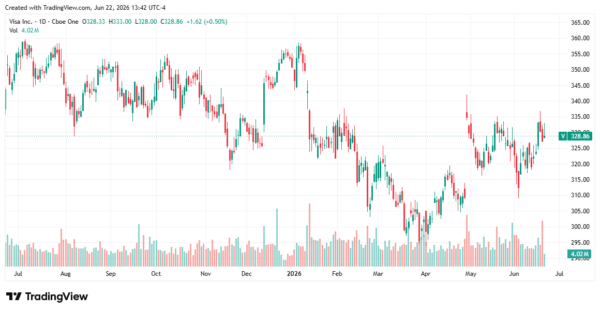
But V stock is trading at a discount. It’s down 2.8% in the last 12 months, with almost that entire loss coming since the start of the year. That said, the valuation looks attractive for a company that’s forecasting approximately 13% earnings growth in the next 12 months.
Synchrony Bank is a High-Risk, High-Reward Play
The name Synchrony Financial (NYSE: SYF) may not be immediately familiar, but its partners certainly are. The company powers the store credit cards for brands like Amazon, PayPal, and Lowe’s, operating across more than 73 million active accounts. That scale makes SYF one of the most direct expressions of consumer credit stress and a compelling contrarian opportunity.
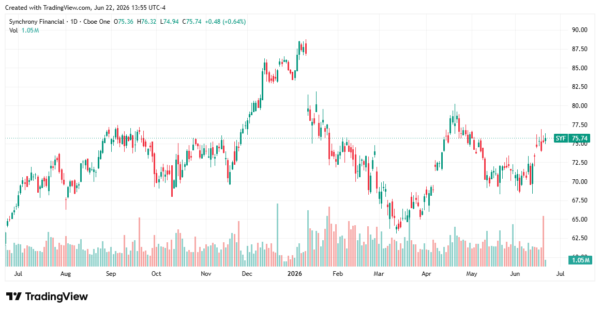
Here’s how that case lays out. Synchrony carries one of the highest 30-plus-day delinquency rates among major card issuers, serving lower-prime and retail-store card segments at roughly double the rate of JPMorgan and Citigroup. That’s the bad news, and it’s priced in. SYF has pulled back significantly from its highs, with analysts’ price targets being cut broadly across consumer finance names.
But the market may be over-discounting the risk. The company’s Q1 2026 EPS rose 20% year-over-year to $2.27, net interest margin expanded to 15.5%, loan yields came in at 21.8%, and charge-offs actually declined to 5.42%. Management also maintained its full-year EPS guidance of $9.10 to $9.50 and expects net charge-offs to remain below 5.5% for the year, with loan receivables growing in the mid-single digits by year-end.
Capital returns tell the same story of confidence. The board approved a new $6.5 billion share repurchase program with no expiration date, replacing the prior program, and also approved a planned 13% increase in the quarterly cash dividend to $0.34 per share beginning in Q3 2026.
The stock trades at a forward P/E of just over 8x, well below the S&P 500 average, while analysts maintain a consensus Buy rating with 16 buy ratings versus only one sell, and a consensus price target implying roughly 26% upside from current levels. For investors willing to hold through near-term volatility, SYF offers an attractive entry point into a business that is built to profit from a consumer debt environment.
Dollar General Will Benefit from the Spending Squeeze
Discount retailers were the winners of the first quarter earnings season. And there was, perhaps, no better example of that than the report from Dollar General (NYSE: DG). The company reported a top- and bottom-line beat, along with an increase in same-store sales.
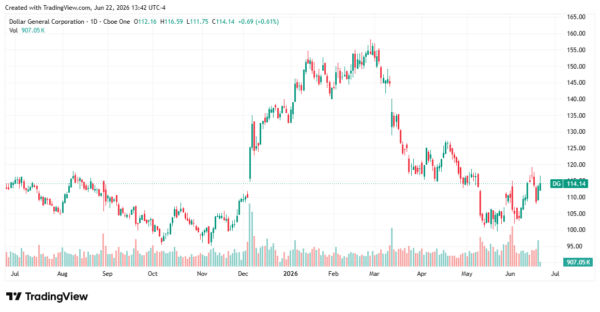
That trifecta, along with rising consumer debt data, should have sent DG stock soaring. But it didn’t, as investors took to selling out of retail stocks in the SpaceX hype. That trend has reversed, and with the stock down nearly 14% in 2026, this could be an excellent time to get in on DG stock at a discount.
One reason to believe in Dollar General was what management had to say about the consumer who was coming through the door. It’s not just the lower-income consumer. Even more affluent consumers are hunting for value. Given that inflation is likely to remain above the Federal Reserve’s preferred target for some time, that trend is likely to stay in place.
These 3 Stocks Can Help Investors Navigate the Consumer Debt Crossroads
The Société Générale note is a useful reminder, not a fire alarm. Record consumer debt is a real trend with real consequences — but it plays out unevenly, and that’s where opportunity lives for investors who look past the headline.
Visa benefits regardless of whether borrowers pay their full balances or carry them, collecting its toll every time a card is swiped. Synchrony is priced as if the consumer credit cycle is worsening, even as its own data show charge-offs stabilizing and earnings growing. And Dollar General is positioned to capture the trade-down behavior that typically accelerates when household budgets are squeezed.
None of these is a bet that the economy weakens further. Instead, they’re bets that the K-shaped reality of consumer debt — stressed at the lower end, resilient in aggregate — continues to shape spending and credit behavior for the foreseeable future. That’s a durable enough thesis to act on today.
Leave a Reply