
For centuries, military power followed a familiar path. Nations fought to control territory, then sea lanes, then the skies above them. Each shift created new winners, new technologies, and new industries. Today, another transition is taking shape, except this time the battlefield sits in space.
Table of Contents
That may sound dramatic until you consider how modern conflicts are fought. Satellites help guide missiles, coordinate troops, support drone operations, and provide the intelligence commanders rely on before making decisions.
That’s why I think investors are still looking at this sector through the wrong lens. The next space race isn’t primarily about tourism, moon landings, or colonizing Mars. It’s about building the systems that allow nations to launch faster, see farther, and act sooner than their rivals. That said, these 3 stocks top my list:
Rocket Lab:The Company Building The Roads Into Orbit
Every satellite, missile-warning system, communications platform, and intelligence network begins with the same question: how does it get into orbit in the first place?
That’s where Rocket Lab (NASDAQ: RKLB) enters the story.
The first thing that comes to most investors’ minds when they hear Rocket Lab is “launch provider”. That term is limiting. Rocket Lab is now morphing into a vertically integrated space and defense contractor, one that launches satellites, manufactures critical components, develops spacecraft, and continues winning larger government programs.
Its recent $816 million missile-warning satellite contract is a perfect example. Governments aren’t awarding contracts of that size because they need rockets, or bragging rights of space landing. They’re awarding them because they need infrastructure. In fact, the company also reported record 2026 quarter 1 revenue of $200 million and a record backlog of $2.2 billion, providing a glimpse into how rapidly demand is expanding across both commercial and defense markets.
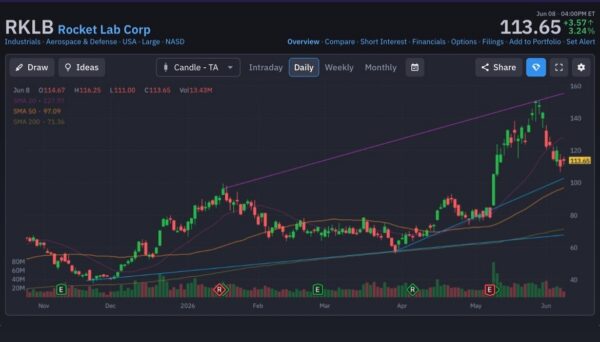
Rocket Lab shares spiked from $60 in April to nearly $150 before pulling back, a move that naturally invited profit-taking after one of the strongest rallies anywhere in aerospace. Yet even after the correction, the stock remains comfortably above its 50-day moving average near $97 and its 200-day moving average near $71. The recent decline looks dramatic when viewed in isolation. Viewed in context, it looks more like investors digesting gains while the underlying business continues accumulating contracts.
Infrastructure might not always be the most exciting part of a military system, but it’s often the most important.
Planet Labs: The Company Building The Eyes
Getting assets into orbit solves one problem. But knowing what’s happening on Earth creates the next advantage.
Military history is filled with examples of armies losing battles because they lacked information. Today the challenge isn’t collecting information. It’s collecting it fast enough to matter. That’s why you’d find Planet Labs PBC (NYSE:PL) an interesting choice.
The company operates one of the largest Earth-observation satellite networks in existence, generating imagery and data that governments use for border surveillance, infrastructure monitoring, military analysis, disaster response, and intelligence gathering. Roughly 60% of revenue comes from defense-related customers, which makes Planet less of a traditional space company and more of an intelligence platform operating from orbit.
Its Q1 fiscal 2027 earnings’ numbers support that view. Revenue climbed 42% to $94.2 million, management raised guidance, and backlog surpassed $900 million. Yet despite those results, the stock suffered a sharp pullback. That took me aback until I looked into what happened before the selloff.
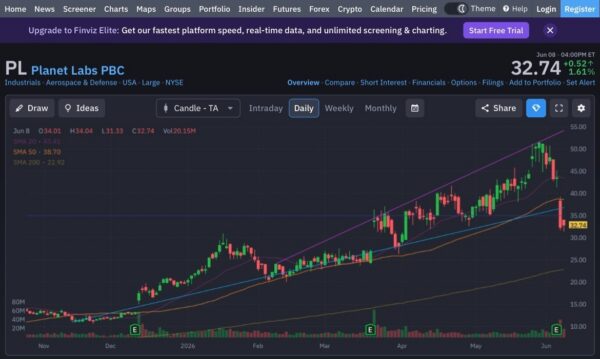
Shares had climbed from under $20 to more than $50 in only a few months, transforming Planet into one of the market’s hottest space names. Investors weren’t paying for a strong business anymore. They were paying for flawless execution. When expectations reach those levels, even good news can trigger selling.
What I find encouraging is where the stock stabilized. Despite the decline, shares remain well above their 200-day moving average, while the broader uptrend remains intact. The market appears to be resetting expectations rather than questioning the long-term opportunity.
If Rocket Lab is building the roads into orbit, Planet is building the eyes.
BlackSky: Turning Information Into Advantage
Information alone doesn’t create military superiority, what you do with it, the interpretation, does. Take a satellite image, for example. Having such an image, and most importantly, knowing what it means before anyone else does can be the difference between getting attacked or being proactive enough to stop it dead in its tracks, which is a real warfare advantage. That’s the role BlackSky Technology Inc (NYSE: BKSY) occupies.
The company combines satellite imagery, AI-powered analytics, and real-time intelligence tools designed to help governments make decisions faster. In many ways, BlackSky sits at the final layer of the military-space stack. Rocket Lab launches the infrastructure. Planet collects the information. BlackSky transforms information into actionable intelligence.
That distinction matters because governments ultimately aren’t just buying pictures but answers.
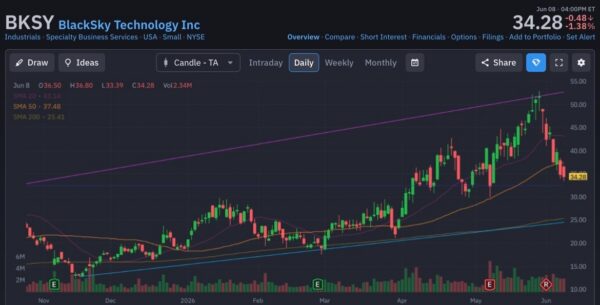
The company generated $20.8 million in quarterly revenue, raised guidance, secured contracts worth up to $160 million, and continues deploying its next-generation Gen-3 satellite constellation. Meanwhile, the stock surged toward $50 before retreating into the mid-$30s as profit-taking spread across the sector.
Yet the longer-term chart remains constructive. Shares continue trading above their 200-day moving average near $25, suggesting investors are reassessing expectations rather than abandoning the thesis altogether. The market may be debating growth rates. But governments are focused on intelligence advantages.
The New Arms Race Is Already Underway
Rocket Lab is helping build the infrastructure. Planet Labs is gathering the information. BlackSky is turning information into intelligence. Three companies. Three layers of the same military-space system. Indicating that the next military race may not be decided by who has the biggest army, the largest navy, or the most advanced aircraft. But by who launches first, sees first, and understands first.
These companies are positioning themselves at every step of that chain, as I am.
Leave a Reply