
During the COVID pandemic, companies faced a problem they had never encountered at scale. Employees were suddenly scattered across spare bedrooms, kitchen tables, and home offices, yet projects still needed approvals, customers still needed support, and decisions still needed to move through organizations. The world responded the only way it knew how: more communication.
Table of Contents
That wave helped transform Zoom Communications Inc. (NASDAQ: ZM) from a business software company into a household name.
In its quarter 1 FY2027 earnings, Zoom reported revenue of $1.17 billion and diluted EPS of $1.41. But the most shocking thing is that today, the company is betting the next workplace revolution will be driven by the opposite problem.
The Modern Workplace Has Become Addicted To Coordination
The truth is, most executives don’t wake up wishing they had more meetings
They want projects moving faster, decisions getting made sooner, and fewer hours disappearing into coordination work that somehow expands every year despite technology supposedly making everyone more productive.
Much of corporate life remains built around one stubborn reality: information moves imperfectly between people, forcing companies to build layers of meetings, approvals, and management structures whose primary purpose is keeping everyone aligned.
The irony is hard to miss. Zoom became one of the defining winners of an era when companies needed more communication and coordination just to keep work moving. Now it’s positioning around a future where businesses pay to eliminate those same frictions, because every hour lost to bureaucracy is an hour not spent creating value. And judging by the numbers in this quarter’s earnings, customers are already beginning to buy into that vision.
Beyond Video Meetings
Zoom Phone surpassed 8 million paid seats while enterprise revenue grew 6% year-over-year.
More importantly, Zoom ended the quarter with 4,192 customers generating over $100,000 in trailing twelve-month revenue, an 8.2% increase from a year ago. Those are the customers with the most bureaucracy, the most coordination challenges, and the most money to spend solving them.
Operating cash flow reached $552 million, free cash flow came in at $504 million, gross margins remained near 77%, and the board authorized an additional $1.2 billion share repurchase program. These numbers indicate a company expanding beyond video meetings.
That’s why management spent so much time discussing AI Companion, Agentic AI, Zoom Workplace, Contact Center, and workflow automation. The common thread running through all of them is simple: reducing the administrative burden surrounding work itself.
The Meeting Is Becoming The Cheapest Part Of Work
For years, technology companies have competed to make communication easier.
Now they are competing to make communication less necessary, a strategy Zoom is integrating into its system at breakneck speed.
In fact, as I write to you, the company is already building tools that summarize conversations, identify action items, retrieve information, automate follow-ups, and move work forward after people stop talking.
That matters because meetings have become a commodity. Microsoft Corporation (NASDAQ: MSFT), Alphabet Inc. (NASDAQ: GOOGL), and Cisco Systems Inc. (NASDAQ: CSCO) can all host meetings.
Now, you’ll find the real value in what happens afterward. Once AI can capture decisions, organize knowledge, assign tasks, and automate follow-through, the meeting starts looking less like the product and more like raw material feeding a larger productivity engine.
That’s a dangerous shift because the companies creating the most value will no longer be the ones helping employees talk to each other, but the ones helping them avoid unnecessary conversations altogether, because now they’ll be able to increase the speed of execution.
This Looks Like A Growing Confidence In Zoom
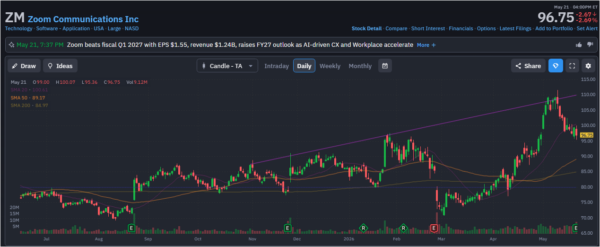
Zoom Communications spent most of the past year building a base between $75 and $90 before finally breaking higher in April. That breakout carried shares above both the 50-day and 200-day moving averages and culminated in a sharp run toward the $110 area, where sellers stepped in almost immediately.
The post-earnings pullback looks more like profit-taking than technical damage. Shares remain above both major moving averages, with the 50-day average near $89 now acting as the first meaningful support level. Volume expanded during the breakout and remained elevated around earnings, suggesting institutions are actively involved.
The key level to watch is the recent breakout zone between $90 and $92. As long as buyers defend that area, the larger uptrend remains intact. A successful retest would strengthen the case that the market is beginning to price Zoom as more than a video conferencing company.
Sit Tight For Another Workplace Revolution
During the pandemic, companies needed more communication because people could no longer sit in the same room. Today, they are searching for ways to reduce bureaucracy because too many people spend too much time discussing work instead of doing it.
AI Companion, Agentic AI, workflow automation, Contact Center, and Zoom’s investment in Anthropic all point in the same direction. The company is less interested in defending a video conferencing product and more interested in owning a larger productivity layer.
So, while investors still see Zoom as a meeting company or a pandemic relic. I see a future where companies spend billions to reduce the friction in work. And if that shift gains momentum, Zoom may benefit from the next workplace transformation just as it benefited from the last one.
Leave a Reply