
At a time when investors have a steep climb up the wall of worry, there’s logic in taking shelter in two blue-chip stocks: Exxon Mobil (NYSE: XOM) and Chevron (NYSE: CVX). Each company reported earnings on May 1. You can’t go wrong with either name in your portfolio as a long-term investment. But there is one name that may be the better short-term play in the energy trade.
Table of Contents
How Geopolitics Are Heating Up the Energy Trade
Energy stocks have been the hot trade since the United States and Israel began military operations against Iran. The subsequent closing of the Strait of Hormuz added more volatility to a super-charged market.
With the Middle East and oil prices in flux, many traders are looking for asymmetric opportunities. But those come with risk, particularly if you’re caught in a long position when oil prices reverse. Of course, when that will be is anyone’s guess. But as of May 8, oil prices were moving lower on anticipation of a resolution. Or at least, the idea that the parties would begin earnest negotiation to that end.
How Exxon Mobil and Chevron Are Similar and Why It Matters?
ExxonMobil and Chevron are integrated oil companies with global portfolios including projects in the coveted Permian Basin as well as in Guyana. Chevron gained access to the latter through its merger with Hess, which was completed in July 2025. However, Exxon Mobil retains rights to some of the projects it had with Hess prior to the merger.
Both companies are at the top of the list when it comes to executing the Trump administration’s plan for U.S. energy independence. They have the scale and the balance sheet to help increase production and keep it flowing.
Reading the Earnings Reports
When companies report earnings, the “headline numbers” (e.g., revenue and earnings per share) get the headlines. But earnings reports are progress reports and are both backward and forward-looking. That’s why it’s important for investors to look beyond the headlines.
The Q1 reports from ExxonMobil and Chevron are a good example of this. ExxonMobil posted GAAP earnings of $4.2 billion, which looks modest until you strip out a $706 million charge related to Middle East supply disruptions. Specifically, physical delivery failures on hedges after Qatari LNG facilities were struck.
Adjusted for that and for mark-to-market timing effects on open derivative positions, XOM earned $8.8 billion. Cash flow from operations came in at $8.7 billion, or $13.8 billion excluding margin postings, above the company’s own 12-quarter average. ExxonMobil paid out $9.2 billion to shareholders in a single quarter.
Chevron’s quarter was shakier. GAAP earnings of $2.2 billion adjusted to $2.8 billion, with the downstream segment acting as the primary drag. International downstream posted an adjusted loss of over $1 billion, driven largely by $1.47 billion in negative timing effects on derivative positions.
Strip those out and the underlying business looks considerably better, with adjusted upstream earnings of $4.1 billion and production climbing to 3,858 thousand barrels of oil equivalent per day — boosted by contributions from the Hess integration. Chevron returned $6 billion to shareholders through dividends and buybacks and notably kept its full-year guidance unchanged.
Both companies responded differently to the Middle East disruption. ExxonMobil has roughly 20% of its global production tied to the region and absorbed a direct operational and financial hit. Chevron’s regional exposure was more limited, reporting only modest production impacts.
That said, both companies benefited from the macro tailwind of the energy trade. That is, crude prices posted their largest-ever monthly gain; LNG spot prices are surging, and refining margins are running above historical averages.
What Happens If There’s a Peace Deal?
This is the question every energy investor should be asking right now. A Strait of Hormuz resolution would likely mean lower crude prices, compressed LNG premiums, and normalizing refining margins — essentially unwinding the primary tailwind both stocks have been riding. Neither name is immune to that scenario. The question is which company holds up better when the trade reverses.
ExxonMobil has accumulated $15.6 billion in structural cost savings since 2019. That’s more than all other major international oil companies combined, as measured by its own accounting. That cost base gives XOM lower effective breakeven and more durable earnings at subdued prices. Its 2030 plan projects $25 billion in earnings growth and $35 billion in cash flow growth at constant prices, meaning the growth story doesn’t depend on oil staying elevated. Chevron’s equivalent cost reduction target is $3 to $4 billion by year-end 2026. That’s meaningful, but just a fraction of XOM’s cumulative effort.
The Technical Picture
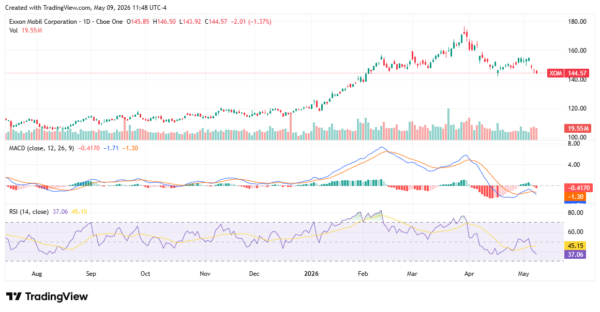
The charts add important context. XOM is trading around $144.57 after pulling back sharply from a March peak near $178. The RSI sits at 37, approaching oversold territory, while the MACD remains in negative territory but is beginning to turn. The stock has found support near the $140 level, which corresponds to a prior area of consolidation from late 2025. A bounce from current levels would have technical merit — and the fundamental story hasn’t deteriorated.
CVX tells a similar technical story. Trading near $181.62 after retreating from highs above $210, its RSI of 38 is also approaching oversold conditions. The MACD pattern mirrors XOM’s, negative but showing early signs of flattening. CVX has held support around the $175-180 zone, which was a prior breakout level in late 2025.
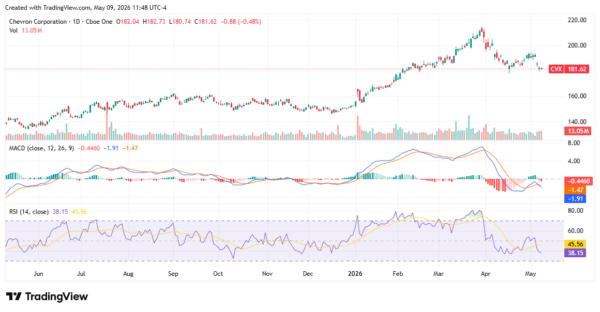
Both charts look like they’re searching for a bottom. Neither is in free fall.
Which Name Is the Better Short-Term Choice in the Energy Trade
For long-term investors, both names deserve a spot in a diversified portfolio. The energy sector’s structural role in the global economy isn’t going away, and both companies have the balance sheets and capital discipline to reward patient shareholders through multiple price cycles.
For traders looking at the shorter-term energy trade, ExxonMobil has the edge. Its earnings quality is stronger, its cost structure is more resilient, its balance sheet is cleaner — net debt-to-capital of just 13% versus Chevron’s more leveraged position — and its operational execution in Guyana and the Permian gives it durable volume growth that doesn’t require conflict to continue. Chevron’s Hess arbitration overhang introduces binary risk that XOM simply doesn’t carry.
Both stocks are near technical support. If oil prices stabilize and the macro backdrop holds, either could reward buyers at current levels. But if you’re choosing one, XOM’s fundamentals make the stronger case.
Leave a Reply