Tower Semiconductor LTD (NASDAQ: TSEM) just reported Q1 2026 earnings with revenue of roughly $414 million, up 15% year-over-year, while diluted EPS climbed to 64 cents from 40 cents last year. Gross profit surged 52% to approximately $111 million as gross margin expanded from 18% to 26.8%.
Table of Contents
That was a good quarter. Then management disclosed a single figure that completely changed how I read the quarterly report.
Specifically, customers prepaid Tower Semiconductor $290 million tied largely to silicon photonics demand, while the company locked in approximately $1.3 billion in contracted silicon photonics revenue for 2027.
But nobody hands a semiconductor foundry $290 million years ahead because things are “comfortable”. That only happens when industries start realizing future access may become more important than future pricing.
AI Boom Is Beginning To Slam Into Physics
For the last two years, the AI race revolved around one thing: more GPUs. But President Trump’s latest visit to China, alongside Nvidia CEO Jensen Huang and other semiconductor executives, revealed something bigger than “GPUs” underneath the AI race.
That is, semiconductor infrastructure has now matured into full geopolitical infrastructure. Governments, hyperscalers, and chip companies are no longer fighting only over AI models or computing power. The pressure is shifting deeper into the systems moving electricity, networking, bandwidth, and data fast enough to keep future AI infrastructure scaling.
This is why I wasn’t surprised when NVIDIA (NASDAQ: NVDA) launched silicon photonics networking systems designed to move data using light rather than traditional electrical signaling, as AI infrastructure keeps scaling up and becoming more power-intensive.
Or when Broadcom (NASDAQ: AVGO) reported that it is also expanding co-packaged optics infrastructure built specifically for AI networking scalability. Because the real problem now is no longer just compute. The systems themselves are beginning to choke on: heat, electricity, latency, bandwidth, and the physical challenge of moving enormous amounts of data between GPUs fast enough to keep scaling AI workloads efficiently.
And if you think that means optical communication systems are set to become mandatory for next-generation AI infrastructure as copper-based systems approach physical scaling limits, you’d be right.
Actions Speak Louder Than Voice
Tower Semiconductor’s operating profit surged roughly 96% year-over-year to approximately $65 million while operating margin expanded from 9.1% to 15.7%. Management also guided Q2 revenue toward roughly $455 million, which would mark the highest quarterly revenue in company history.
Those figures were strong. But the prepayments were stronger because customers usually do not reserve future foundry capacity this aggressively unless they believe the next bottleneck is already forming underneath the market.
In fact, as we speak, Tower Semiconductor is set to quintuple monthly silicon photonics output by the end of 2026 after securing large AI-linked customer agreements tied directly to future infrastructure demand.
That combination stayed with me the entire earnings call: $290 million upfront, $1.3 billion in future contracts, record guidance, exploding margins, and aggressive optical infrastructure expansion underneath the AI buildout.
The quarter started feeling less like a semiconductor earnings report and more like companies quietly scrambling to secure positions before the next infrastructure bottleneck gets worse. Let that settle in for a second.
How Big Is The $290 Million Prepayment?
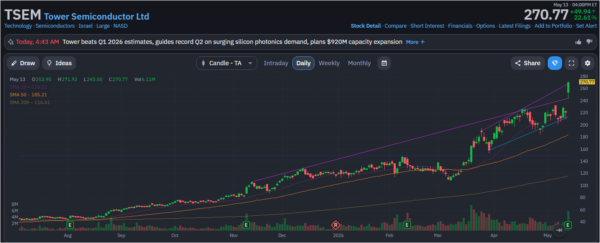
TSEM surged more than 22% after earnings, closing near $270 after exploding higher from the prior close of around $220. Volume also surged above 6 million shares, several times higher than the stock’s normal trading activity.
Wall Street does not usually gap a semiconductor foundry higher by that magnitude overnight unless investors believe something inside the business has changed.
Buyers aggressively repriced the stock after management disclosed: $290 million in customer prepayments, $1.3 billion in contracted silicon photonics revenue, and plans to expand photonics capacity to meet accelerating AI infrastructure demand.
Technically, the earnings move also shattered the upper trend channel that had capped price action for months while pushing TSEM dramatically above the 20-day moving average near $216 and the 50-day moving average near $185. The gap itself completely altered the chart’s structure.
The key zone now sits around roughly $240-$245 near the top of the breakout area. If institutional buyers continue defending that earnings gap aggressively, investors may begin treating TSEM less like a specialty foundry and more like a strategic infrastructure company sitting underneath the next phase of AI scaling.
I’m In Position with Tower Semiconductor
If you still think the AI race revolves around whichever company sells the fastest chips, you’ll need to catch up. The fight is already moving lower into the infrastructure stack itself.
AI systems now need faster networking, lower latency, lower heat generation, and dramatically more efficient data transfer just to keep scaling larger workloads. That pressure is pushing the industry toward optical communication systems capable of replacing parts of the copper-based architecture that modern AI systems increasingly struggle to scale efficiently.
And Tower Semiconductor suddenly sits right in the middle of that transition.
Customers already prepaid $290 million before much of that future infrastructure even fully arrives. That doesn’t look like normal semiconductor demand to me.
Instead, it looks like an industry starting to realize the next AI bottleneck may already be forming underneath the surface – and quietly paying up before everybody else catches on.
Leave a Reply