
The global lithium market is just starting to rebound. In fact, as sentiment improves and long-term demand expectations strengthen, analysts are predicting a lithium boom. Several mining companies are moving quickly to restart production and advance new exploration programs across key lithium-producing regions. Companies like Core Lithium, for example, just restarted its Finniss mine operation in Australia’s Northern Territory. Mineral Resources restarted operations at its Bald Hill Lithium mine in Australia, as well.
Table of Contents
In addition, with global electrification trends accelerating and governments around the world prioritizing lithium supply needs, many analysts believe the lithium sector may still be in the early stages of its next major growth cycle.
Also, remember, as noted by Wood Mackenzie, “Lithium is irreplaceable for the energy transition, and the industry faces structural supply challenges that require immediate action. The question isn’t whether we need more lithium. It’s whether the industry can mobilize capital fast enough to meet demand while navigating an increasingly fragmented global trade environment.”
Lithium Supply Constraints Are Becoming a Major Theme
Even after lithium prices corrected sharply from their 2022 highs, many producers slowed expansion projects or delayed new developments due to lower profitability. That slowdown is now creating concerns about future supply availability just as electric vehicle demand begins accelerating again.
Analysts increasingly believe the market could face another meaningful supply deficit by the end of the decade, particularly as battery manufacturers secure long-term contracts to lock in raw materials. This dynamic is helping restore investor confidence across the lithium sector and could create favorable conditions for lithium-focused equities and ETFs moving forward.
One of the simplest and most effective strategies to trade a lithium boom is through exchange-traded funds (ETFs).
Why ETFs May Be the Smartest Way to Play the Lithium Boom
Lithium investing can be highly volatile because individual mining companies are often exposed to operational setbacks, geopolitical risks, and fluctuating commodity prices. ETFs help reduce some of that company-specific risk by spreading exposure across multiple segments of the lithium supply chain.
Investors not only gain access to lithium miners but also battery manufacturers, chemical processors, and electric vehicle companies that stand to benefit from long-term electrification trends. For investors looking to participate in the lithium boom without betting heavily on a single stock, diversified ETFs can provide a more balanced approach.
ETFs provide diversified exposure across the entire lithium value chain — from mining and refining to battery production and electric vehicles.
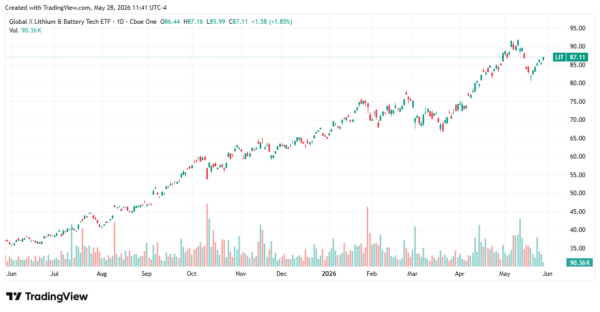
For example, the Amplify Lithium & Battery Technology ETF (NYSEARCA: LIT) offers broad exposure to companies involved in battery metals, energy storage, and EV manufacturing. Its portfolio includes a mix of miners, manufacturers, and technology firms, giving investors a balanced way to participate in the lithium ecosystem without relying on any one company to perform.
This is a market-cap weighted fund with approximately $2.2 billion in assets under management (AUM). And investors should be warned that the fund’s net expense ratio is 0.75%, which is a bit high. As of May 28, 2026, the fund’s largest holding by weight is Rio Tinto (NYSE: RIO), which is about 20% of the fund’s weight.
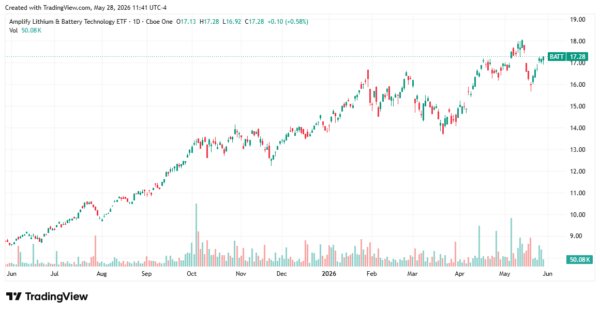
Another popular option is the Global X Lithium & Battery Tech ETF (NYSEARCA: BATT), which takes a similarly comprehensive approach. This fund invests across the full lithium cycle, including upstream mining companies and downstream battery producers. Its holdings span global leaders in the space, providing diversified access to a sector that is expected to play a central role in the future of energy.
Like LIT, this is a market-cap weighted fund, but it’s much smaller. As of May 28, 2026, the fund had approximately $139 million of AUM. Tesla Inc. (NASDAQ: TSLA) and Freeport-McMoRan (NYSE: FCX) are among the top holdings. The fund’s net expense ratio is 0.59%.
Institutional Investors Are Returning to Battery Metals
Another emerging trend supporting lithium stocks is the renewed interest from institutional investors and large asset managers. As governments expand clean energy initiatives and automakers commit billions toward EV production, battery metals are increasingly being viewed as strategic long-term resources.
This shift is encouraging greater capital investment into lithium exploration, refining infrastructure, and battery technology development. At the same time, geopolitical concerns surrounding supply chains are pushing Western countries to prioritize domestic and allied lithium production, creating additional tailwinds for companies operating in politically stable mining regions.
Diversification is Key
The lithium boom appears to be entering a new phase, one defined by structurally strong demand and increasingly constrained supply. As electrification trends accelerate globally, lithium’s role in the energy transition becomes even more critical, reinforcing the long-term case for a sustained lithium bull market.
While short-term volatility is always a factor in commodity markets, the underlying fundamentals supporting the lithium boom remain firmly intact. Supply deficits, rising EV adoption, and growing institutional attention all point to a market that may be tighter than many investors expect.
For investors willing to take a disciplined and diversified approach, the current environment could offer an attractive entry point. Whether through individual equities or broad-based ETFs, positioning for the next phase of the lithium boom may prove to be a strategic move as the global energy transition continues to unfold.
Leave a Reply