
Back in the early 2000s, people constantly mocked Microsoft Corp (NASDAQ: MSFT) products. Outlook froze. Internet Explorer became a meme before memes even existed. Employees complained about Windows every chance they got. Yet corporations stayed locked inside Microsoft’s ecosystem because replacing it would have wrecked workflows across entire organizations already built around the software.
Table of Contents
I think investors should look at Salesforce Inc (NYSE: CRM) through that exact lens right now.
Salesforce reported first-quarter fiscal 2027 earnings, with earnings per share coming in hot at $3.88 and revenue of $11.13 billion, both ahead of Wall Street estimates. Fine. Everybody already knows that part. What interests me now is the growing gap between how the market talks about Salesforce and what the figures actually suggest about customer behavior underneath the surface.
Customers Keep Committing More Future Dollars Despite AI Threat
Start with the figure that changes the entire quarter once you connect it to the broader software environment: current remaining performance obligations rose 12% year over year while revenue grew 13%.
Subscription and support revenue climbed another 9% year over year, while Salesforce closed 98 deals worth more than $1 million in annual contract value during the quarter. That is important because large enterprises usually cut experimental software spending first when budgets tighten. The numbers here suggest Salesforce still sits inside the “mission-critical” category for many organizations.
Even with such hard figures and facts, investors still analyze Salesforce like consumers choosing apps on a phone. Large corporations do not operate that way. Entire sales operations, customer databases, support systems, compliance workflows, and internal automations often sit inside Salesforce after years of customization and integration work. Replacing it becomes expensive, political, disruptive, and risky across multiple departments at once.
Why Governments Trust Industry Monarchs Over Unproven Startups
Now connect those figures to the company’s recent partnerships and contracts because they support the same thesis from another angle.
Salesforce expanded its Formula 1 partnership around Agentforce. The U.S. Department of Labor adopted Agentforce to support citizen services. Then the U.S. Army awarded Salesforce a $5.6 billion contract tied to military modernization and Department of War readiness initiatives.
Most people will skim those headlines and move on because they do not sound as flashy as AI chip announcements or trillion-dollar infrastructure spending stories.
But you see, large institutions do not hand sensitive workflows, operational systems, or citizen interactions to unproven AI startups with no track record. They lean toward vendors, the industry Monarchs, already embedded inside their infrastructure, because trust matters more once critical systems get involved. Salesforce understands this. The company is trying to position itself as the trusted AI layer sitting inside existing enterprise operations before the software landscape shifts further.
And honestly, I think the market still underestimates how powerful incumbency becomes during periods of technological transition. AI may eventually weaken software moats over time, but right now, it may actually strengthen the largest enterprise incumbents first because enterprises prefer familiar vendors handling sensitive data and workflow automation.
The Relentless Doubting Thomases
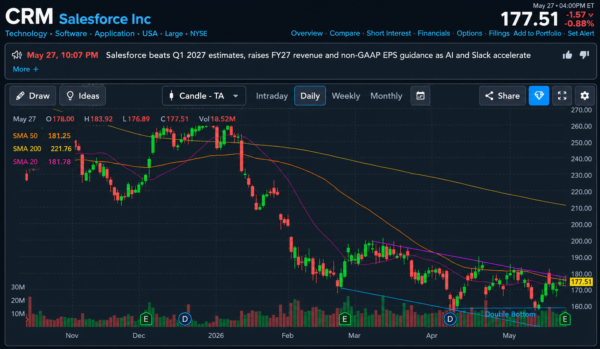
Look at the chart, and you can already feel the hesitation around Salesforce (NYSE: CRM). The company beat earnings, raised guidance, pushed AI partnerships harder, and still the stock closed at $177.51, down 0.88% after trading nearly 18.52 million shares. That reaction tells you investors still do not fully trust the story.
And honestly, I understand the skepticism. CRM has spent months trapped below its declining 50-day and 200-day moving averages after getting crushed from the $260 zone earlier this year. Every rally attempt keeps running into sellers, which usually happens when institutions are still questioning whether AI can genuinely reaccelerate growth or merely defend the existing business.
Still, despite all the volatility, the stock keeps defending the mid-$150s area while building a possible double bottom structure. That does not look like panic liquidation anymore. It looks more like a market waiting for proof.
If It Looks, Acts, And Moves Like A Mature Company… Maybe it is
The rest of the quarter reinforces the same transition.
Operating cash flow reached $6.5 billion while free cash flow came in at $6.3 billion. Non-GAAP operating margin expanded to 32.3%, and management announced a $25 billion accelerated share repurchase, the largest buyback program in company history.
The more I think about it, the more Salesforce looks like a mature enterprise platform extracting more profit, more cash flow, and more operating leverage from an already entrenched customer base. Hypergrowth software companies usually prioritize expansion and aggressive reinvestment above everything else. On the flip side, mature enterprise platforms prioritize margins, cash generation, and shareholder returns because the customer base already behaves like recurring infrastructure revenue.
That transition creates the tension around CRM now because the market still wants software companies to produce explosive AI-driven acceleration, yet Salesforce’s figures continue pointing toward something more durable and less exciting on the surface: a deeply embedded enterprise platform using AI to strengthen customer dependence before competitors can weaken it.
Remember The Threat, But Stick To The Figures
At the same time, the long-term threat remains obvious. If AI agents eventually sit above software stacks and automate workflows independently, traditional software suites could lose pricing power across the industry. Microsoft remains dangerous because it already controls productivity infrastructure while integrating AI deeper into enterprise workflows every quarter.
Still, this earnings report showed something investors probably should not ignore. Enterprises continue committing future dollars to Salesforce despite every AI headline screaming that software disruption is accelerating.
Until those figures crack, betting against Salesforce becomes harder than many investors want to admit.
Leave a Reply