
Pinterest Inc. (NYSE: PINS) reported Q1 2026 earnings results, with EPS of $0.27 vs $0.23 expected and revenue of $1.008 billion, a clean beat on both lines. But if you stop there, you miss what actually happened.
Table of Contents
This wasn’t a case of demand returning or users suddenly flooding back into the platform. This is the result of a system that has become far more aggressive at turning attention into revenue through its latest adoption of AI.
Revenue Is Outrunning Users
Pinterest grew monthly active users to 631 million, up 11% year-over-year, while revenue climbed 18%, and that gap is not a rounding error or a seasonal quirk. It is the cleanest signal in the entire report that something structural has changed in how the platform makes money. You see, when revenue grows materially faster than users, it means one thing – the platform is pulling more value out of the same people.
Global ARPU rose 6%, with Europe up 17% and the Rest of World up 38%. That kind of acceleration – especially outside the U.S. – doesn’t come from luck or macro tailwinds; it comes from a system that has learned to monetize intent more efficiently across markets. That doesn’t happen unless what users see – and what they’re pushed toward – has changed.
The Intervention Of AI: Good or Bad?
Pinterest lays this out clearly, even if it doesn’t say it outright in those terms, because its entire discovery engine is now built on proprietary AI systems that decide what users see, how they see it, and when they see it, powered by its Taste Graph and retrieval models that optimize for relevance and engagement at scale. Ai now decides what exists in your feed and what doesn’t.
Once that layer is controlled, monetization follows.
Sure enough, that shows up in the ad stack, where about 30% of lower-funnel revenue now runs through Performance and campaigns, with advertisers using those tools scaling spend nearly twice as fast as others.
Additionally, Pinterest now reports over 80 billion monthly searches, with roughly 50% carrying commercial intent, and 72% of impressions coming from search surfaces. Meaning the platform is no longer about wandering and finding ideas, but about directing users toward outcomes that convert.
Cash Register Keeps Ringing, But Customers Are Dissatisfied
Now here’s where the clean story breaks, because while the numbers point to a stronger business. Take, for example, how Pinterest delivered an adjusted EBITDA of $207 million at a 20% margin, confirming that the model scales as monetization improves, while the company continues to invest heavily with sales and marketing up 25% and R&D up 15%, reinforcing that the machine is working…
…the user layer is telling a very different story if you actually listen to what users are saying when they’re not filtered through earnings calls or PR language.
Feeds are filled with AI-generated images that look the same, feel the same, and repeat endlessly. Human creators are getting buried under algorithmic outputs. Searches that used to surface unique ideas now return optimized, commercial-looking results that feel engineered rather than discovered. The platform feels less inspiring, less useful, more like scrolling through generated content than finding something real.
Put another way, the same system flattening the experience is the one driving the ARPU higher.
The Market Rushed In, Then Stepped Back to Think
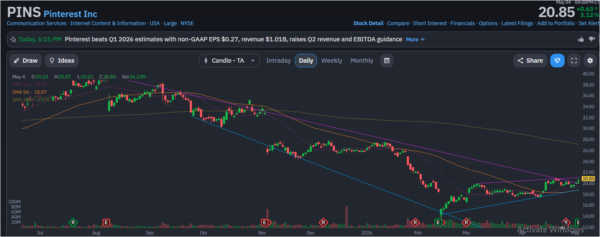
The reaction in PINS stock tells a more honest story than the headline number, because yes, the stock spiked roughly 17% immediately after earnings, but what followed matters more than the spike itself.
That move wasn’t random; it was the market quickly repricing the earnings beat, raising guidance, and clear improvement in monetization, and you can see it in the surge in volume right after the release, which signals institutional participation rather than retail chasing.
But here’s the thing: the stock didn’t continue vertically. It stalled, consolidated, and started moving sideways just under resistance, while still sitting below a declining 200-day moving average, which means the long-term trend has not flipped even after a strong catalyst.
In other words, the market reacted fast, but didn’t fully commit.
Price is now holding above a rising support trendline from the March lows near $16, which suggests buyers are stepping in, but the hesitation near current levels tells you that the market is willing to reward the numbers, but it’s still evaluating the quality of the story behind them.
A Masterstroke Or Disaster Waiting To Happen?
Pinterest didn’t beat because demand came back.
It beat because its system got sharper, tighter, and more aggressive at converting intent into revenue.
Revenue outpaced users because more value is being extracted per interaction. AI now controls discovery. Search dominates impressions. The platform is no longer optimizing for inspiration; it is optimizing for outcomes.
That explains both sides of the story: why the numbers look strong and why the product feels different. But the fact remains that Pinterest didn’t just improve its business, it traded what made the platform work, that is – originality, relatability, and users behavior – to get there. Going forward, this could either be a masterstroke from the management, or a disaster waiting to happen as customers’ interests fade over time. I’ll be watching from the sidelines.
Leave a Reply